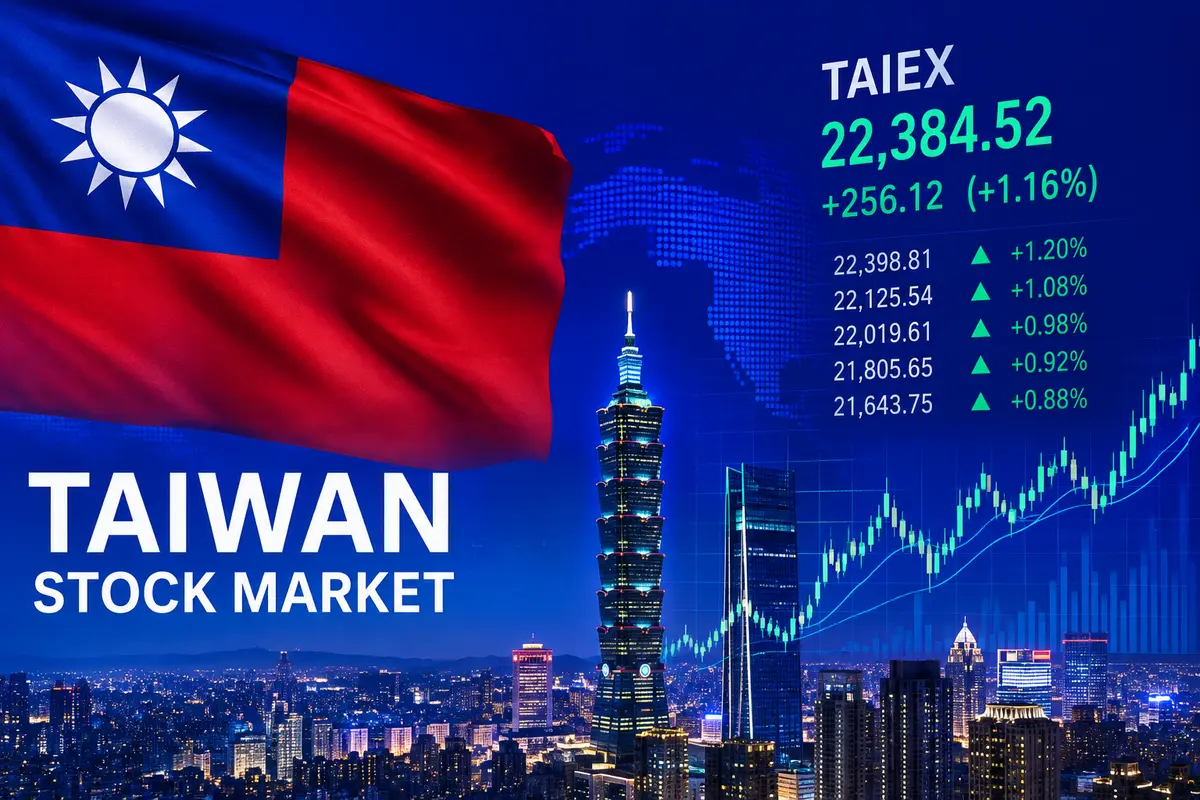
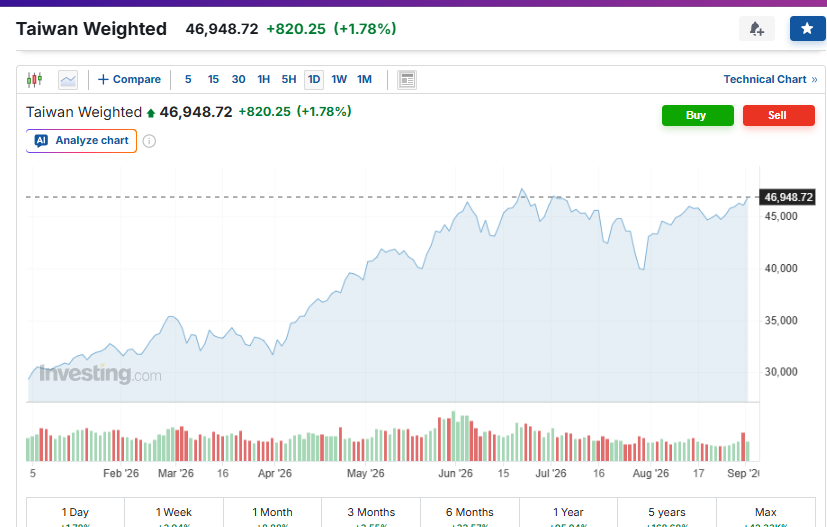
Taiwan stocks closed sharply higher on Tuesday, September 1, 2026, with the benchmark Taiwan Weighted Index (TAIEX) rising 820.25 points, or 1.78%, to 46,948.72, its highest close since early July, as reported by Central News Agency and Focus Taiwan. Gains were led by semiconductors and AI-related shares after Nvidia announced a US$3.5 billion investment in MediaTek, while Oil & Gas, Communication & Internet and Machinery sectors also advanced amid solid institutional buying.
TAIEX Rises 1.78% to 46,948 as MediaTek Hits Limit-Up on Nvidia Deal
The TAIEX opened at 46,177.11, traded between 46,081.11 and 46,948.72, and closed at the day’s high. Turnover reached NT$1.08 trillion (about US$34.1 billion). Rising stocks outnumbered decliners 608–609 to 362–374, with about 135–137 issues unchanged.
MediaTek (2454) surged the daily limit of 10% to NT$4,315 after Nvidia subscribed US$3.5 billion of its record US$3.9 billion overseas convertible bond offering, contributing roughly 190 points to the index. TSMC (2330) rose 1.46% (or about NT$35) to NT$2,440 and added around 280 points. Silicon-photonics and ASIC-related names, including stocks tied to SEMICON Taiwan, also posted strong gains.
Among the session’s top performers cited in market summaries were HORNG SHIUE HOLDING (2243) +10% to 46.20, Msscorps (6830) +10% to 572.00 and Mospec Semiconductor (2434) +10% to 68.20. The weakest included Fortune Oriental (2491) –9.94% to 45.75, Aces Electronics (3605) –9.71% to 125.50 and Jochu Technology (3543) –9.38% to 48.30.
Sector leadership came from Oil, Gas & Electricity, Communication and Internet, and Machinery. Three major institutional groups (foreign investors, investment trusts and dealers) recorded a combined net buy of about NT$56.1 billion. In commodities, October crude oil rose 0.78% to US$86.43 a barrel, December Brent jumped 3.03% to US$91.05, and December gold futures edged up 0.15% to US$4,488.16. USD/TWD fell 0.24% to 31.63.
Nvidia-MediaTek Deal Overpowers Wall Street Weakness to Drive Taiwan Tech
Investors largely shrugged off overnight Wall Street losses driven by higher oil prices and rising expectations of a Federal Reserve rate hike. The Nvidia-MediaTek partnership was widely viewed as a vote of confidence in Taiwan’s AI ASIC and advanced-chip design capabilities, sparking broad buying across the semiconductor supply chain, silicon photonics and related high-end components. Strong institutional inflows and positive momentum from recent sessions further supported the advance, pushing the index to a two-month closing high despite external geopolitical and inflation concerns.
Taiwan Market Remains Tech-Heavy with TSMC Over 40% Weight as AI Spending Supports Recovery
Taiwan’s equity market remains heavily weighted toward technology, with TSMC alone accounting for more than 40% of total market capitalization. The island’s chipmakers and related firms have been key beneficiaries of global AI infrastructure spending. The September 1 rally extended a recent recovery after the index had retreated from its mid-year peaks (52-week range roughly 23,885–48,219). Upcoming catalysts include SEMICON Taiwan, Apple’s expected product launch and the release of August corporate revenue figures. Currency markets showed the Taiwan dollar strengthening modestly against the US dollar, while the US Dollar Index Futures edged higher to 99.45.
Focus Turns to AI Momentum and External Risks After Taiwan’s Strong Rally
Market participants will watch whether the AI and semiconductor momentum continues into the rest of the week, particularly around industry events and corporate earnings updates. Analysts note that while domestic tech fundamentals remain supportive, external factors—oil-price volatility, US rate expectations and Middle East tensions—could introduce short-term swings. Stabilization of institutional flows and further evidence of order strength in AI-related supply chains will be key near-term gauges.
Sources & Methodology
Primary-source standard: Market-moving facts should link to original data releases, regulator notices, company filings or official project announcements whenever available. Secondary reporting is used for additional context, not as a substitute for original evidence.
Page last reviewed: