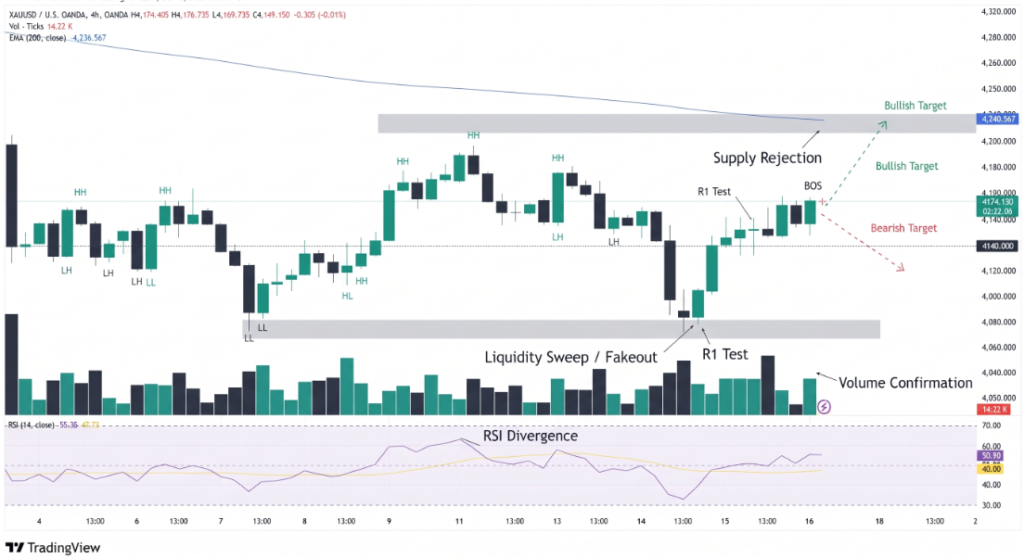
Gold prices steadied on Friday after climbing to a two-week high in the previous session, supported by falling US Treasury yields and a weaker dollar. Investors moved toward bonds as concerns about heavy investment in artificial intelligence pressured technology shares, improving the appeal of non-yielding bullion. At 00:49 ET, spot gold rose 0.1% to $4,174.76 an ounce, while US gold futures advanced 0.6% to $4,195.87. However, persistent inflation and expectations of further Federal Reserve tightening continued to limit the metal’s recovery.
Bond Rally Supports Gold Prices
Gold gained 1.6% on Thursday, marking its strongest daily advance in more than two weeks. The move followed selling across equity markets, as concerns about the sustainability of the artificial intelligence investment boom prompted investors to reassess risk and increase exposure to fixed-income assets.
The resulting US Treasury bond rally pushed yields down by approximately 12 to 15 basis points across parts of the yield curve. A basis point equals 0.01 percentage point. Lower yields can support gold because bullion pays no interest, making it relatively more attractive when returns on government securities decline.
The US Dollar Index fell 0.2% to 101.9 in the reported snapshot, providing additional support. Since gold is priced internationally in dollars, a weaker US currency can make the metal less expensive for buyers using other currencies.
Other precious metals also advanced:
- Silver: Rose 0.6% to $57.7855 an ounce.
- Platinum: Gained 0.6% to $1,640.78.
- Palladium: Increased 0.9% to $1,143.
Despite the rebound, gold remains vulnerable to elevated borrowing costs. The metal has lost roughly one-fifth of its value since the US-Iran conflict began in late February, according to the supplied market report.
Inflation Revives Fed Rate-Hike Risks
Recent US economic releases have complicated the outlook for precious metals. The September Consumer Price Index (CPI) report showed stronger-than-expected inflation, while Thursday’s producer-price and retail-sales releases added to uncertainty about the economy and monetary policy.
Persistent price pressures could encourage the Federal Reserve to maintain restrictive conditions or raise interest rates again. Higher rates generally weigh on gold by increasing the opportunity cost of holding an asset that generates no income.
Markets also watched Federal Reserve Chair Kevin Warsh during his October 16 discussion with International Monetary Fund Managing Director Kristalina Georgieva in Bangkok. Warsh declined to signal whether the Fed would raise rates at its October 27–28 meeting, saying he does not prejudge policy decisions. His comments offered no clear confirmation of the next move.
Conclusion
Gold’s ability to hold near $4,175 reflects support from falling Treasury yields and a softer dollar, but the inflation outlook remains a significant obstacle. Further declines in yields could help bullion extend its recovery, while persistent price pressures and renewed rate-hike expectations could revive selling. Investors will continue monitoring economic releases, bond-market movements and Federal Reserve communications for clearer direction.
Sources & Methodology
Primary-source standard: Market-moving facts should link to original data releases, regulator notices, company filings or official project announcements whenever available. Secondary reporting is used for additional context, not as a substitute for original evidence.
Page last reviewed: