Gold prices remained under pressure on Wednesday, October 14, trading near $4,155 an ounce after two consecutive sessions of losses. Expectations of another Federal Reserve interest-rate increase and renewed inflation concerns linked to Middle East tensions weighed on the precious metal. Investors are now focusing on September’s U.S. Consumer Price Index (CPI) report for fresh guidance on monetary policy. New York Fed President John Williams indicated that another rate increase could be appropriate in 2026, although he does not currently expect further tightening in 2027.
Gold pressured by Fed rate outlook
Spot gold (XAU/USD) slipped 0.2% to $4,154.63 an ounce at 21:28 ET, while Gold Futures held nearly unchanged at $4,177.45. The decline extended bullion’s two-session loss to approximately 0.8%, reflecting concerns that elevated inflation could keep borrowing costs higher for longer.
Other precious metals also weakened. Silver (XAG/USD) fell 0.3% to $58.9890 an ounce, while platinum (XPT/USD) dropped 0.7% to $1,654.96. Palladium (XPD/USD) declined 0.2% to $1,125.23. Meanwhile, the U.S. Dollar Index remained broadly steady at 102.18.
Williams’ comments provided some support for gold by suggesting that the Federal Reserve may not need to continue raising rates beyond this year. Lower U.S. Treasury yields also helped limit bullion’s losses.
Gold does not pay interest, making it less attractive when government bonds and other interest-bearing assets offer higher returns. The metal has retreated substantially since the U.S.-Iran conflict began in late February, as rising energy costs and expectations of tighter monetary policy challenged investor demand.
CPI and oil set the next move
The latest developments in the Middle East have complicated the inflation outlook. Brent crude oil traded above $106 a barrel in the period covered by the report, raising concerns that higher fuel and transportation costs could keep consumer prices elevated.
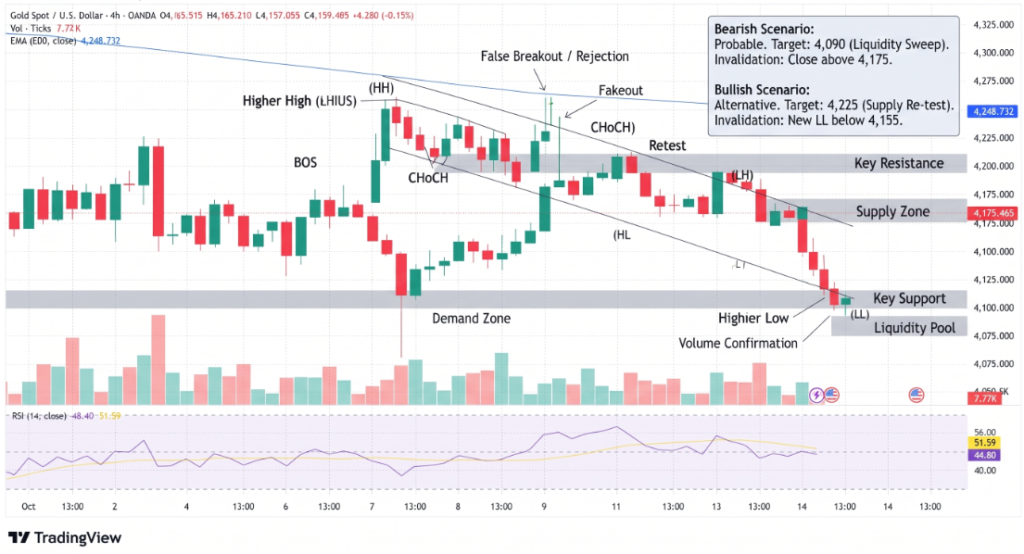
The September U.S. CPI report is scheduled for release on Wednesday, October 14, at 8:30 a.m. Eastern Time, according to the Bureau of Labor Statistics. The figures could influence expectations for the Federal Reserve’s next policy decision.
- Stronger inflation: Could reinforce expectations of another rate increase, supporting the dollar and pressuring gold.
- Softer inflation: Could ease tightening concerns and improve demand for non-yielding bullion.
- Persistent energy inflation: Could complicate the Fed’s efforts to return inflation to its 2% target.
Markets have assigned a relatively low probability to an October rate increase while maintaining expectations of possible tightening later in the year. These projections remain sensitive to incoming economic data and policymakers’ comments.
Conclusion
Gold’s near-term direction depends on the balance between inflation risks and expectations for Federal Reserve policy. Rick Kanda, managing director of The Gold Bullion Company, has argued that the recent correction should be considered alongside gold’s substantial gains over the preceding year. Bullion reached a record high near $5,560 an ounce in January before retreating toward $4,185 on October 12. The pullback does not, by itself, invalidate the longer-term outlook. However, persistent inflation and additional rate increases could prolong the correction, while softer CPI data and lower yields could help stabilize prices.
Sources & Methodology
Primary-source standard: Market-moving facts should link to original data releases, regulator notices, company filings or official project announcements whenever available. Secondary reporting is used for additional context, not as a substitute for original evidence.
Page last reviewed: