
Gold is consolidating after a sharp correction from its recent highs, with traders watching the $4,300-$4,450 region for evidence of the next sustained move. Spot gold was around $4,372 on Sept. 21, while recent technical levels place support near $4,342 and resistance around $4,407. The market remains sensitive to U.S. interest-rate expectations, Treasury yields and the dollar after the Federal Reserve raised its policy rate by 25 basis points to 3.75%-4% on Sept. 16.
Gold Price Tests Key Range
The current structure reflects a market caught between competing forces. Buyers have defended lower levels following the recent decline, but gold has struggled to establish a sustained move above the upper-$4,300s.
Recent technical analysis identified the $4,341-$4,342 area as an important support zone, while $4,407 represents a near-term resistance level. A broader move through $4,450 would mark a stronger test of the recovery, while a break below $4,300 would put deeper support levels back into focus.
The setup matters because gold’s September decline has been closely linked to higher yields and changing expectations for Federal Reserve policy. Reuters reported that bullion fell more than 1% following the Fed’s Sept. 16 rate increase as the dollar strengthened and non-yielding gold became less attractive.
Key levels traders are monitoring include:
- Immediate support: around $4,342
- Near-term resistance: around $4,407
- Major range support: $4,300
- Major range resistance: $4,450
Momentum Signals Remain Mixed
Short-term indicators provide some evidence that selling pressure has eased, but they do not yet establish a confirmed trend reversal. Recent technical analysis showed gold recovering from its 200-day EMA before approaching its 50-day EMA, illustrating the importance of the moving-average cluster around current prices.
Momentum should also be viewed alongside the broader trend. A low ADX reading generally indicates limited directional strength, meaning a price move outside the current range could be vulnerable to reversals unless supported by stronger volume and a clear fundamental catalyst.
The Federal Reserve remains central to that equation. The central bank’s latest projections point to continued policy restraint, while markets are assessing whether inflation and economic activity could require additional rate increases. Higher rates generally create a headwind for gold because the metal does not provide an interest yield.
Breakout Levels Could Define Direction
A sustained move above $4,450 would shift attention toward higher resistance levels and provide stronger evidence that buyers are regaining control. However, traders would typically want confirmation rather than relying on a brief intraday move above resistance.
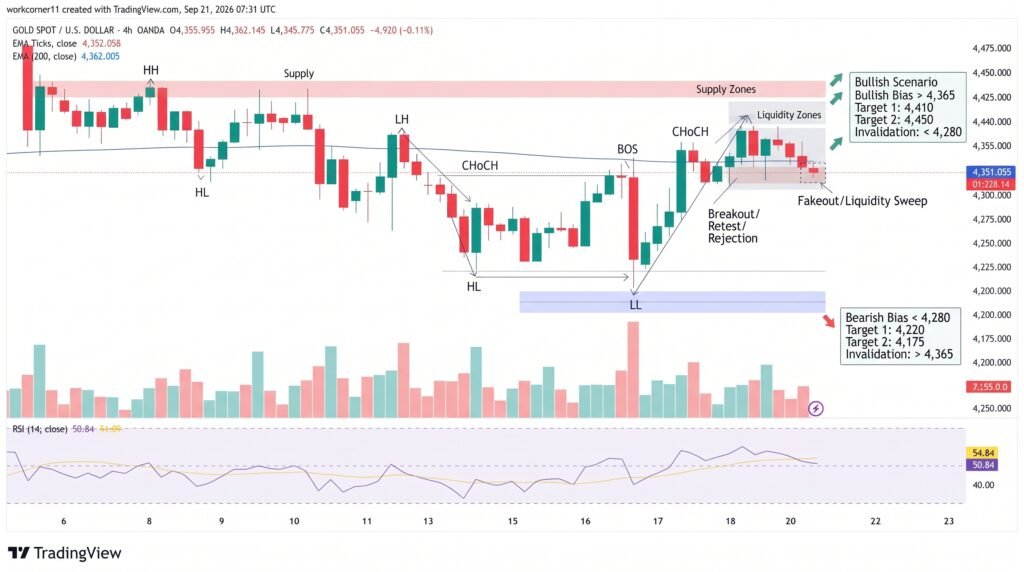
A break below $4,300 would produce the opposite signal. It would indicate that buyers have failed to maintain the broader consolidation and could expose gold to lower support zones. Recent technical analysis has identified levels around $4,250 and $4,160 as potential downside reference points if selling accelerates.
The fundamental backdrop remains equally important. Treasury yields and the U.S. dollar continue to influence bullion, while geopolitical tensions in the Middle East can generate competing effects through safe-haven demand and inflation expectations. On Sept. 21, Reuters reported that gold was under pressure as U.S. yields rose and markets continued to price the possibility of further Federal Reserve tightening.
Conclusion
Gold is currently navigating a technically compressed market in which $4,300 and $4,450 provide useful reference points for assessing the next major move. The area between those levels remains vulnerable to false breakouts while momentum is subdued. A sustained break above $4,450 would strengthen the recovery structure, whereas a decisive move below $4,300 would weaken it. Until either boundary gives way with confirmation, the interaction between gold prices, Treasury yields, the dollar and Federal Reserve policy remains critical to the outlook.
Sources & Methodology
Primary-source standard: Market-moving facts should link to original data releases, regulator notices, company filings or official project announcements whenever available. Secondary reporting is used for additional context, not as a substitute for original evidence.
Page last reviewed: