
Hyperliquid’s HYPE token is facing a key technical test as US regulators open the door to perpetual futures contracts linked to individual stocks. The Commodity Futures Trading Commission’s November 3 announcement marks a significant step toward bringing equity-linked perpetual derivatives onto qualifying US-regulated exchanges. The development could expand the market associated with Hyperliquid’s infrastructure, although it does not represent direct regulatory approval for the decentralized platform itself. HYPE was quoted near $81.73 in the supplied market snapshot, with support around $78.42 in focus.
CFTC opens US equity perpetual markets
The Commodity Futures Trading Commission said November 3 that perpetual futures tied to individual equities can begin trading on designated contract markets that are also registered with the Securities and Exchange Commission as national securities exchanges for security futures products.
CFTC Chairman Michael Selig described the move as an effort to bring innovative derivatives into regulated US markets. Perpetual futures, commonly called perps, are derivatives without a fixed expiration date. Traders can maintain positions indefinitely, subject to margin requirements and funding payments.
The announcement extends the agency’s earlier efforts to bring perpetual contracts into the domestic regulatory framework, including Bitcoin-linked products. The CFTC and SEC will share oversight under the applicable security-futures framework.
The distinction matters for Hyperliquid investors: the CFTC announcement concerns qualifying regulated exchanges, not an unrestricted authorization for every offshore or decentralized venue to offer US equity perpetuals.
Legal challenge creates regulatory uncertainty
The regulatory shift immediately drew opposition from established market participants. The Capital Markets Alliance filed a lawsuit in the Southern District of New York challenging the CFTC’s position. Cboe Global Markets, Citadel Securities and the Healthy Markets Association joined the challenge.
The plaintiffs argue that single-stock perpetual derivatives should fall under the SEC’s security-based swap jurisdiction and that the CFTC exceeded its authority. The dispute could determine how these products are classified and which regulatory protections apply.
Hyperliquid also has a separate route toward US expansion. On October 29, Intercontinental Exchange and Trade[XYZ] announced plans to establish a regulated US market and clearing structure built on Hyperliquid technology. ICE is expected to operate the venue and make a strategic investment in Trade[XYZ], subject to regulatory approvals. The proposed platform could offer perpetual contracts linked to equities, commodities, currencies and cryptocurrencies.
HYPE forecast: $78.42 support in focus
The supplied daily-chart snapshot places HYPE at $81.73, below its 20-day and 50-day exponential moving averages (EMAs) at $83.40 and $82.64. The Relative Strength Index (RSI) at 47.27 indicates slightly negative momentum, while the Stochastic reading near 34 suggests weakening buying pressure.
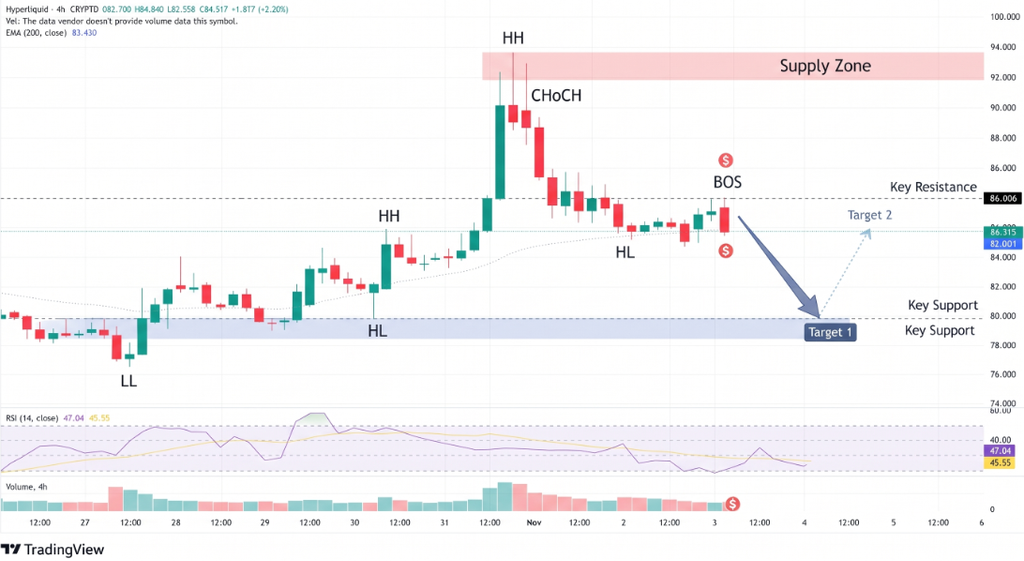
The 100-day EMA at $78.08 converges with horizontal support at $78.42, creating an important downside zone. A sustained break could expose $75.69, followed by $67.63 and $61.16.
Key resistance levels include:
- $82.64–$83.40: 50-day and 20-day EMAs
- $85.04: Horizontal resistance
- $87.68: Descending trendline barrier
- $97.84: Higher resistance target
Conclusion
Regulatory developments could strengthen Hyperliquid’s longer-term market position, but the legal challenge introduces uncertainty over how US equity perpetuals will be governed. For HYPE, holding $78.42 would help preserve the current support structure. A break below it would expose lower levels, while recovery above $85.04 would improve the technical outlook.
Sources & Methodology
Primary-source standard: Market-moving facts should link to original data releases, regulator notices, company filings or official project announcements whenever available. Secondary reporting is used for additional context, not as a substitute for original evidence.
Page last reviewed: