
Bitcoin miner MARA Holdings transferred 996.105 BTC, valued at approximately $81.13 million, to a wallet linked to Galaxy Digital as cryptocurrency liquidations exceeded $1 billion over 24 hours. The October 9 transaction, flagged by blockchain analytics platform Lookonchain, came during a sharp Bitcoin sell-off driven by elevated US Treasury yields, geopolitical uncertainty and pressure on risk assets. Although the transfer prompted speculation about a sale, the blockchain transaction alone does not confirm that the Bitcoin was sold.
MARA Transfer Draws Market Attention
Lookonchain identified the movement of 996.105 BTC to Galaxy Digital, a firm that provides institutional cryptocurrency trading and other digital-asset services. The transfer was worth about $81.13 million at the time, putting the miner’s Bitcoin treasury back in focus as traders assessed the impact of large-holder activity on market liquidity.
The distinction between a transfer and a confirmed sale matters. Bitcoin sent to an institutional trading platform may be sold, placed into custody or moved for another financial purpose. Investors should therefore avoid treating the transaction as definitive evidence of an immediate market sale.
MARA has previously disclosed that it may sell Bitcoin to support operations, strengthen financial flexibility and fund capital projects. Its second-quarter 2026 shareholder letter reported total holdings of 35,577 BTC as of June 30, including Bitcoin that was loaned or pledged as collateral. That company-reported figure is different from wallet-specific balances tracked by analytics platforms.
$1 Billion Liquidation Wave Hits Crypto
The transfer coincided with a broad derivatives-market unwind. CoinGlass liquidation data showed more than $1 billion in cryptocurrency positions were liquidated over a 24-hour period. Liquidations occur when exchanges forcibly close leveraged positions after traders fail to maintain required margin.
Long positions—bets that prices will rise—accounted for most of the reported losses. When prices fall rapidly, forced selling can accelerate the decline, triggering further liquidations and reducing available liquidity.
Key figures from the market turmoil included:
- 996.105 BTC: transferred by a wallet linked to MARA.
- $81.13 million: approximate value of the transfer.
- More than $1 billion: total crypto liquidations reported over 24 hours.
- $19.98 million: reported value of the largest single liquidation, involving an ETH position on Hyperliquid.
Bitcoin and Ethereum faced substantial long-position liquidations, underscoring how leverage amplified the market downturn.
Bitcoin Outlook Depends on Key Levels
Bitcoin’s decline unfolded amid elevated US Treasury yields, higher oil prices and renewed US-Iran tensions. Rising yields can make non-yielding and speculative assets less attractive, while geopolitical uncertainty can prompt investors to reduce risk exposure. Outflows from spot Bitcoin ETFs added another potential source of selling pressure.
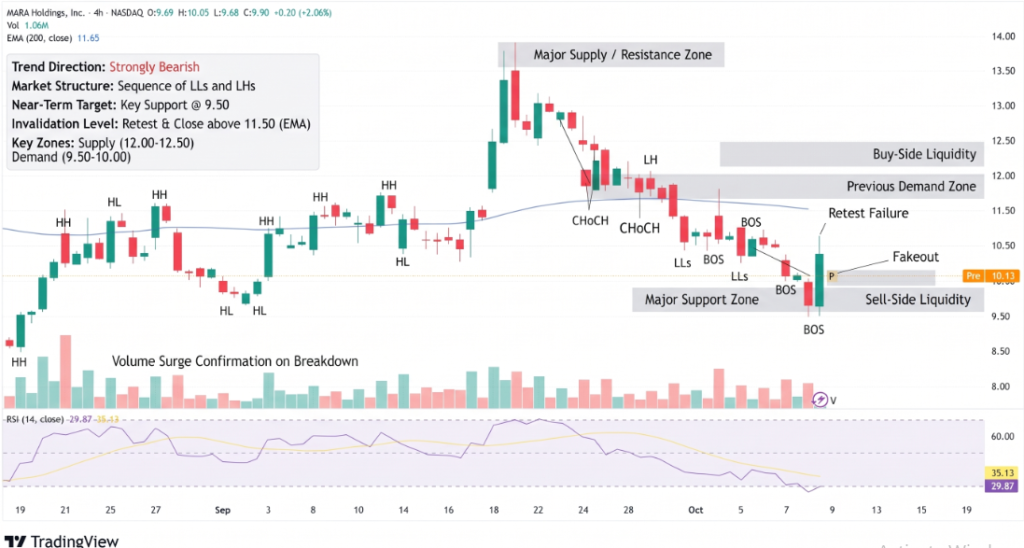
MARA Holdings Price Chart – Source: Tradingview
Bitcoin subsequently rebounded as oil prices eased and Treasury yields retreated from their reported highs. The US Dollar Index (DXY) also weakened toward 102, offering some relief to risk-sensitive assets. Traders were watching whether Bitcoin could hold its 50-day moving average and recover toward $83,000 and $87,000.
Derivatives positioning also showed signs of stabilization, with reported Bitcoin futures open interest rising about 0.35% over four hours. However, open interest measures outstanding contracts, not buying pressure alone; the increase does not independently confirm a bullish reversal.
Conclusion
MARA’s 996 BTC transfer has intensified scrutiny of large Bitcoin holders during a market-wide liquidation event, but it does not independently prove that a sale occurred. Bitcoin’s near-term direction will depend on whether buyers can defend important technical support as Treasury yields, ETF flows and geopolitical risks shape sentiment. A sustained recovery would support a move toward $83,000, while renewed selling could expose the market to further downside.
Sources & Methodology
Primary-source standard: Market-moving facts should link to original data releases, regulator notices, company filings or official project announcements whenever available. Secondary reporting is used for additional context, not as a substitute for original evidence.
Page last reviewed: