
Pyth Network (PYTH) climbed above $0.0800 on Friday, extending a rally after a roughly 10% gain on Thursday. The move followed the approval of OP-PIP-136, a governance proposal that directs eligible protocol revenue toward accumulating PYTH for the network’s strategic reserve. The policy gives the token a stronger connection to revenue generated by Pyth’s data products, although its effect on market prices will depend on continued adoption, token demand and broader trading conditions. PYTH now faces resistance near $0.0887, with $0.1000 the next major psychological target if buyers secure a breakout.
Pyth Redirects Revenue to PYTH Reserve
The Pyth decentralized autonomous organization (DAO) approved OP-PIP-136 on September 24, replacing its previous recurring treasury-purchase mechanism with a framework for accumulating PYTH through eligible revenue and other treasury assets. The network announced on October 8 that 100% of funds it receives from Pyth products would go toward its PYTH Reserve.
Pyth reported that its annualized revenue run rate reached $11.5 million in September 2026, compared with less than $1 in 2025. Annualized revenue run rate, or ARR, estimates the annual pace implied by current revenue; it is not the same as cash already earned over a full year. The network attributed growth to increasing demand for its financial data services, including applications involving real-world assets (RWAs).
The reserve policy could support token demand by directing eligible revenue toward PYTH accumulation. However, it does not guarantee a higher token price: market liquidity, token supply, investor sentiment and the pace of future revenue growth remain important variables.
PYTH Technical Outlook Points to $0.10
PYTH’s short-term technical structure has strengthened, with the token trading above the reported 50-day and 200-day exponential moving averages (EMAs) at $0.0643 and $0.0557, respectively. The daily Relative Strength Index (RSI) has risen to 67, indicating strong buying momentum but approaching territory where traders often watch for overextension.
The Moving Average Convergence Divergence (MACD) remains marginally below its signal line, suggesting that bullish momentum has not yet received full confirmation.
Key levels traders are monitoring include:
- $0.0887: Previous weekly high and immediate resistance.
- $0.1004: First upside extension based on Fibonacci analysis.
- $0.1153: Higher Fibonacci extension target if momentum persists.
- $0.0741: Initial support near the September 22 high.
- $0.0672–$0.0643: Lower support zone around the 50% retracement and 50-day EMA.
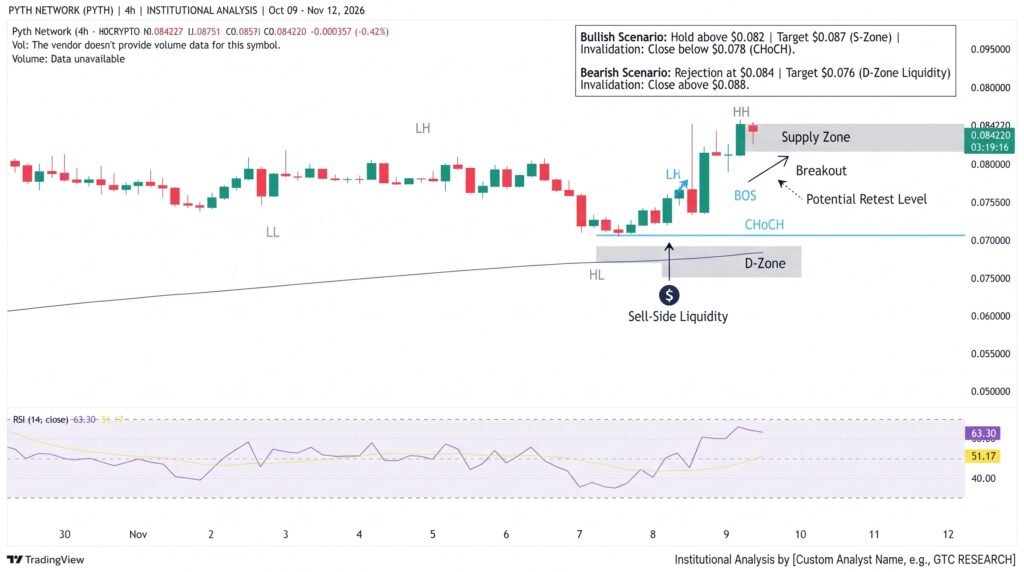
A sustained move above $0.0887 would strengthen the case for a test of $0.1000. Failure to break resistance could prompt consolidation or a pullback toward support.
Revenue Growth Meets Breakout Test
The reserve policy gives PYTH a fundamental development to complement its technical recovery, but traders must distinguish a governance change from a confirmed shift in market demand. Continued growth in paid data usage could provide more resources for reserve accumulation, while weaker adoption or broader crypto-market selling could limit the impact.
Conclusion
PYTH’s rally above $0.0800 reflects improving momentum and attention on Pyth’s new revenue-allocation policy. A decisive break above $0.0887 could open a path toward $0.1004 and potentially $0.1153. If resistance holds, traders will watch $0.0741 and the $0.0672–$0.0643 support area. The outlook remains constructive, but a sustained breakout—not the buyback announcement alone—would provide stronger technical confirmation.
Sources & Methodology
Primary-source standard: Market-moving facts should link to original data releases, regulator notices, company filings or official project announcements whenever available. Secondary reporting is used for additional context, not as a substitute for original evidence.
Page last reviewed: