

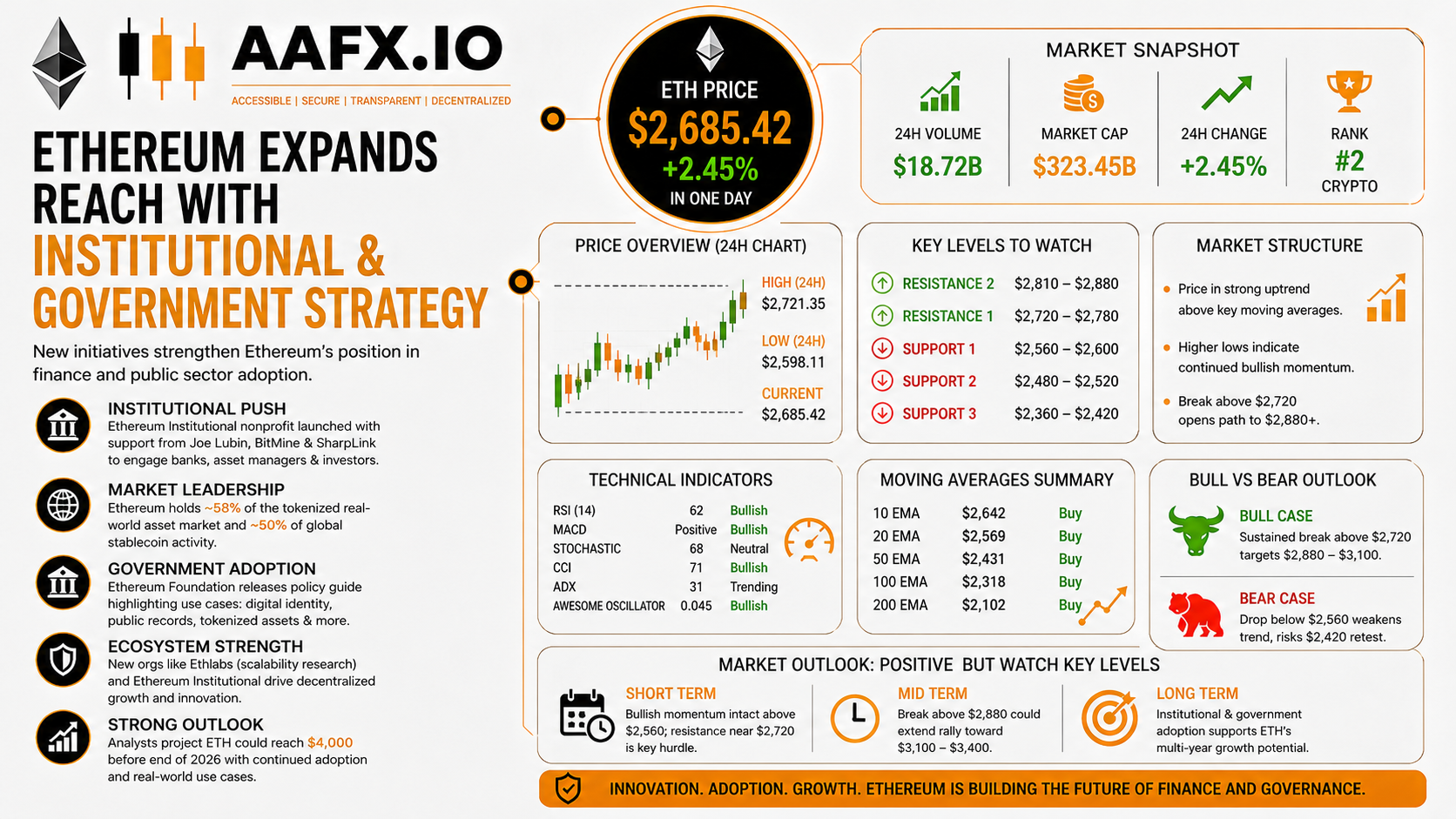
Ethereum is accelerating its long-term growth strategy through two major initiatives aimed at strengthening its position in global finance and public-sector technology. The blockchain network has launched a dedicated institutional nonprofit while simultaneously promoting its infrastructure as a viable solution for government services.
These developments arrive at a time when competition among blockchain networks is intensifying. Yet Ethereum continues to hold a leading role in digital finance, supported by its dominant share of tokenized assets and stablecoin activity.
The dual strategy reflects a broader effort to deepen adoption among financial institutions and public agencies while reinforcing confidence in the network’s future.
Ethereum Targets Global Institutions
A newly launched nonprofit, Ethereum Institutional, has been created to build stronger relationships between Ethereum and major financial organizations. Backed by Ethereum co-founder Joe Lubin, along with treasury-focused firms BitMine and SharpLink, the organization aims to serve as a bridge between blockchain innovators and traditional finance.
The nonprofit plans to establish operations in several key financial hubs, including New York, London, Hong Kong, and Singapore. Its primary objective is to help banks, asset managers, and investment firms better understand Ethereum’s infrastructure and its growing role in digital finance.
Supporters of the initiative believe institutional adoption has often been slowed by communication barriers rather than technology limitations. Ethereum Institutional seeks to address that challenge by creating direct engagement channels with decision-makers across global markets.
Key institutional strengths supporting Ethereum include:
- Approximately 58% of the tokenized real-world asset market
- Nearly 50% of global stablecoin activity
- A broad developer ecosystem supporting decentralized finance applications
- Established infrastructure used by leading financial technology projects
Financial institutions increasingly view blockchain technology as a tool for improving efficiency, transparency, and settlement processes. Ethereum’s leadership in these areas positions it as a primary candidate for future institutional integration.
Government Adoption Gains Momentum
Beyond financial markets, Ethereum is also making a stronger case for government adoption. The Ethereum Foundation recently released a policy framework outlining how the blockchain could support public-sector services and digital infrastructure.

According to the foundation, Ethereum’s decentralized architecture offers advantages in transparency, security, and long-term reliability. These characteristics could make it suitable for a range of government functions.
Potential applications highlighted in the framework include:
- Digital identity verification systems
- Public records management
- Tokenized government assets
- Secure data-sharing across agencies
By leveraging blockchain technology, governments could reduce administrative inefficiencies while maintaining verifiable and tamper-resistant records.
Long-Term Growth Outlook
The policy initiative comes during a period of organizational change within the Ethereum ecosystem. Earlier this year, the Ethereum Foundation underwent restructuring efforts in response to concerns regarding governance and transparency.
At the same time, independent organizations have stepped forward to support ecosystem growth. Ethlabs is advancing scalability research, while Ethereum Institutional focuses on financial-sector adoption and strategic partnerships.
Market analysts remain optimistic about Ethereum’s future despite recent volatility. Standard Chartered analyst Geoff Kendrick recently maintained his forecast that Ethereum could reach $4,000 before the end of 2026, citing continued institutional participation and expanding real-world use cases.
As blockchain adoption moves beyond cryptocurrency trading, Ethereum’s focus on institutions and governments may prove critical in shaping the next phase of digital infrastructure. By targeting both sectors simultaneously, the network is positioning itself as a foundational technology for the evolving global economy.
