

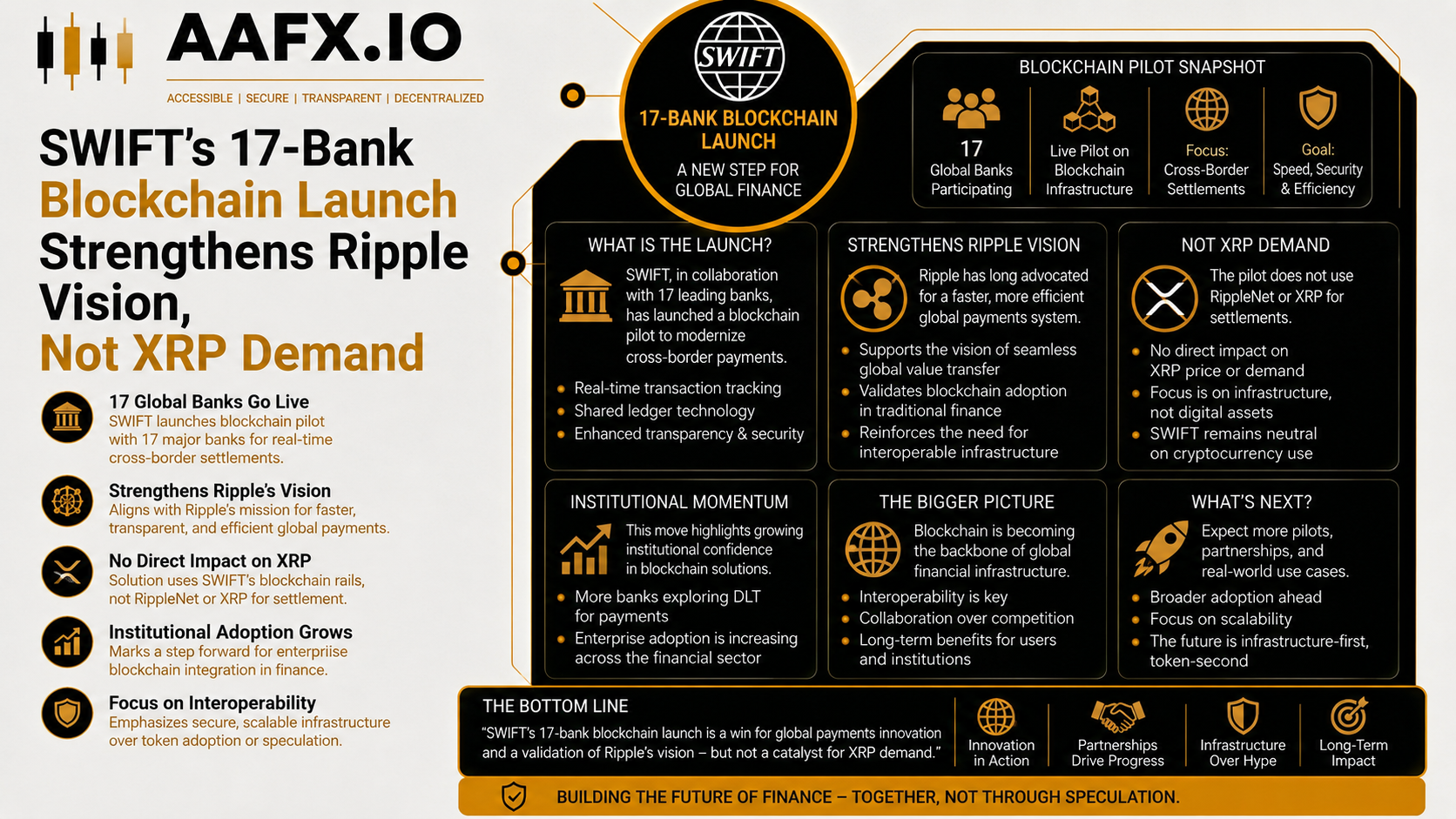
SWIFT’s 17-bank blockchain network supports Ripple’s vision for digital payments, but XRP adoption still depends on banks choosing ODL liquidity services.
SWIFT Moves Blockchain Into Production
SWIFT has accelerated the financial industry’s transition toward blockchain by launching a live distributed ledger platform with 17 pioneering banks, marking one of the organization’s most significant digital infrastructure upgrades. The initiative demonstrates that blockchain technology has moved beyond pilot projects into real-world banking operations, although it does not automatically increase demand for XRP.
The new platform enables participating financial institutions to process cross-border payments around the clock using tokenized commercial bank deposits instead of relying solely on traditional correspondent banking networks. Built on Hyperledger Besu and integrated with Chainlink’s Cross-Chain Interoperability Protocol (CCIP), the infrastructure supports continuous settlement without being limited by conventional banking hours.
Unlike public blockchain networks that depend on cryptocurrencies, SWIFT’s system operates entirely within regulated financial institutions. Banks retain control over compliance, governance, and settlement while benefiting from faster transaction execution and programmable payment capabilities.
This milestone reflects a broader shift in global finance. Rather than questioning blockchain’s role, major financial institutions are now focused on integrating distributed ledger technology into existing payment systems without disrupting regulatory frameworks.
Ripple’s Strategy Gains Recognition
Although SWIFT’s latest blockchain platform does not incorporate XRP into its settlement process, the development reinforces a strategy Ripple has promoted for more than a decade: modernizing international payments through blockchain technology.
Ripple has consistently advocated for instant settlement, continuous payment availability, and reduced dependence on pre-funded correspondent banking accounts. Those objectives closely align with the direction now being taken by many of the world’s largest financial institutions.
Earlier this year, Ripple expanded its institutional footprint through additional regulatory approvals across Europe while strengthening partnerships with international banking organizations. These developments position the company as an established provider of blockchain-based payment infrastructure, even as SWIFT builds its own independent network.
However, Ripple’s success should not be confused with automatic demand for XRP. Financial institutions can adopt blockchain payment systems without using the digital asset, meaning Ripple’s enterprise growth and XRP’s market adoption remain separate commercial stories.
Key Industry Highlights
- 17 banks joined SWIFT’s live blockchain settlement network.
- The platform operates on Hyperledger Besu with Chainlink CCIP interoperability.
- Payments can settle 24 hours a day, seven days a week.
- Transactions use tokenized bank deposits, not XRP.
- Ripple continues expanding regulatory approvals and banking partnerships globally.
What This Means for XRP
The long-term outlook for XRP depends on whether banks adopt Ripple’s On-Demand Liquidity (ODL) solution, which uses XRP as a bridge asset for real-time foreign exchange settlement. Without ODL integration, institutional blockchain adoption alone does not generate direct demand for the cryptocurrency.
Across the financial sector, investment is accelerating in tokenized deposits, regulated stablecoins, central bank digital currencies (CBDCs), and programmable payment networks. The common objective is to reduce settlement delays, lower operational costs, improve liquidity management, and minimize counterparty risk while maintaining regulatory oversight.
SWIFT remains the world’s largest financial messaging network, connecting more than 11,000 financial institutions across over 200 countries and territories. Its transition toward blockchain infrastructure highlights how rapidly digital settlement technologies are entering mainstream banking.
For Ripple, the latest development serves as strategic validation that the banking industry is embracing blockchain-powered payments. For XRP investors, however, meaningful adoption will ultimately depend on whether financial institutions move beyond blockchain messaging and tokenized deposits to liquidity models that actively utilize XRP within cross-border transactions.
