


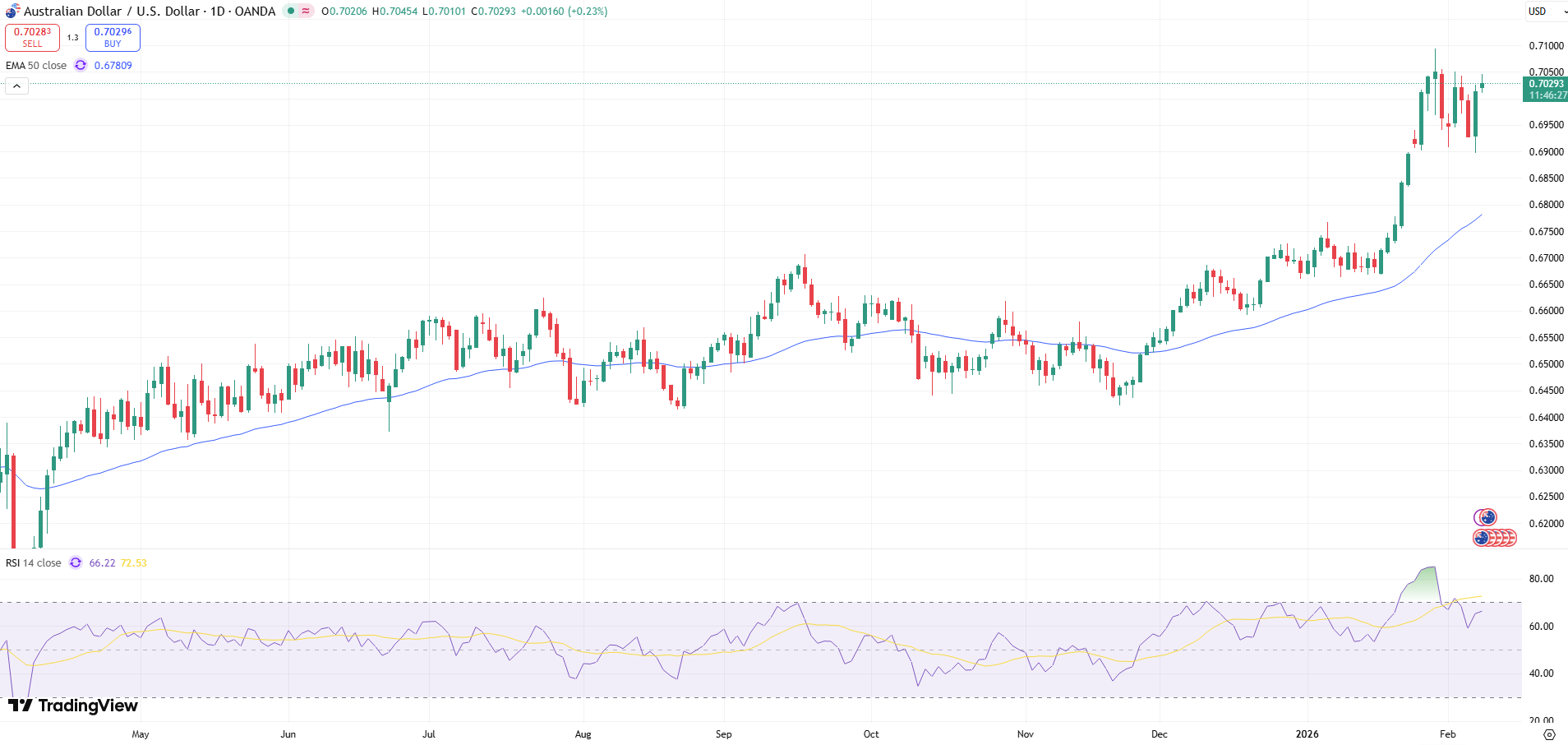
The Australian dollar began the week with cautious momentum after rebounding from below 0.6900, reflecting a friendlier global mood and continued selling pressure on the U.S. dollar. Traders are watching whether AUD/USD can break decisively above the mid-0.7000s before committing to larger bullish bets. On Friday, the pair traded around 0.6910, a level that still sits beneath a longer-term rising channel on the daily chart.
Technical signals are mixed but leaning constructive. The 14-day RSI stands at 57, suggesting mild bullish momentum rather than overheating. The pair faces its first hurdle at the nine-day EMA of 0.6946. A sustained move back inside the ascending channel could open the door toward 0.7094, the highest level since February 2023, reached on January 29. Beyond that, chart traders see potential toward the channel’s upper boundary near 0.7270. On the downside, the key line in the sand is the 50-day EMA at 0.6771, which would signal deeper stress if broken.
RBA policy backs the currency
Domestic fundamentals are providing meaningful support for the Aussie. Reserve Bank of Australia Governor Michele Bullock said the economy is more “capacity-constrained” than previously thought, forcing policy to stay tighter to cool demand unless supply can rise faster.
That stance was reinforced last Tuesday when the RBA lifted the Official Cash Rate by 25 basis points to 3.85%, citing stronger growth and sticky inflation. Markets have reacted sharply: they now assign roughly an 80% probability of another hike in May and price in about 40 bps of additional tightening through the rest of the year.
Recent data have been supportive. Australia’s December trade surplus widened to AUD 3,373 million, up from a revised AUD 2,597 million in November and slightly above expectations of AUD 3,300 million. Exports rebounded 1.0% month-on-month after a revised 4.0% fall in November, helped by metal ores and minerals, while imports slipped 0.8%, a steeper drop than the prior 0.2% decline.
Business surveys echoed that strength:
- S&P Global Composite PMI: 55.7 in January vs 51.0 in December — the strongest reading in 45 months.
- Services PMI: 56.3 vs 51.1, beating the flash estimate of 56.0 and marking two straight years above the 50 expansion line.
Dollar softens as jobs cool
The U.S. dollar is losing ground after two days of gains, with the DXY index trading near 97.90. Traders are increasingly leaning toward Federal Reserve rate cuts starting in June, and the CME FedWatch tool shows a 77.3% chance the Fed holds rates steady in March.
Recent labor data have reinforced that view. Initial jobless claims rose to 231,000, above estimates of 212,000 and the prior 209,000. Private hiring was even weaker: ADP reported just 22,000 new jobs in January, far below expectations of 48,000 and the revised 37,000 from December.
Fed Governor Lisa Cook warned she would not support another cut without clearer evidence that inflation is cooling, but markets are still pricing two cuts this year (June and likely September). Investors are also weighing President Trump’s nomination of Kevin Warsh as potential Fed chair — a figure seen as favoring a smaller balance sheet and fewer cuts — even as Trump insisted rates are “way high.”
External signals also matter for the Aussie. China’s Services PMI rose to 52.3 in January from 52.0, beating expectations of 51.8, a modest positive for Australia’s key trading partner.
Key levels and events to watch (about 15%)
- Resistance: 0.6946 (9-day EMA) → 0.7094 → 0.7270
- Support: 0.6771 (50-day EMA)
- RBA rate: 3.85% after 25-bp hike
- Markets price: 80% chance of May hike; ~40 bps more this year
- U.S. jobs: 231K claims; 22K ADP jobs
- China Services PMI: 52.3
Taken together, a hawkish RBA and a cooling U.S. labor market are tilting the near-term balance in favor of the Australian dollar — provided global sentiment stays constructive.

