

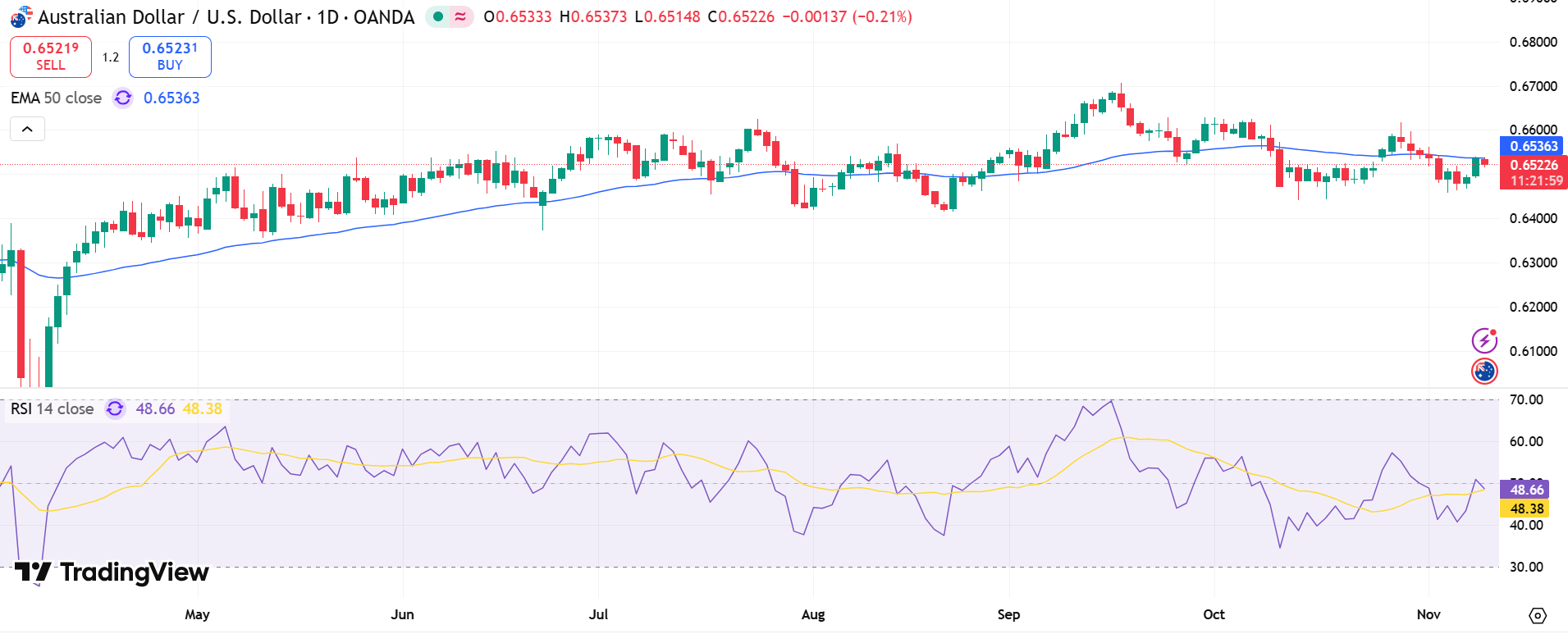
The Australian Dollar (AUD) edged lower against the U.S. Dollar (USD) on Tuesday, erasing two days of gains as a stronger greenback overshadowed upbeat domestic sentiment. The AUD/USD pair traded near 0.6530, down 0.3%, as investors turned to the U.S. Dollar amid optimism that a deal to end the U.S. government shutdown is imminent.
Australia’s Westpac Consumer Confidence Index jumped 12.8% in November to 103.8, reflecting improving household sentiment. However, the boost in confidence did little to offset external pressure from a resurgent U.S. Dollar and global rate expectations.
Technical indicators suggest the pair is consolidating within a rectangle pattern, moving sideways but holding above its 9-day Exponential Moving Average (EMA)—a sign of short-term resilience. The 50-day EMA at 0.6536 serves as the next resistance level, with a breakout possibly targeting 0.6630 and, beyond that, the 13-month high of 0.6707 recorded on September 17.
On the downside, support is seen at 0.6520, followed by 0.6500 and 0.6470, with deeper losses potentially testing the five-month low of 0.6414 from August 21.
RBA Maintains Cautious Policy Outlook
The Reserve Bank of Australia (RBA) maintained its cautious stance, emphasizing the need to keep financial conditions tight to rein in inflation. Deputy Governor Andrew Hauser described current monetary conditions as “unusually challenging,” noting that Australia’s post-pandemic recovery began with demand exceeding supply—leaving little room for near-term easing.
Meanwhile, business sentiment offered mixed signals. The National Australia Bank’s Business Conditions Index inched up to 9 in October from 8 in September, supported by improved sales and profitability, while Business Confidence dipped slightly to 6 from 7.
These data points reflect a steady but cautious outlook for Australia’s economy, with inflation control remaining the central bank’s priority.
U.S. Dollar Gains on Shutdown Hopes
The U.S. Dollar Index (DXY) strengthened to 99.70, buoyed by optimism surrounding progress in Washington to end the 41-day government shutdown. The Senate approved a funding bill in a 60–40 vote, sending it to the House of Representatives for final approval. President Donald Trump has indicated he will sign the measure once it reaches his desk, potentially reopening the government within days.
Key U.S. factors influencing sentiment:
- Inflation forecast lowered to 1.5%, suggesting easing price pressures.
- Fed officials signaled possible 25–50 bps rate cuts in December.
- Treasury Secretary Scott Bessent warned the shutdown’s economic impact is deepening.
Meanwhile, China’s trade and inflation data also played a role in shaping market mood. The CPI rose 0.2% year-over-year in October, while the PPI fell 2.1%, showing gradual stabilization. As China remains Australia’s largest trading partner, its economic recovery remains crucial for AUD performance.
The Australian Dollar’s outlook remains finely balanced between global risk sentiment and domestic resilience. With traders watching both RBA signals and U.S. fiscal developments, volatility in the AUD/USD pair is likely to persist in the short term.

