

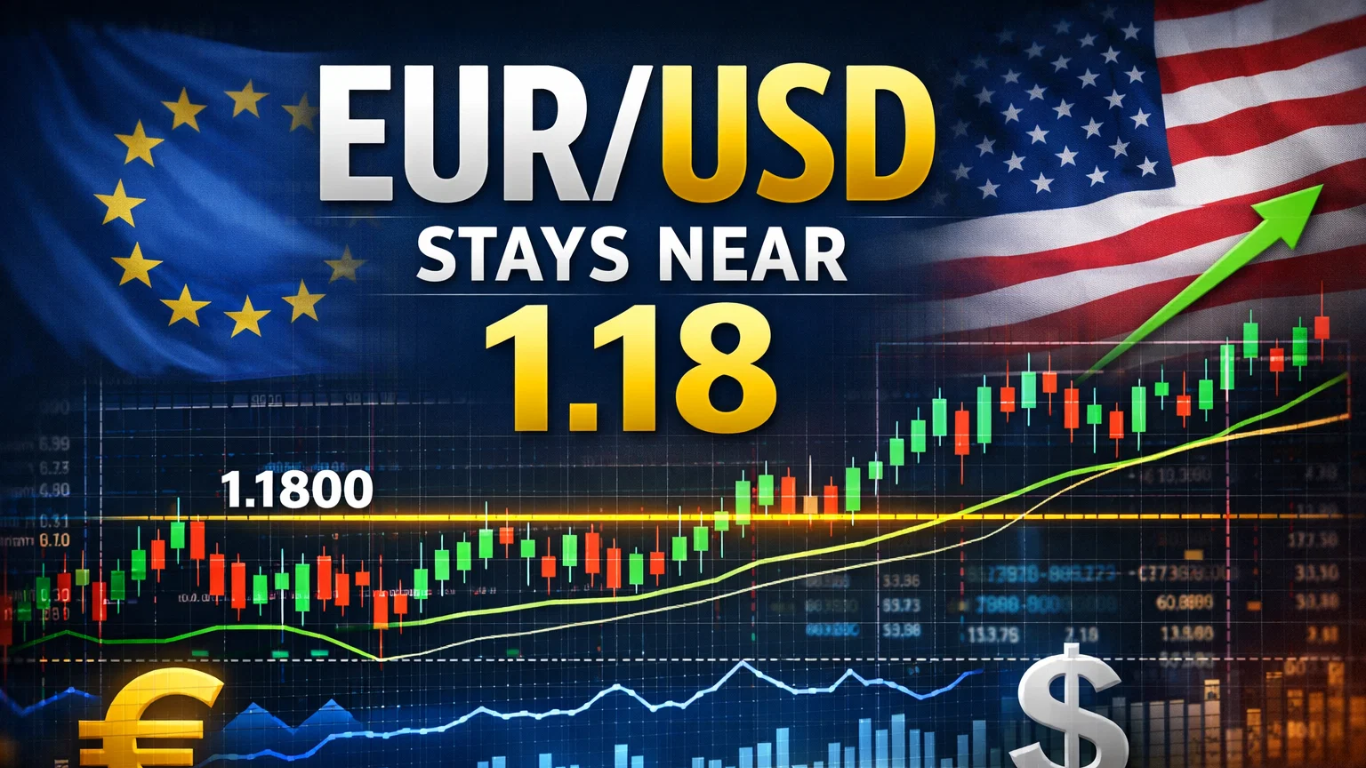
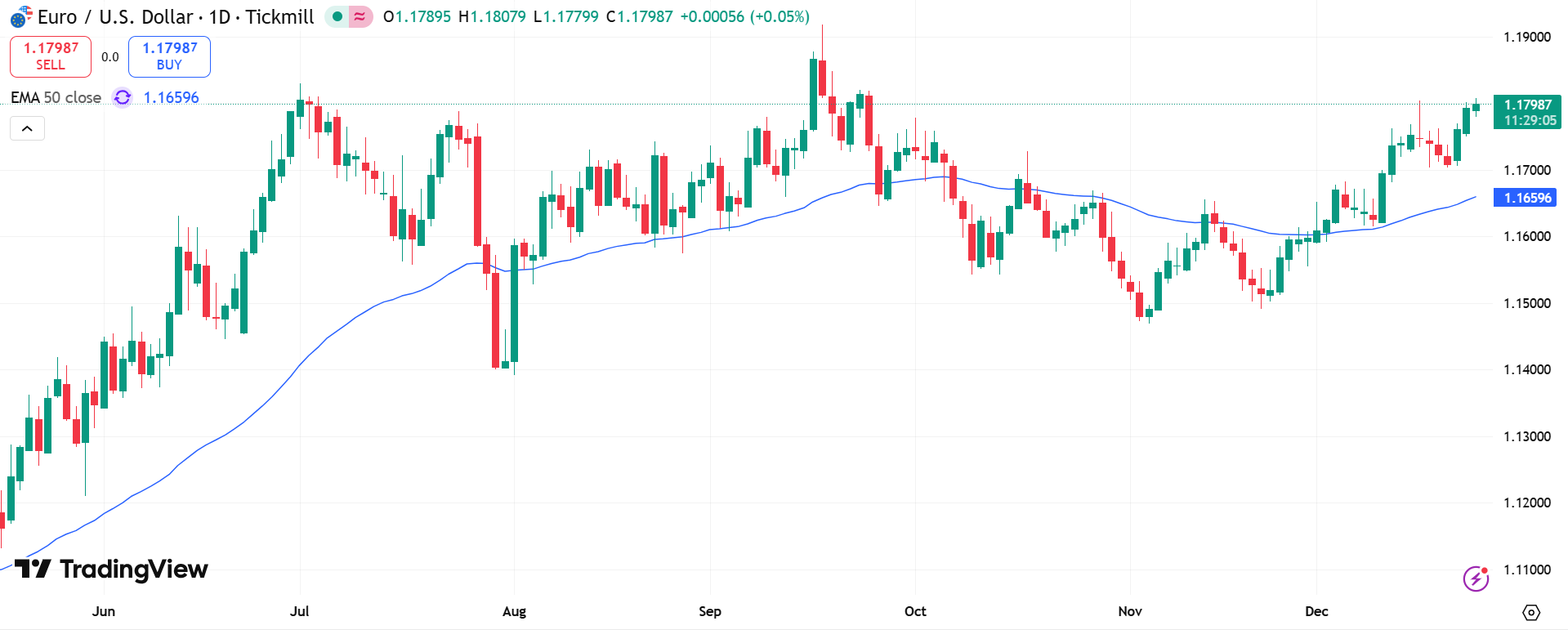
The euro held firm against the U.S. dollar on Wednesday, with EUR/USD hovering near 1.1790–1.1800 after retreating slightly from three-month highs. The pair has now posted gains for a third consecutive session, supported by broad-based dollar weakness and a technical structure that continues to favor buyers, even as momentum indicators flash early signs of fatigue.
Thin holiday trading conditions have amplified moves in the foreign-exchange market, while geopolitical tensions in the Middle East have added pressure on the U.S. dollar. Against that backdrop, the euro has remained resilient despite a lack of fresh economic catalysts from the euro zone.
EUR/USD Holds Uptrend Despite Overbought Signals
From a technical perspective, the broader bias in EUR/USD remains constructive. On the daily chart, the pair continues to trade within a clearly defined ascending channel, holding above all major moving averages. The 14-day Relative Strength Index (RSI) stands near 69–71, hovering in overbought territory, a level that often precedes consolidation rather than outright reversals.
Momentum indicators suggest that buying pressure is moderating, but not yet reversing. This environment typically favors sideways trading or shallow pullbacks before the dominant trend resumes. Importantly, the pair has so far managed to defend recent gains, signaling underlying demand for the euro on dips.
Short-Term Charts Signal Firm Support
Shorter-term technicals reinforce the bullish outlook. On the four-hour chart, the 20-period Simple Moving Average (SMA) remains above both the 100- and 200-period SMAs, with all three sloping higher. This alignment points to trend strength across multiple time frames.
Key technical reference points include:
- 20-period SMA: near 1.1739, acting as first dynamic support
- 100-period SMA: around 1.1692, reinforcing a broader support zone
- RSI (4-hour): near 65, easing from overbought conditions
While momentum has slowed, the risk profile still skews to the upside as long as prices hold above these support levels. A sustained break below them would be needed to challenge the current bullish structure.
Dollar Weakness Persists After U.S. Data
Fundamentally, the euro’s strength has been driven less by Europe-specific news and more by persistent softness in the U.S. dollar. The greenback failed to capitalize on upbeat U.S. data, including a report showing the economy expanded at an annualized 4.3% in the third quarter, well above market expectations of 3.3%.
Other U.S. indicators offered mixed signals. Private-sector job creation averaged 11,500 jobs per week in early December, according to ADP data, while inflation pressures resurfaced as the GDP Price Index rose to 3.7% from 2.1%. The stronger inflation reading briefly steadied the dollar, but the broader bearish trend remained intact.
For now, EUR/USD appears poised to consolidate near 1.1800, balancing stretched momentum against ongoing dollar weakness. A decisive break above recent highs could open the door to further gains, while consolidation would help reset indicators before the next directional move.

