

The British pound is holding firm against the U.S. dollar, with GBP/USD trading near 1.3400 in early European hours as investors digest recent central bank signals. The pair’s resilience follows an upbeat market mood and a broadly steady dollar, even as traders recalibrate expectations after policy decisions from the Federal Reserve and the Bank of England.
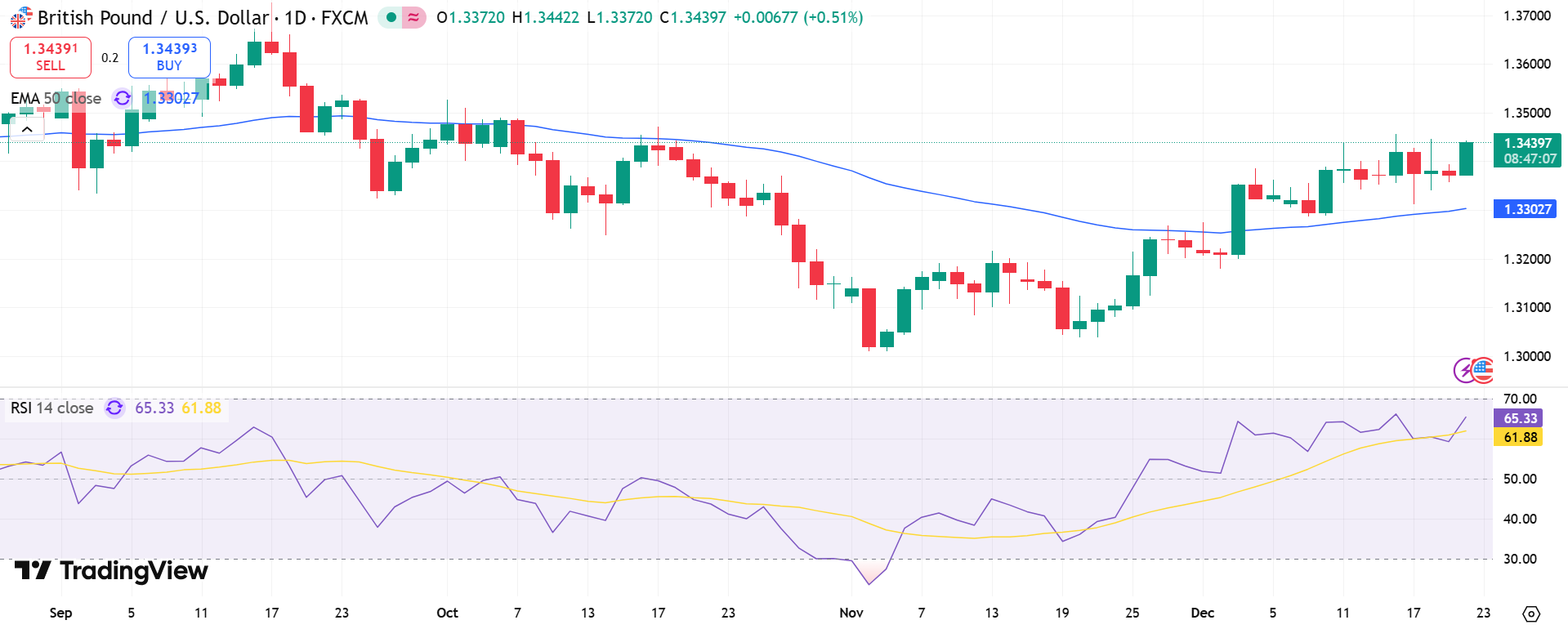
A decisive overnight breakout above the 1.3275–1.3280 zone proved pivotal. That area combined the 200-day simple moving average and the 38.2% Fibonacci retracement of the September–November decline, a level closely watched by technical traders. Clearing it has shifted short-term momentum in favor of sterling, reinforcing the recovery narrative after weeks of consolidation.
Daily momentum indicators remain in positive territory, suggesting that buyers retain control for now. As long as the pair stays above former resistance-turned-support, the technical bias points toward further gains.
Technical Levels Guide Near-Term Direction
With the recovery intact, traders are focusing on a series of well-defined price markers that could shape the next leg higher or lower. A sustained move above 1.3365, the 50% retracement level, would likely open the door for a renewed test of 1.3400 and beyond.
If bullish momentum persists, attention shifts to the 1.3455–1.3460 region, aligned with the 61.8% Fibonacci retracement, before the psychologically important 1.3500 level comes into view.
Key levels shaping near-term trade include:
- Resistance: 1.3400, then 1.3455–1.3460
- Major upside target: 1.3500 psychological level
- Initial support: 1.3300 round figure
- Downside risk zone: 1.3225–1.3200
- Bearish extension: 1.3145 and sub-1.3100
A decisive break below 1.3200 would undermine the bullish setup and tilt the balance back toward sellers.
Fed and BoE Policy Outlook in Focus
Monetary policy expectations remain the dominant macro driver. Markets are pricing in nearly a 90% probability that the Federal Reserve will cut rates by 25 basis points at the conclusion of its two-day meeting this week. If delivered, it would mark the third reduction this year, bringing the target range to 3.50%–3.75%.
However, investors expect a “hawkish cut.” Persistent inflation risks and a resilient U.S. labor market could prompt the Fed to signal a pause in early 2026, offering underlying support to the dollar and potentially capping GBP/USD gains.
On the UK side, the pound faces its own challenges. Concerns over higher taxation following the autumn budget, easing inflation pressures, and a cooling labor market have strengthened expectations of further Bank of England easing. Financial markets currently assign an around 88% probability to a quarter-point BoE rate cut in December, underscoring a narrowing policy divergence that could limit sterling’s upside.

