

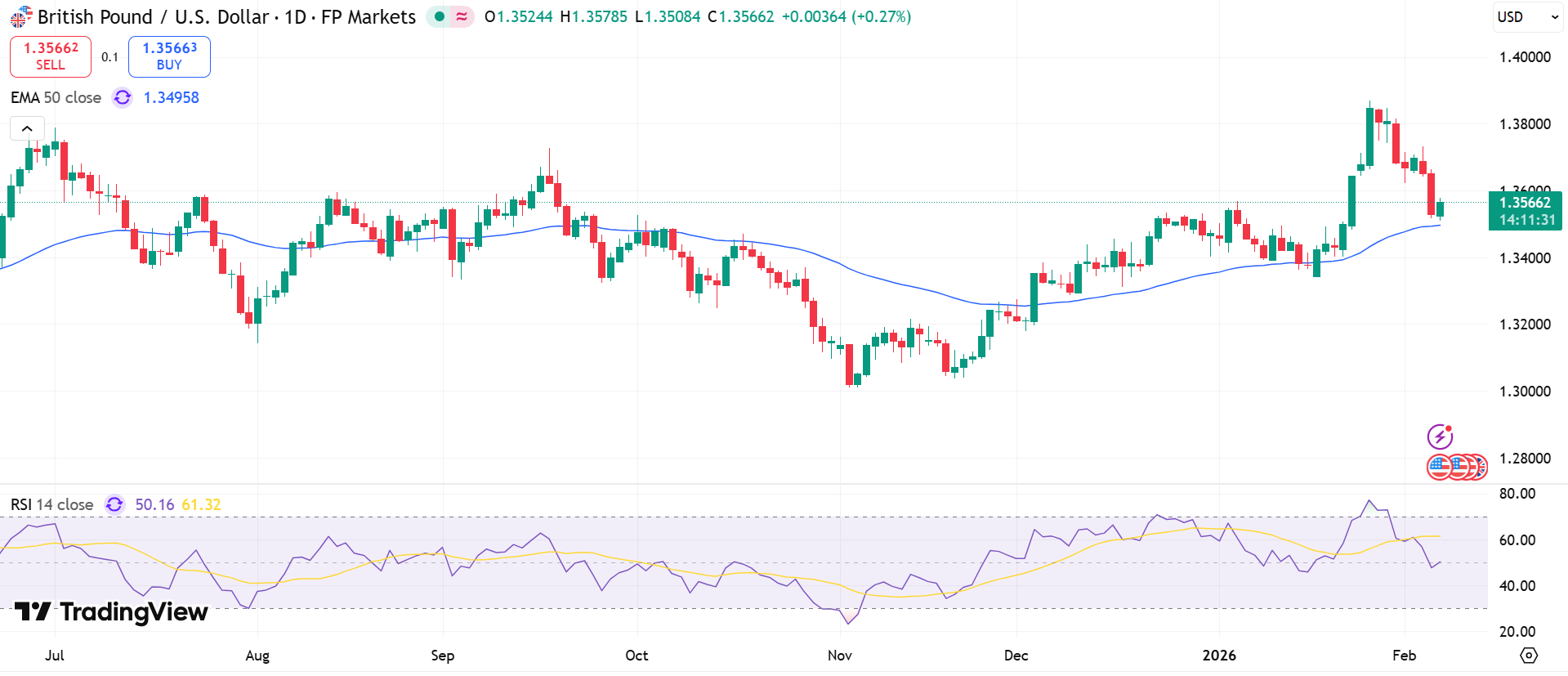
The British Pound (GBP) moved lower against the U.S. Dollar (USD) on Friday, trading around 1.3560 during Asian hours after two days of small gains. Although the pair bounced earlier, the overall picture still looks shaky.
On a daily chart, GBP/USD appears close to the bottom of a rising channel — a pattern that often hints at a possible pullback. In simple terms, the price climbed smoothly for weeks, but now it looks tired and may slide again before trying to rise.
A key safety line sits near 1.3600, which matches a 50% Fibonacci level — a technical tool traders use like stepping stones on a staircase. If price stays above this level, bulls (buyers) can breathe easier. If it falls below, bears (sellers) may take control.
Short-term indicators are mixed. The MACD, which measures momentum, is still slightly negative, while the RSI near 32 suggests the market is close to “oversold,” like a rubber band stretched too far down. This means a bounce is possible, but not guaranteed.
Another important floor lies at 1.3548 (the 61.8% retracement). A clear break under this point could open the door to deeper losses. If price holds above it, a gentle recovery could form, though rising will remain difficult as moving averages are trending lower.
Why the pound is under pressure
Thursday brought fresh selling, pulling GBP/USD away from last week’s high near 1.3870 — its strongest level since 2021. The main reason was a firmer U.S. dollar, which pushed the pair down to around 1.3600, a two-week low.
At the same time, all eyes are on the Bank of England (BoE). Most economists expect the BoE to keep interest rates at 3.75%, even though inflation is still above its 2% target.
However, traders believe rate cuts could arrive in 2026 because the UK job market is cooling. Unemployment is stuck at a four-year high of 5.1%, and about 43,000 jobs were lost in December. Slower wage growth also supports the idea of future easing.
What really matters this week is not just the rate decision, but how the BoE votes and what Governor Andrew Bailey says afterward. His tone could either lift or sink the pound.
Dollar strength vs. rate-cut hopes
The U.S. dollar has been bouncing back from recent lows. President Trump’s pick of Kevin Warsh as potential Fed chair made markets worry the Fed might be less eager to cut rates, which briefly boosted the dollar.
Yet weaker U.S. jobs data are pushing the other way. Private employers added only 22,000 jobs in January, far below expectations, strengthening bets that the Federal Reserve will still cut rates twice in 2026.
Trump even said he would not have nominated Warsh if he wanted higher rates — a comment that limits how far the dollar can rise.
Key levels to watch this week:
- 1.3600 — short-term pivot point
- 1.3548 — critical downside support
- 1.3870 — recent high bulls want back
Bottom line
GBP/USD is stuck between shaky UK data and uncertain U.S. policy. If the BoE sounds cautious, the pound could slip further. If the Fed remains dovish, the dollar may soften and give the pound room to rebound. For now, traders are waiting — and patience is the safest bet.

