

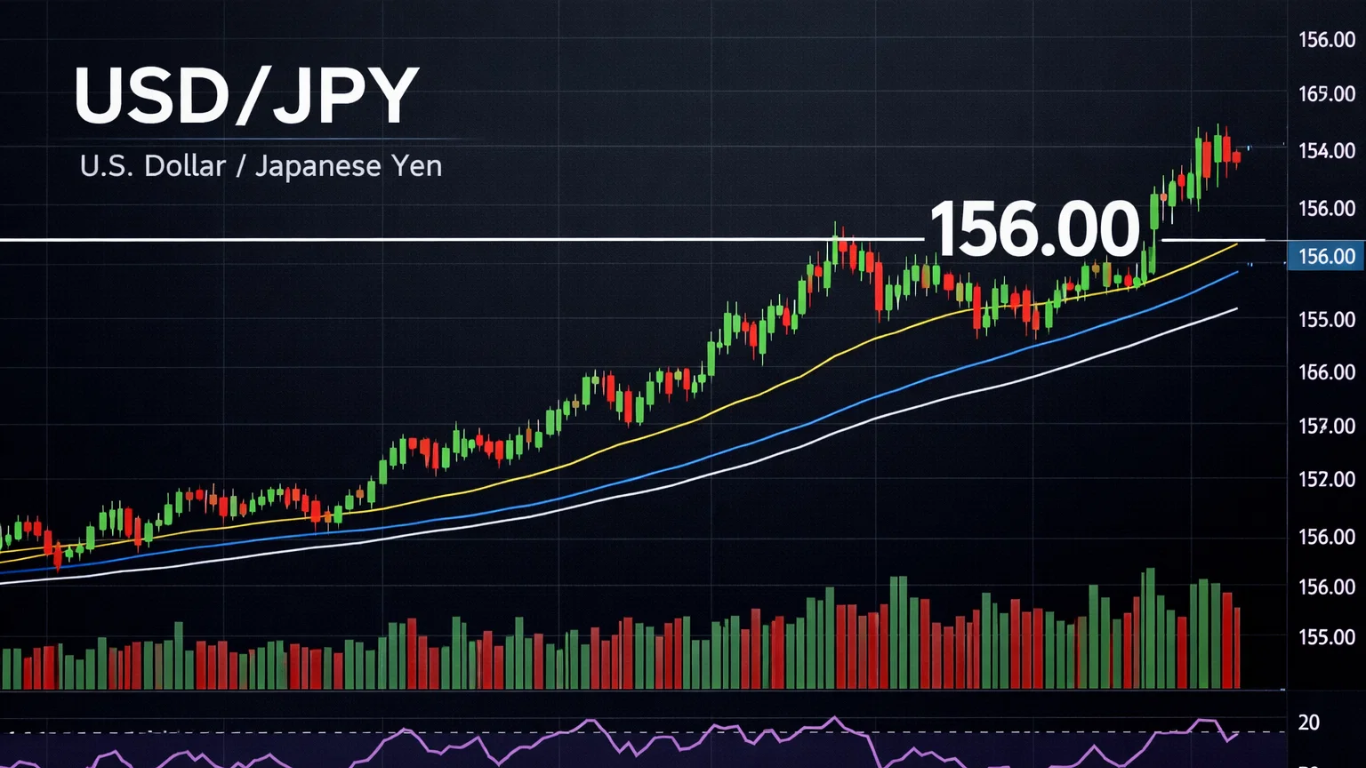
The Japanese yen is struggling to gain clear direction, oscillating between modest gains and losses as investors weigh hawkish signals from the Bank of Japan against fiscal uncertainty and a still-supportive global risk mood. Against a softer U.S. dollar, the currency has stalled its rebound from a near two-week low, reflecting hesitation rather than conviction among market participants.
At the center of the debate is timing. While the BoJ has made clear it is open to further tightening, traders remain unconvinced about how soon the next rate hike might arrive. That uncertainty has left the yen trading in a narrow range near the mid-¥156 level, even as broader fundamentals tilt gradually in its favor.
Technical Signals Point to Consolidation
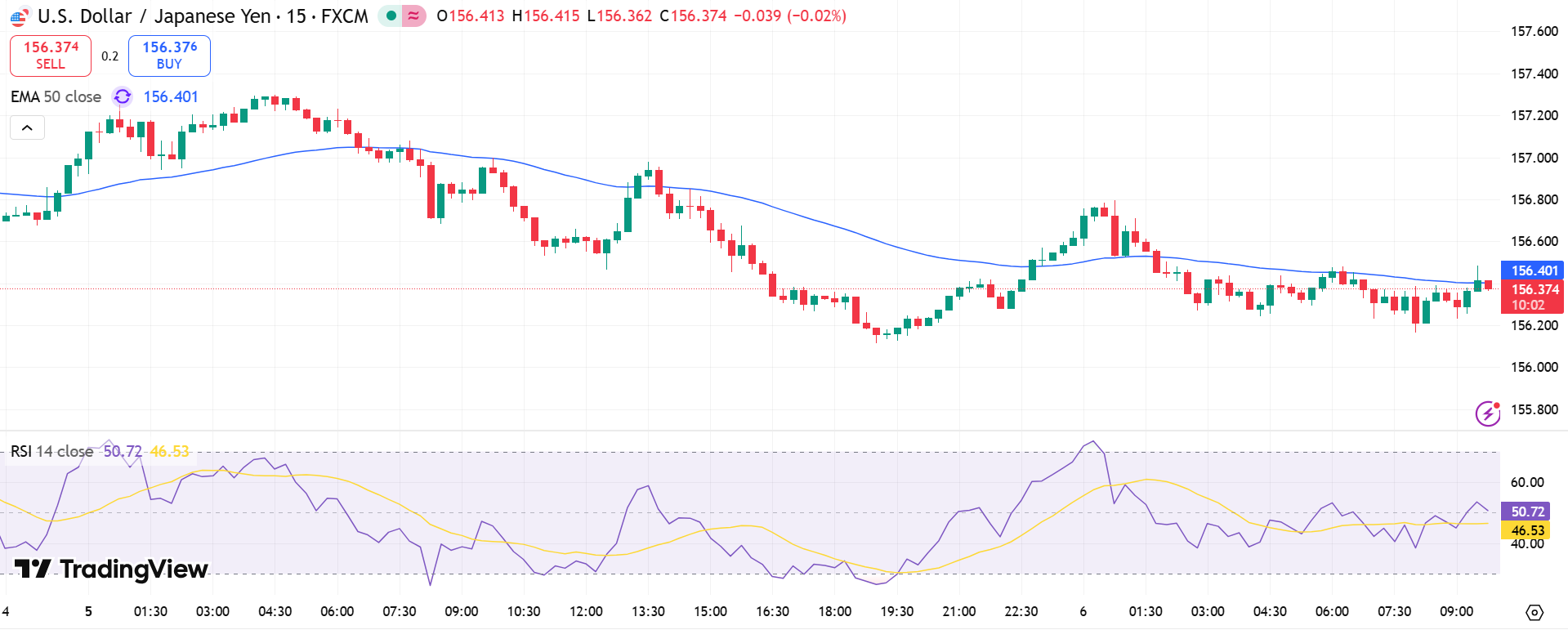
Price action in USD/JPY suggests consolidation rather than a trend reversal. The pair continues to trade within an ascending channel that has been intact since the 155.46 area, with the lower boundary near 156.13 acting as near-term support.
Momentum indicators reinforce the idea of balance rather than momentum:
- Short-term moving averages have flattened
- MACD sits just above the zero line, signaling fading downside pressure
- RSI near 43 reflects neutral conditions, not oversold stress
A sustained break above the channel top near 157.16 could open the door to renewed upside. Failure to attract follow-through buying, however, would likely push the pair back toward the lower edge of the channel.
BoJ Signals vs Fiscal Uncertainty
On the policy front, BoJ Governor Kazuo Ueda reiterated that the central bank will continue raising interest rates if growth and inflation evolve as forecast. He emphasized that adjusting monetary support is essential for achieving sustained growth, with wages and prices expected to rise together at a moderate pace.
Those comments pushed Japanese government bond yields sharply higher. The two-year JGB yield reached its highest level since 1996, while the 10-year yield climbed to levels last seen in 1999. The resulting narrowing of yield differentials with the U.S. and Europe is a structural positive for the yen.
Yet fiscal concerns remain a counterweight. Expectations of large-scale spending under Prime Minister Sanae Takaichi’s growth agenda, combined with energy subsidies and stable food prices, have raised doubts about how quickly inflation will remain strong enough to justify aggressive tightening into 2026.
Fed Cut Bets Keep Dollar in Check
Adding to the yen’s underlying support is a softening U.S. dollar. Markets are increasingly pricing in a Federal Reserve rate cut as early as March, with another possible later in the year. Recent data reinforced that view: while the S&P Global Manufacturing PMI held at 51.8, the ISM index slipped to 47.9, signaling ongoing contraction.
For now, traders are reluctant to take strong positions ahead of Friday’s U.S. Nonfarm Payrolls report, a key test for Fed policy expectations.
Taken together, the yen lacks immediate momentum but retains a supportive фундамент. With BoJ normalization contrasting sharply with a dovish Fed outlook, the broader backdrop still leans in favor of Japanese yen bulls—once uncertainty gives way to clarity.

