

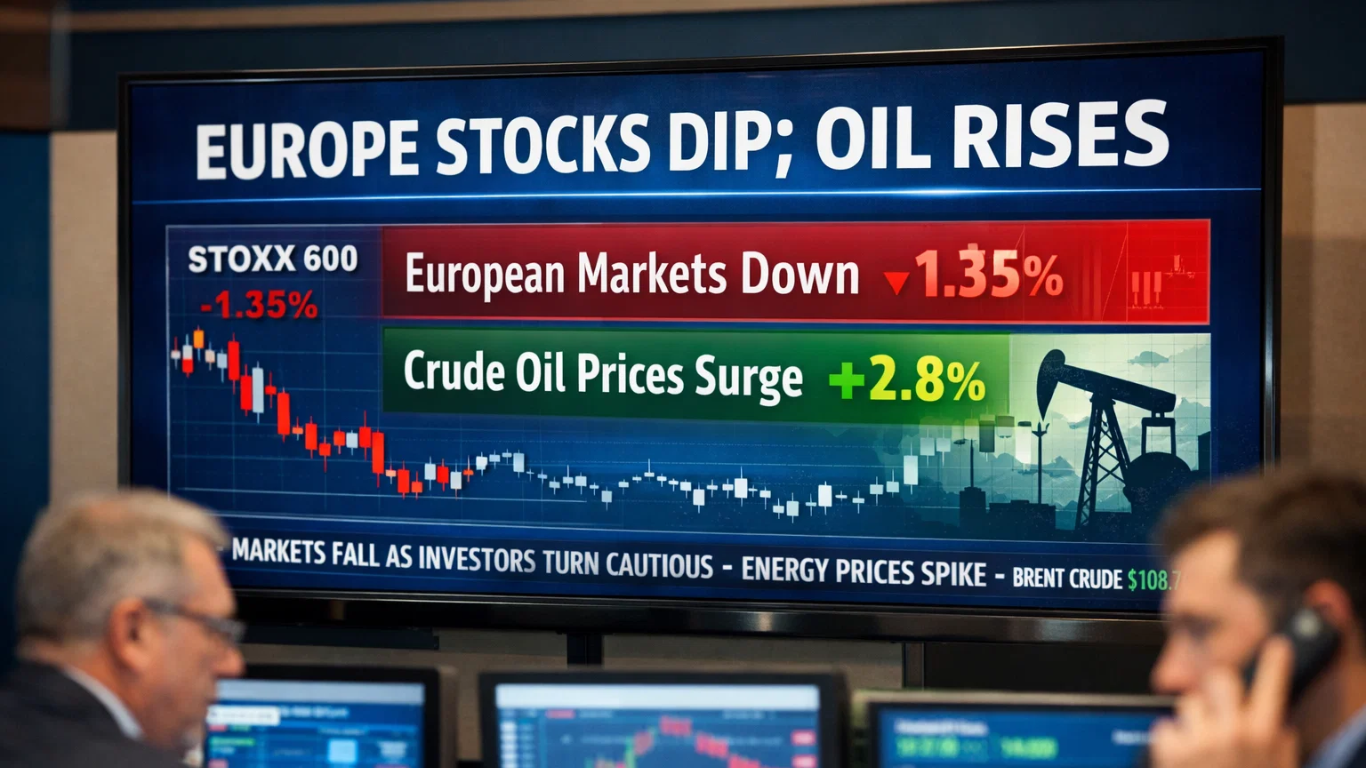
European equity markets moved cautiously lower on Thursday as investors absorbed rising geopolitical uncertainty tied to U.S. rhetoric over Greenland. Concerns intensified after Washington’s recent military action in Venezuela, which unsettled diplomatic norms and raised fears of broader strategic moves.
By early morning trading, Germany’s DAX edged up 0.2%, while France’s CAC 40 slipped 0.1% and the FTSE 100 fell 0.3% in London. The uneven performance reflected defensive positioning rather than outright risk-off selling.
Greenland, a semi-autonomous territory of Denmark, has re-emerged as a geopolitical flashpoint after U.S. President Donald Trump reiterated that national security considerations could justify extreme measures. With both Denmark and the U.S. members of NATO, investors are grappling with the implications of a scenario that could strain or even fracture the alliance.
U.S. Secretary of State Marco Rubio confirmed plans to meet Danish officials next week, underscoring the seriousness with which markets are treating the issue. For European investors, the concern is not only political stability but also the potential disruption to Arctic trade routes, defense cooperation, and energy security.
German Data Brightens an Uneven Outlook
Economic data offered a partial counterweight to geopolitical unease. German factory orders jumped 5.6% month-on-month in November, signaling that Europe’s largest economy ended last year with stronger-than-expected industrial momentum.
In contrast, the U.K. housing market showed renewed weakness. British house prices fell 0.6% in December, according to Halifax, reinforcing concerns that higher borrowing costs continue to weigh on domestic demand.
Key macro signals investors are tracking include:
- German industrial recovery gaining traction
- Persistent softness in U.K. consumer-linked sectors
- Europe’s sensitivity to U.S. monetary policy shifts
- Capital flows tied to global risk perception
Attention is now firmly on Friday’s U.S. nonfarm payrolls report, a data point Federal Reserve officials have repeatedly described as central to rate decisions. Markets are currently pricing in two U.S. rate cuts this year, making employment data critical for global asset pricing.
Earnings and Oil Prices Shape Sentiment
Corporate updates provided mixed signals. French catering group Sodexo reported 1.8% organic revenue growth in its first quarter, slightly above expectations, though currency effects dragged reported revenue down 2.2%. In the U.K., bakery chain Greggs delivered a solid finish to the year, with fourth-quarter sales rising 7.4%.
Energy markets also influenced sentiment. Oil prices rebounded after two sessions of losses, supported by a larger-than-expected draw in U.S. inventories. Brent crude rose 0.3% to $60.11 a barrel, while WTI gained 0.2% to $56.11.
The U.S. Energy Information Administration reported a 3.8 million-barrel decline in crude stockpiles, far exceeding expectations. However, investor focus remains on Venezuela, as reports suggest Washington is considering deeper involvement in PdVSA, potentially reshaping global oil supply dynamics.
For Europe’s markets, the balance between geopolitical risk, economic resilience, and energy volatility is likely to define near-term direction.

