

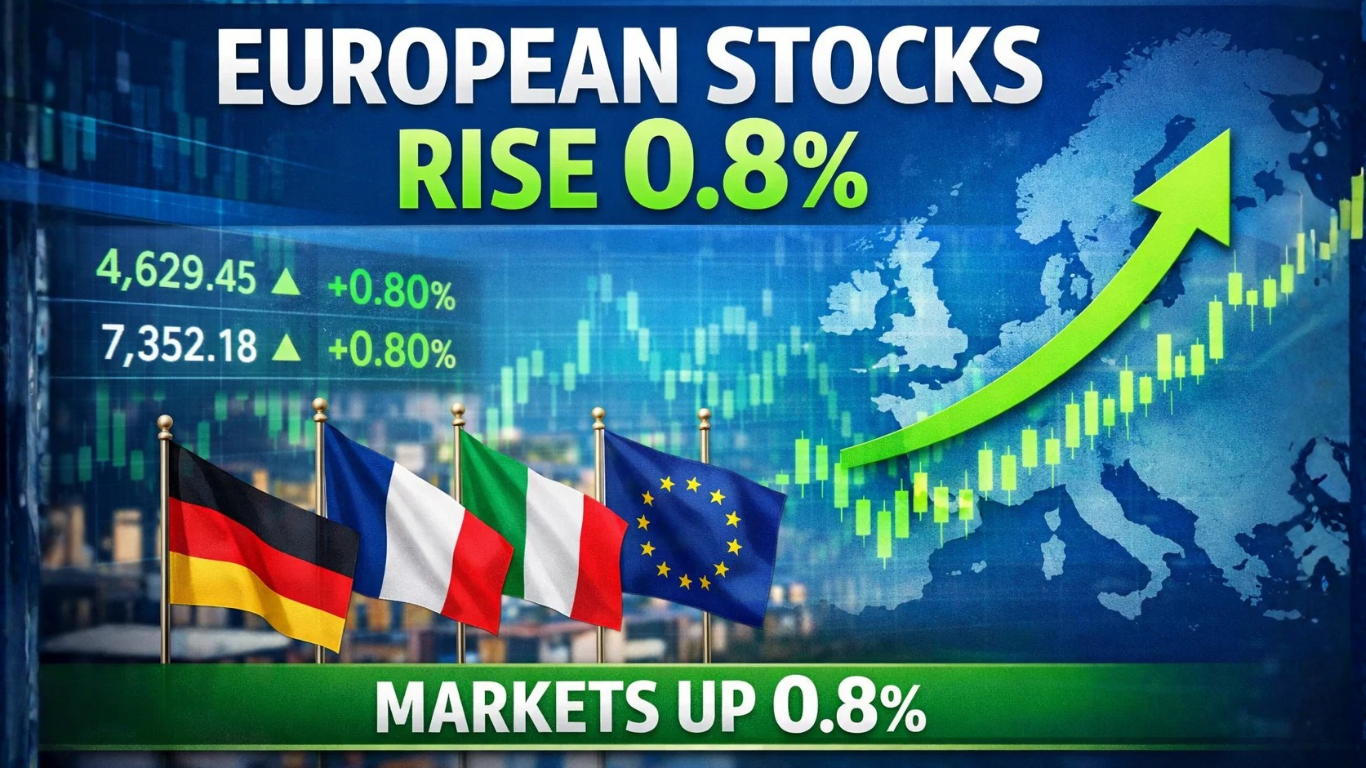
European equity markets moved modestly higher on Wednesday as investors positioned ahead of a dense calendar of central bank decisions across the region. Softer inflation data in the U.K. provided a notable boost to London-listed shares, while continental markets advanced more cautiously.
By mid-morning trading, Germany’s DAX and France’s CAC 40 each rose 0.2%. The U.K.’s FTSE 100 outperformed, climbing 0.8%, supported by easing price pressures and renewed expectations for lower borrowing costs. The cautious tone elsewhere reflected uncertainty over how long central banks will maintain restrictive policy as economic momentum fades.
Despite global headwinds, European stocks have shown resilience, helped by easing energy prices earlier this year and fiscal support in key economies. However, investors remain sensitive to signals on interest rates, which continue to dominate market direction.
Central Banks and Inflation in the Spotlight
Attention is firmly fixed on policymakers. The European Central Bank is widely expected to hold its key interest rate at 2% on Thursday, reflecting a delicate balance between cooling inflation and slowing growth. Recent data suggest the eurozone economy has absorbed some of the shock from higher U.S. tariffs, even as exports have softened.
That resilience is showing cracks. Manufacturing activity remains in contraction, and services growth has slowed more than expected toward year-end. While November eurozone inflation data is due later in the session, it is unlikely to materially shift the ECB’s near-term stance.
In the U.K., inflation data offered clearer direction. Annual consumer price inflation eased to 3.2% in November from 3.6% in October, the lowest reading in eight months. Monthly prices fell 0.2%, reinforcing the view that price pressures are cooling faster than anticipated.
Key policy signals investors are watching include:
- A potential Bank of England rate cut to 3.75% from 4%
- The ECB’s guidance on 2026 rate expectations
- Final 2025 decisions from Sweden’s Riksbank and Norway’s Norges Bank
The Bank of England narrowly voted 5–4 to hold rates last month, but softer inflation strengthens the case for renewed easing early in the new year.
Corporate Updates and Oil Add Momentum
Corporate news also shaped sentiment. Serco lifted its 2025 profit guidance and delivered an upbeat outlook for 2026, citing strong demand for government services.
Thyssenkrupp Nucera reported quarterly results broadly in line with expectations, while Bunzl reaffirmed its 2025 profit outlook despite persistent economic challenges.
Energy markets added another layer of complexity. Oil prices jumped after U.S. President Donald Trump ordered a blockade of sanctioned Venezuelan oil tankers. Brent crude rose 1.4% to $59.73 a barrel, while U.S. crude gained 1.5% to $55.94.
Analysts note Venezuela exported roughly 600,000 barrels per day in November, with most shipments destined for China. Any sustained disruption could tighten specific crude grades, though broader supply concerns linked to Russia-Ukraine talks continue to cap upside.
Together, easing inflation, policy uncertainty, and selective corporate strength are shaping a cautiously optimistic backdrop for European markets.

