

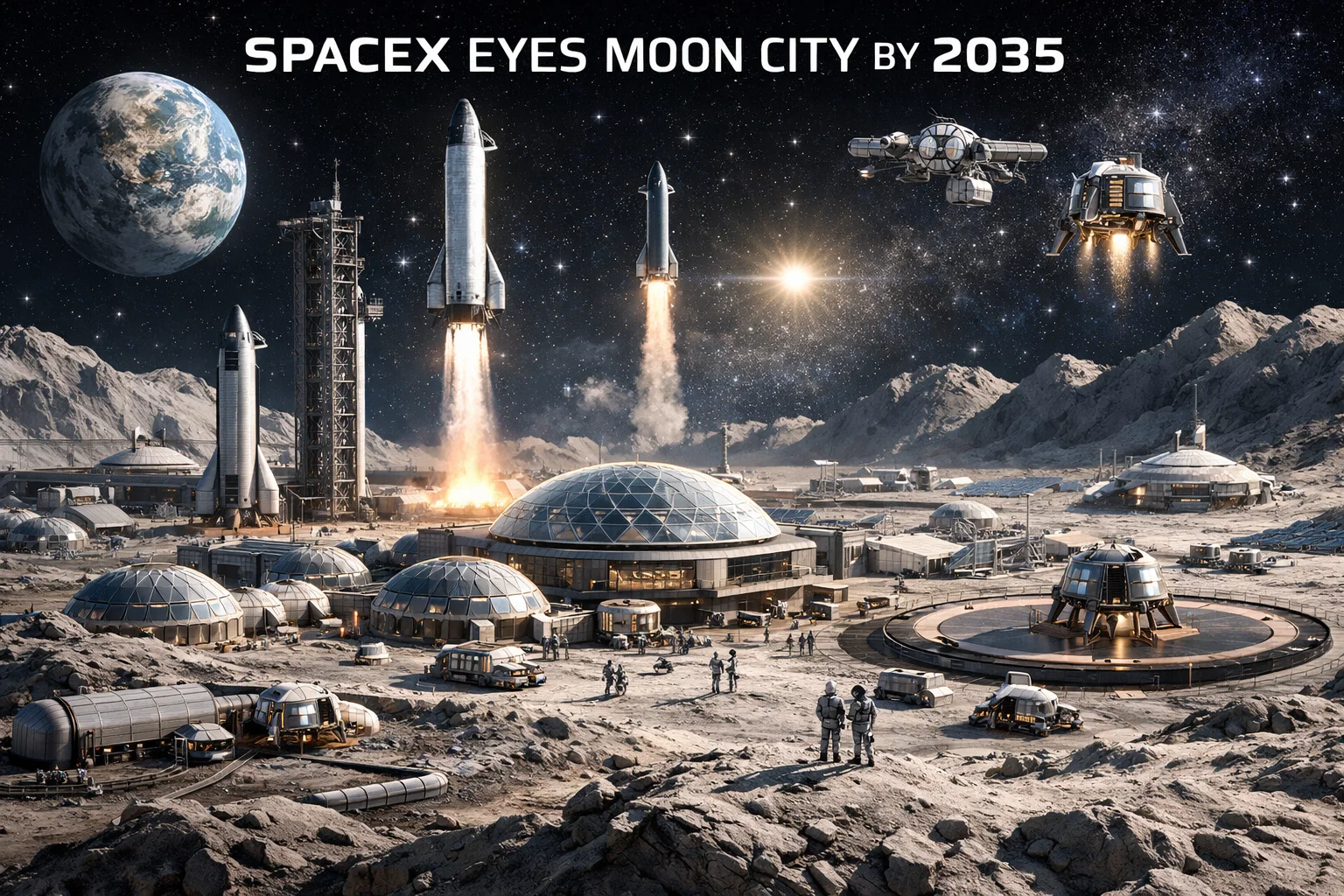
Elon Musk said Sunday that SpaceX is changing its biggest goal. Instead of racing first to Mars, the company will now focus on building a “self-growing city” on the Moon, something Musk believes could be possible in less than 10 years. He said the Moon is faster and safer for “securing the future of civilization.”
SpaceX still plans to work toward a human city on Mars, but that timeline has moved. Musk wrote on X that Mars could begin in five to seven years, while the Moon is now the top priority. This matches a Wall Street Journal report that SpaceX told investors it is targeting March 2027 for an uncrewed lunar landing.
The shift is happening as the U.S. faces serious competition from China in the race back to the Moon. No humans have walked on the lunar surface since Apollo 17 in 1972, more than 50 years ago. SpaceX is a key partner in NASA’s Artemis program, holding a $4 billion contract to land astronauts using its Starship rocket.
Money, AI, and Starlink
Less than a week ago, Musk announced that SpaceX bought xAI, the artificial-intelligence company he also runs. The deal values SpaceX at $1 trillion and xAI at $250 billion. Supporters say this could help SpaceX build space-based data centers that may use less energy than Earth-based ones as AI computing demand explodes.
SpaceX is preparing for what could be the largest public stock offering in history. The company hopes to raise up to $50 billion in an IPO later this year.
Musk also revealed that NASA will make up less than 5% of SpaceX’s revenue in 2026. He said the “vast majority” of money comes from Starlink, SpaceX’s global satellite internet system. On Sunday, SpaceX aired its first Super Bowl ad to promote Starlink Wi-Fi.
Tesla’s $20B turn
While reshaping SpaceX, Musk is also steering Tesla in a new direction. After helping build the global electric-car industry, Tesla now plans to spend $20 billion this year to pivot toward autonomous driving and humanoid robots.
To make space for robot production, Tesla will stop making two car models at its California factory, clearing room to build its Optimus humanoid robots. Musk says robots could become a bigger business for Tesla than cars in the long run.
Key facts at a glance (about 20%)
- Moon city target: under 10 years
- First uncrewed Moon landing: March 2027
- Last human Moon visit: 1972 (Apollo 17)
- SpaceX valuation: $1 trillion; xAI: $250 billion
- Planned IPO raise: up to $50 billion
- NASA share of revenue: less than 5%
- Artemis landing contract: $4 billion
- Tesla investment this year: $20 billion
In simple terms, Musk is betting big on the Moon now, keeping Mars for later, funding it with Starlink and AI, and turning Tesla from just cars into cars plus robots.

