


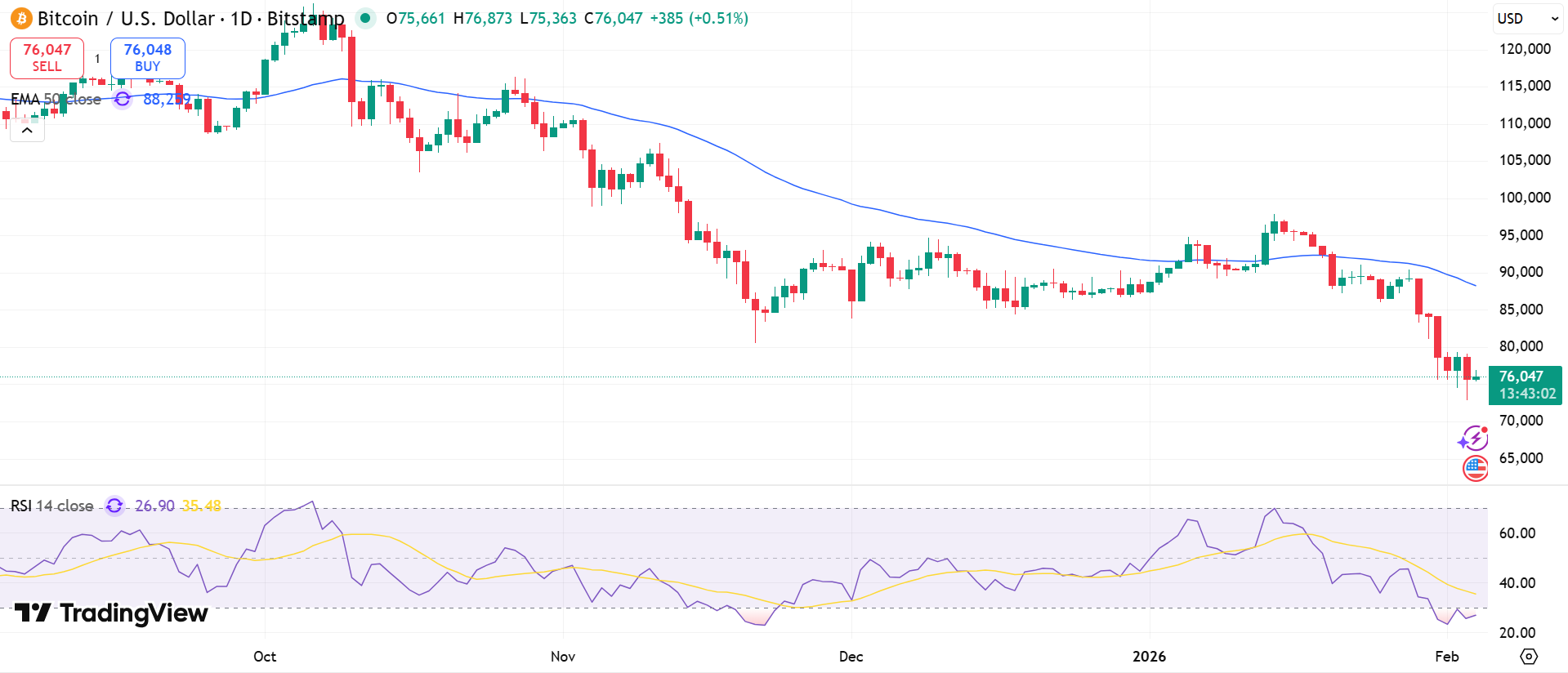
Michael Burry—the investor who famously foresaw the 2008 housing crash—has issued his starkest warning yet on Bitcoin, arguing that the asset’s recent slide has crossed a dangerous threshold for the broader financial system. After retreating more than 40% from its recent peak to around $72,897, Bitcoin now looks less like “digital gold” and more like a highly leveraged speculative trade, in his view.
Burry contends that Bitcoin lacks an organic, real-world use case strong enough to stabilize prices once momentum turns negative. Instead, he sees a market increasingly dependent on ETF flows, retail enthusiasm, and corporate treasury bets. Massive outflows from spot Bitcoin ETFs in recent weeks, he says, signal that institutional demand is cooling just as leverage remains elevated.
He also notes that Bitcoin has failed to behave like a traditional hedge. During periods of U.S. dollar weakness or geopolitical stress—moments that typically lift gold—Bitcoin has often moved in lockstep with tech stocks instead. Monday’s reaction to weak ISM manufacturing data, when BTC briefly jumped above $79,000 alongside equities, reinforced that pattern for many traders.
Corporate exposure raises systemic risk
Burry’s gravest concerns center on more than 150 publicly listed “Bitcoin treasury” companies that hold the cryptocurrency on their balance sheets. If prices slide below $70,000, he estimates Strategy (formerly MicroStrategy) alone could face roughly $4 billion in unrealized losses, pressuring lenders and shareholders alike.
Further declines, he warns, could push energy-intensive Bitcoin miners toward insolvency as revenues shrink while power and hardware costs stay high. Veteran chartist Peter Brandt has even floated a possible drop toward $54,000 if technical supports fail.
Key risks Burry highlights:
- Margin stress: forced selling as collateral values fall
- Liquidity drain: thinner trading depth amplifying moves
- Policy headwinds: expectations of a hawkish Fed under Kevin Warsh
- Contagion channels: spillovers from crypto to equities
Burry has criticized Bitcoin before, but he argues today’s setup is more perilous because corporate balance sheets—not just speculators—are directly exposed.
What this means for gold and silver
Burry also links the recent rout in gold and silver to crypto distress. He suggests some institutions have been liquidating tokenized metal futures to cover crypto margin calls, creating downward pressure on physical metals even as macro fundamentals remain supportive.
He cautions that many “tokenized gold and silver” contracts are not fully backed by physical bullion, which could deepen volatility if confidence evaporates. In a worst case, he says, these instruments could collapse with few natural buyers.
Still, broader contagion may be limited. Bitcoin’s roughly $1.5 trillion market value remains small relative to global equity and bond markets, and household exposure is uneven. That buffer, however, could erode quickly if prices keep sliding.
For now, Burry’s message is simple: what began as a crypto correction could morph into a multi-asset reckoning if selling accelerates and leverage unwinds across interconnected markets.

