

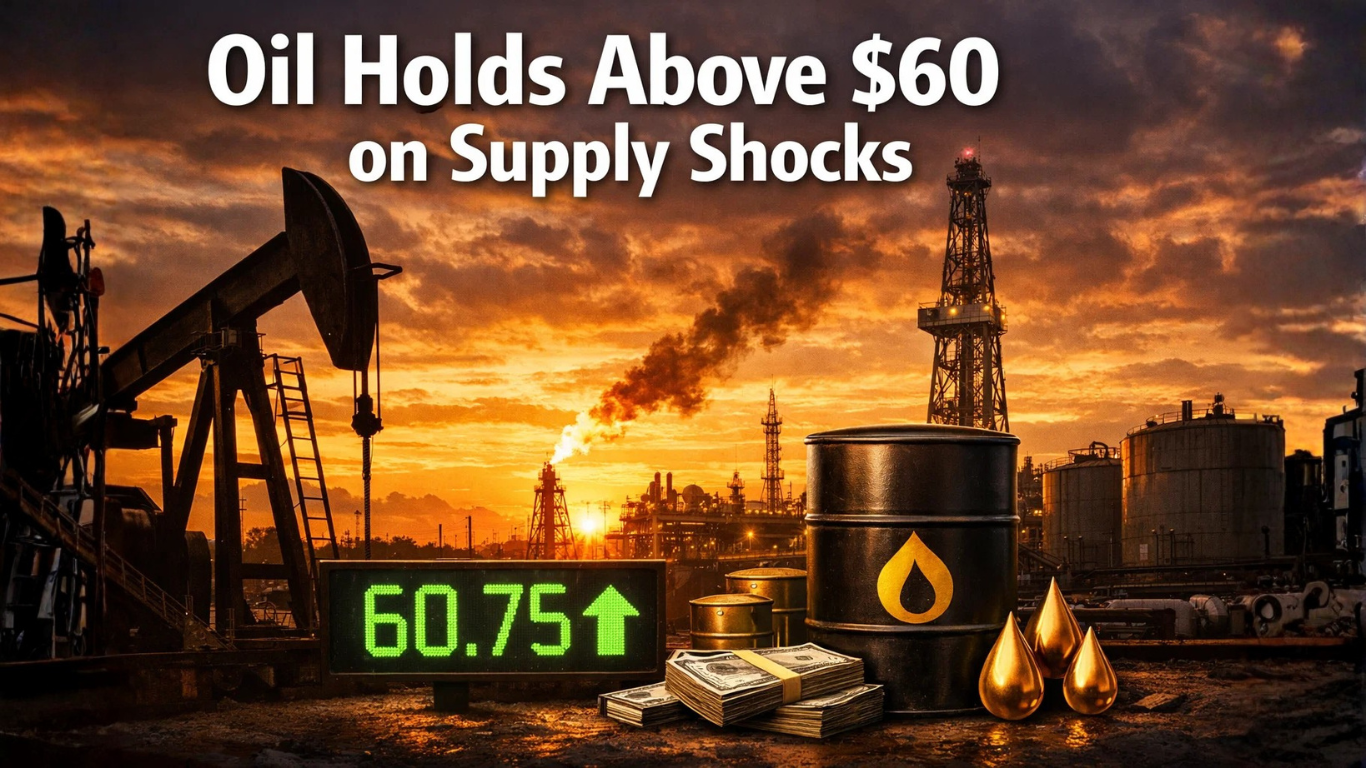
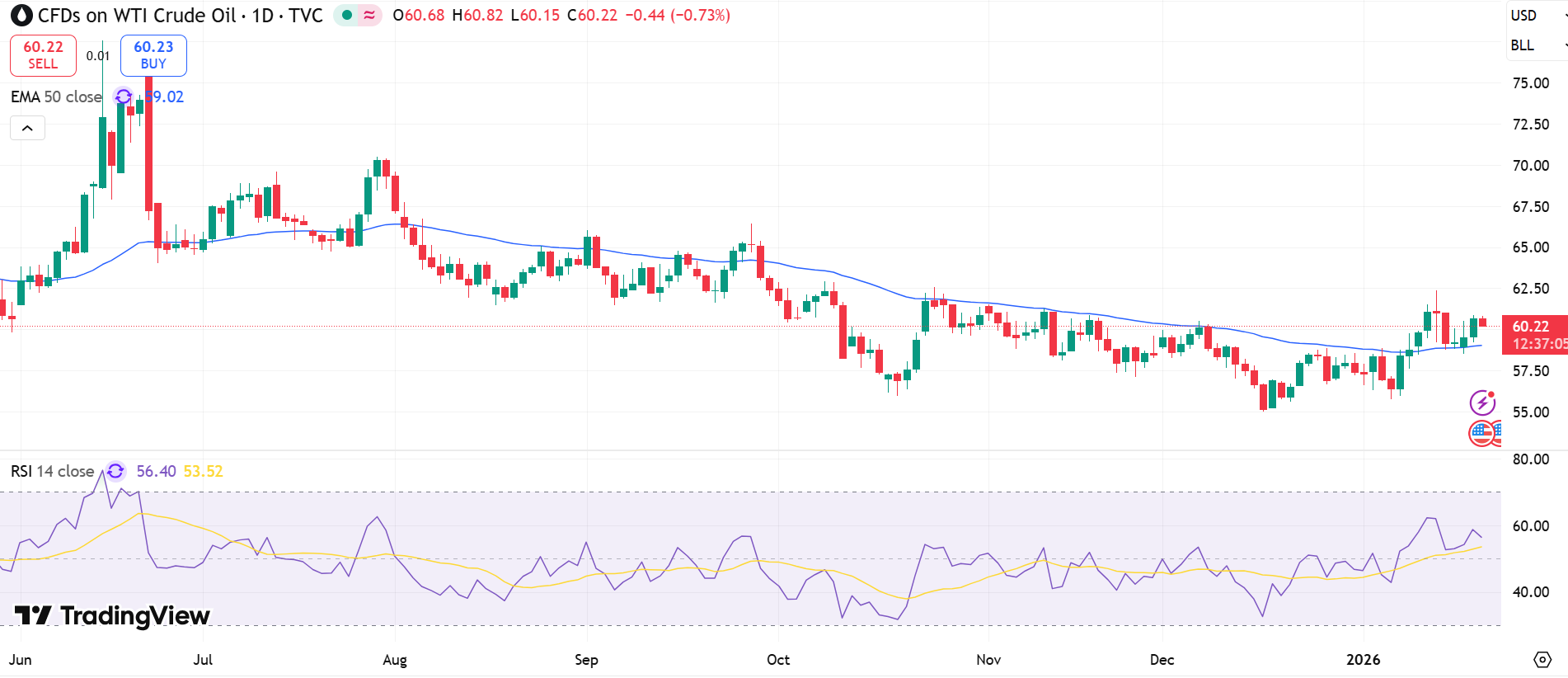
Oil prices edged higher in early Thursday trading, extending gains from the previous two sessions as easing geopolitical tensions in Europe coincided with fresh supply disruptions and improving long-term demand expectations. Brent crude rose 0.14% to $65.33 a barrel, while U.S. West Texas Intermediate (WTI) for March delivery climbed 0.21% to $60.75.
The modest gains follow a strong two-day advance of nearly 2%, reflecting renewed confidence that near-term downside risks may be limited. While global oil markets remain well supplied, traders are increasingly focused on supply reliability and forward demand rather than spot inventory levels alone.
Crude prices are now holding above the key $60 threshold for WTI, a level many analysts view as critical for U.S. shale profitability and broader market stability.
Greenland easing reduces trade war risks
Sentiment improved after U.S. President Donald Trump softened his stance on potential trade measures tied to Greenland, signaling progress toward a diplomatic framework with European allies. Speaking Wednesday, Trump ruled out the use of force and suggested an agreement over the Danish territory could be reached soon.
Markets interpreted the comments as reducing the likelihood of a U.S.–Europe trade conflict, which had threatened to weaken global economic growth and energy demand. Analysts note that trade stability remains a key pillar for oil consumption, particularly in manufacturing-heavy economies.
At the same time, geopolitical risks have not disappeared entirely. Ongoing uncertainty around Iran continues to offer underlying price support, even as Trump expressed hope that military action would not be necessary unless Tehran resumed its nuclear program.
Key geopolitical factors influencing oil prices include:
- Reduced risk of U.S.–EU tariffs tied to Greenland
- Continued uncertainty surrounding Iran’s nuclear stance
- NATO security concerns impacting energy flows
Supply disruptions and demand outlook support prices
Supply-side concerns added further support after Kazakhstan temporarily halted output at its Tengiz and Korolev oilfields due to power distribution issues. Kazakhstan, a key OPEC+ producer, plays a meaningful role in global supply balances, and any disruption tends to attract market attention.
Meanwhile, the International Energy Agency (IEA) revised its 2026 global oil demand growth forecast higher in its latest monthly report. While the agency still expects a surplus this year, the adjustment suggests tighter balances ahead as consumption growth outpaces earlier estimates.
U.S. inventory data sent mixed signals. According to the American Petroleum Institute:
- Crude inventories rose by 3.04 million barrels
- Gasoline stocks increased by 6.21 million barrels
- Distillate inventories fell by 33,000 barrels
Despite rising stockpiles, analysts say prices are finding support near current levels, with expectations that WTI will remain anchored around $60 barring a sharp deterioration in demand.

