


Oil prices edged higher on Tuesday as traders weighed escalating geopolitical tensions that threaten already fragile supply channels. Brent crude traded at $63.24, up 0.1%, while West Texas Intermediate rose 0.2% to $59.42 in early Asian hours. Both benchmarks extended gains from Monday, with WTI hovering near a two-week high.
Market sentiment has been shaped by a trio of risks: renewed Ukrainian drone attacks on Russian energy infrastructure, rising strains between the United States and Venezuela, and uncertainty surrounding this week’s U.S. fuel inventory data. Analysts at Saxo said crude “held its gains as traders awaited President Trump’s moves on Venezuela and assessed Black Sea terminal damage,” underscoring the sensitivity of prices to political developments.
The Caspian Pipeline Consortium confirmed on Monday that shipments resumed through one of its Black Sea mooring points following a significant drone strike on November 29. According to Russian publication Kommersant, loadings restarted through SPM 1, while SPM 2 remains offline due to structural damage.
Supply Threats Extend Beyond the Black Sea
The escalating military activity around key export infrastructure has heightened concerns over near-term supply reliability. Ritterbusch and Associates noted that the latest attacks reinforce expectations that a negotiated peace agreement remains distant. They warned that disruptions to Russian gasoil and diesel flows may “pull the complex back upward” as refined-fuel markets tighten.
Ukrainian President Volodymyr Zelenskiy said Kyiv continues to prioritize sovereignty and long-term security assurances, stressing that territorial disputes remain unresolved. The U.S. envoy, Steve Witkoff, is scheduled to brief Kremlin officials on Tuesday, though expectations of diplomatic progress remain muted.
Separately, uncertainty surrounding Venezuela continues to simmer. DBS energy strategist Suvro Sarkar said that while a full-scale conflict is unlikely, “ongoing events could destabilize the country internally and threaten oil production and exports.” Over the weekend, President Donald Trump declared that airspace “above and surrounding Venezuela should be considered closed,” adding to investor unease.
OPEC+ Steady on Output; U.S. Inventory Data Mixed
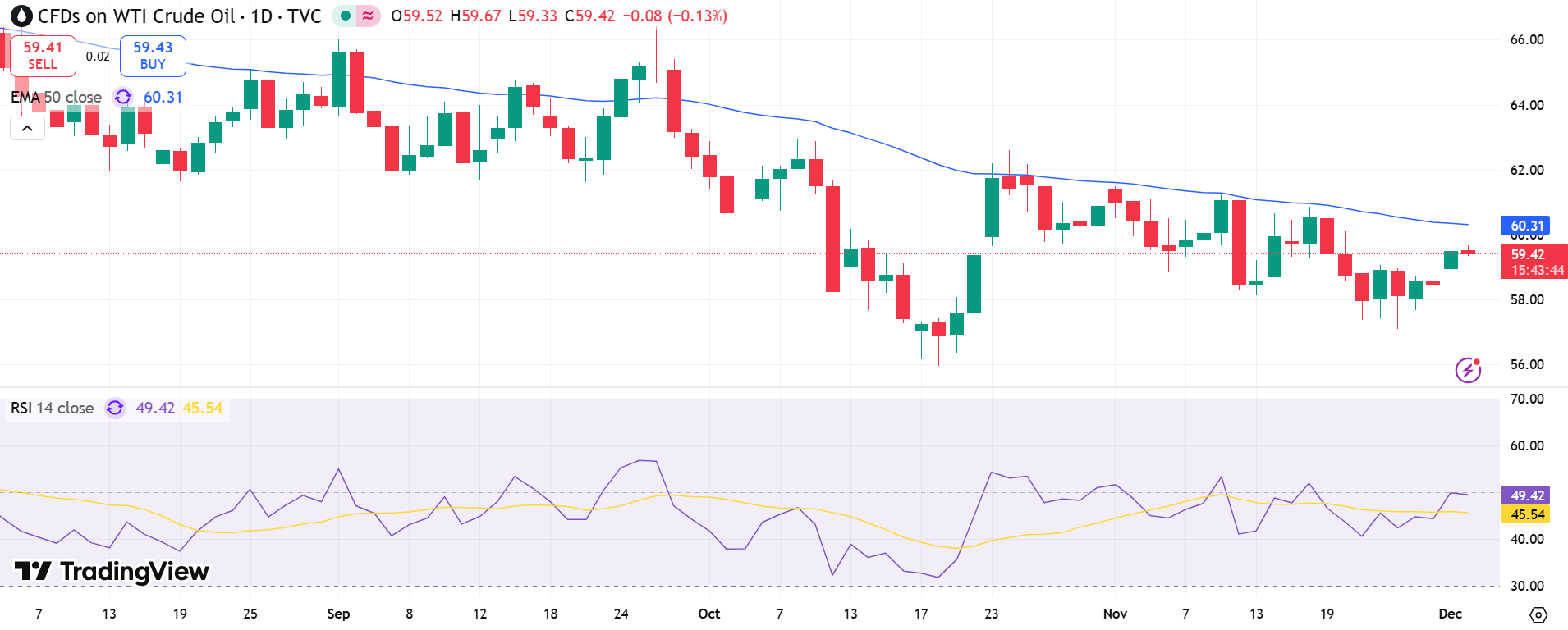
OPEC+ maintained its plan for a modest output increase in December, followed by a pause in the first quarter of next year as concerns grow over a potential supply glut. Sarkar said the group’s “near-term discipline remains supportive for prices,” particularly amid ongoing geopolitical risks.
Traders are also preparing for this week’s U.S. inventory figures. A Reuters poll of four analysts projects a decline in crude stockpiles but higher product inventories, a combination that could influence short-term price momentum.
Factors shaping crude sentiment:
- Ukrainian drone strikes on Russian infrastructure
- U.S.–Venezuela political tensions
- OPEC+ output strategy
- Mixed expectations for U.S. inventories

