


Global oil markets moved sharply higher after U.S. President Donald Trump ordered what he called a “total and complete” blockade of sanctioned oil tankers entering and leaving Venezuela. The directive injected fresh geopolitical risk into a market already struggling to balance fragile demand against ample supply.
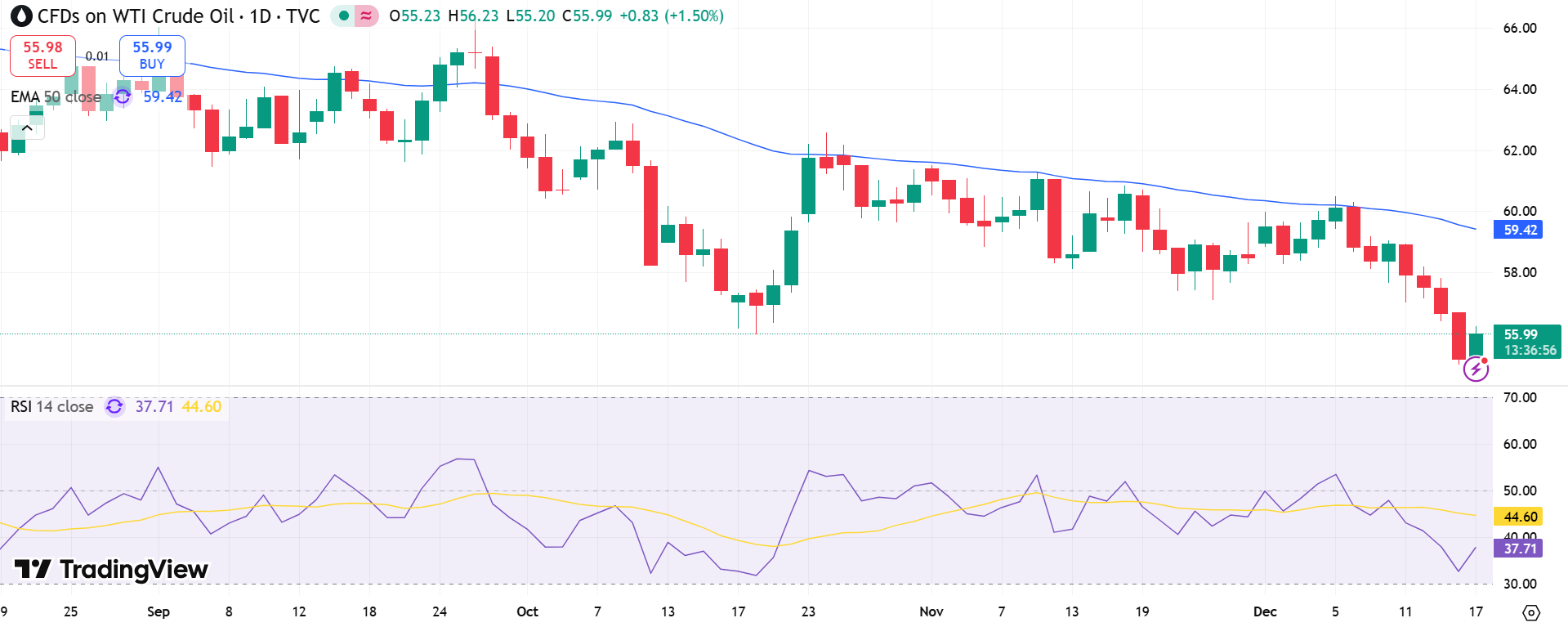
By early Wednesday trading, Brent crude futures climbed 87 cents, or 1.5%, to $59.79 a barrel, while U.S. West Texas Intermediate gained 85 cents, also 1.5%, to $56.12. The rebound followed a sharp selloff a day earlier, when prices hovered near five-year lows.
The timing matters. Oil had been under pressure as progress in Russia-Ukraine peace talks raised expectations that Western sanctions on Moscow could eventually be eased. Any relaxation would potentially return additional Russian barrels to an already well-supplied global market.
Prices Rebound After Five-Year Lows
Market participants in Asia noted that the price rise was not driven solely by geopolitics. Futures buying accelerated after Brent briefly slipped below the psychologically important $60-per-barrel level, triggering technical rebounds and short covering.
Still, traders cautioned against reading too much into the move. Venezuela’s oil output represents roughly 1% of global production, limiting its ability to shift prices in a lasting way. The broader market focus remains on global demand, which has shown signs of strain amid slowing economic growth.
Trump’s announcement follows the recent U.S. seizure of a sanctioned oil tanker off Venezuela’s coast and increased U.S. naval presence in the region. However, questions remain over enforcement, including how many vessels will be affected and whether the U.S. Coast Guard will be used to interdict tankers.
Limited Supply Impact, Lingering Downside
Analysts emphasize that Venezuelan crude flows are concentrated among a small group of buyers, reducing the shock to global supply. China is the largest purchaser, with Venezuelan barrels accounting for about 4% of its crude imports, while other buyers include the U.S. and Cuba.
Key market realities shaping the outlook include:
- Venezuelan output near 1% of global supply
- China as the dominant buyer of Venezuelan crude
- Ongoing authorization for Chevron to ship oil to the U.S.
- Expectations of a global supply glut through 2025
According to industry analysts, ample availability of sanctioned crude from Venezuela, Iran, and Russia is likely to cap any sustained rally, particularly in Asian markets. In the short term, prices remain vulnerable to renewed selling unless disruptions spread beyond Venezuela.
Over the longer horizon, however, prolonged interruptions could support heavy crude grades, which are harder to replace. For now, oil’s 1.5% jump reflects sentiment rather than a fundamental shift, leaving markets exposed to renewed downside if demand weakens further.

