

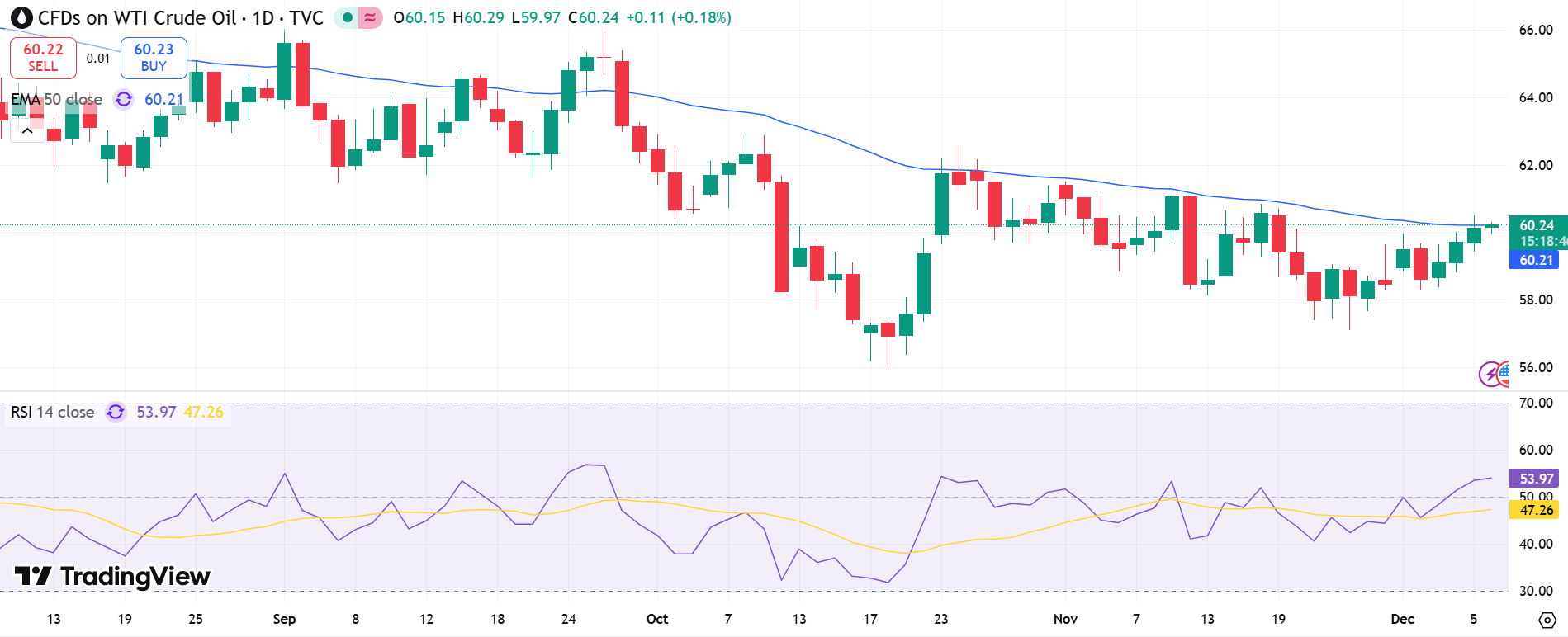
Oil prices steadied near two-week highs on Monday as traders positioned for a potential U.S. Federal Reserve rate cut, a move widely expected to lift economic activity and boost fuel demand. Brent crude edged up 0.14% to $63.84, while West Texas Intermediate rose 0.13% to $60.16 by early Asian trading. Both benchmarks ended Friday at their strongest levels since November 18.
Market pricing shows an 84% probability of a quarter-point Fed cut this week, according to LSEG data. However, policymakers appear sharply divided, making this one of the central bank’s most contested meetings in years. Investors are now watching closely to gauge how deep and how quickly the Fed plans to ease policy through 2025.
Geopolitics Add Supply Risks for Russia, Venezuela
Global crude markets continue to monitor geopolitical tensions that threaten supply from major producers, particularly Russia and Venezuela. Progress in Ukraine peace negotiations remains slow, with key disputes over security guarantees for Kyiv and the future of Russian-held territory still unresolved. Washington and Moscow also maintain starkly different interpretations of the peace framework proposed by the Trump administration.
ANZ analysts warned that political outcomes tied to these talks could swing global oil supply by more than 2 million barrels per day, depending on whether output cuts, sanctions relief, or renewed disruptions emerge. Additional headwinds include heightened U.S. pressure on Venezuela, which recently escalated to maritime strikes and renewed discussions of potential military action aimed at destabilizing President Nicolás Maduro’s government.
Analysts note several key geopolitical variables:
- Potential disruptions to Russian infrastructure
- G7–EU talks on a maritime services ban
- Heightened U.S. enforcement against sanctioned producers
- Uncertain Venezuelan export trajectories
Analysts Flag Oversupply Risks Despite Tightness
While supply threats dominate near-term headlines, some analysts see a softer market taking shape over the longer horizon. Commonwealth Bank of Australia analyst Vivek Dhar argues that global oversupply is likely to re-emerge as Russia finds new ways to redirect crude flows around existing sanctions.
Dhar expects oil prices to gradually drift toward $60 per barrel through 2026, barring major geopolitical shocks. A ceasefire in Ukraine remains the largest downside risk, as a rebound in Russian exports could ease current tightness. Conversely, continued damage to Russia’s energy infrastructure could push prices sharply higher.
Meanwhile, China’s independent refiners have accelerated purchases of Iranian crude using newly issued import quotas. These drawdowns of onshore storage barrels are beginning to ease local oversupply, adding another layer of complexity to the global supply map.
With markets balancing monetary policy shifts, geopolitical flashpoints, and structural supply changes, crude remains highly sensitive to any new signals emerging this week.

