

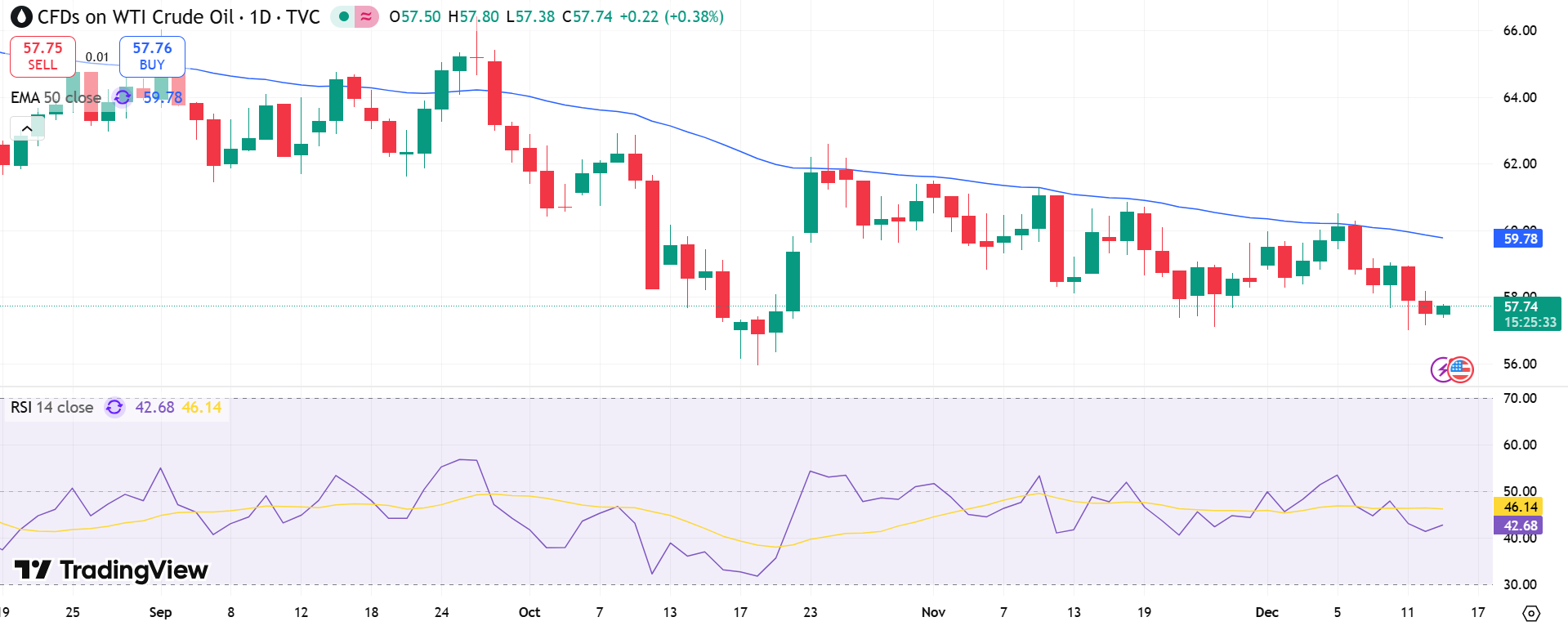
Oil prices opened the week on firmer footing as supply risks tied to Venezuela overshadowed lingering concerns about a global surplus. Brent crude rose 0.54% to $61.45 a barrel, while U.S. West Texas Intermediate gained 0.54% to $57.75, recovering modestly after both benchmarks slid more than 4% last week.
The rebound followed reports that the United States is preparing to intercept additional vessels transporting Venezuelan oil, escalating enforcement of sanctions against President Nicolás Maduro’s government. Shipping data and maritime sources indicate that Venezuela’s exports have already fallen sharply after a tanker seizure earlier this month and new restrictions on shipping companies.
Analysts say these developments have injected a short-term risk premium into oil markets, even as broader fundamentals remain soft.
Key drivers currently supporting prices include:
- Reduced Venezuelan crude flows following U.S. sanctions
- Heightened geopolitical uncertainty in Latin America
- Disruptions linked to enforcement actions at sea
Surplus Outlook Still Caps the Upside
Despite Monday’s gains, expectations of persistent oversupply continue to weigh on sentiment. JPMorgan Commodities Research warned over the weekend that oil surpluses emerging in 2025 are likely to widen into 2026 and 2027, with global supply projected to grow at three times the pace of demand through 2026.
That outlook has kept investors cautious after crude’s strong performance earlier in the year. Tsuyoshi Ueno, senior economist at NLI Research Institute, noted that while geopolitical tensions are supporting prices for now, markets remain directionless. He cautioned that WTI could slip below $55 in early 2026 if supply risks fail to intensify.
Adding to the uncertainty, U.S. energy producers cut active oil and gas rigs for a second time in three weeks, according to Baker Hughes. While the decline suggests some supply discipline, it has not yet been enough to materially shift the longer-term balance.
Russia-Ukraine Talks Add Another Variable
Geopolitics beyond Venezuela are also influencing oil’s outlook. Russia-Ukraine peace negotiations remain fluid after Ukrainian President Volodymyr Zelenskiy signaled willingness to reconsider NATO ambitions during talks with U.S. envoys in Berlin. U.S. officials described the discussions as constructive, though no formal agreement has been reached.
Markets remain sensitive to any progress that could lead to sanctions relief on Russian energy exports, potentially releasing additional barrels into global supply. Russia’s oil and gas revenues are already under pressure, with December proceeds expected to fall nearly 50% year-on-year to 410 billion roubles ($5.1 billion) due to lower prices and a stronger rouble.
Meanwhile, Ukraine reported a strike on a major Russian refinery in Yaroslavl, temporarily halting output and adding another layer of short-term supply uncertainty.
For now, oil prices appear caught between near-term geopolitical risks and a structurally oversupplied future, leaving markets reactive to headlines rather than driven by conviction.

