

Oil prices moved lower during Asian trading hours on Wednesday as investors turned cautious amid escalating geopolitical tensions tied to Greenland and ahead of a closely watched outlook from the International Energy Agency (IEA). The pullback followed a brief rebound in the prior session, highlighting fragile confidence in global energy markets.
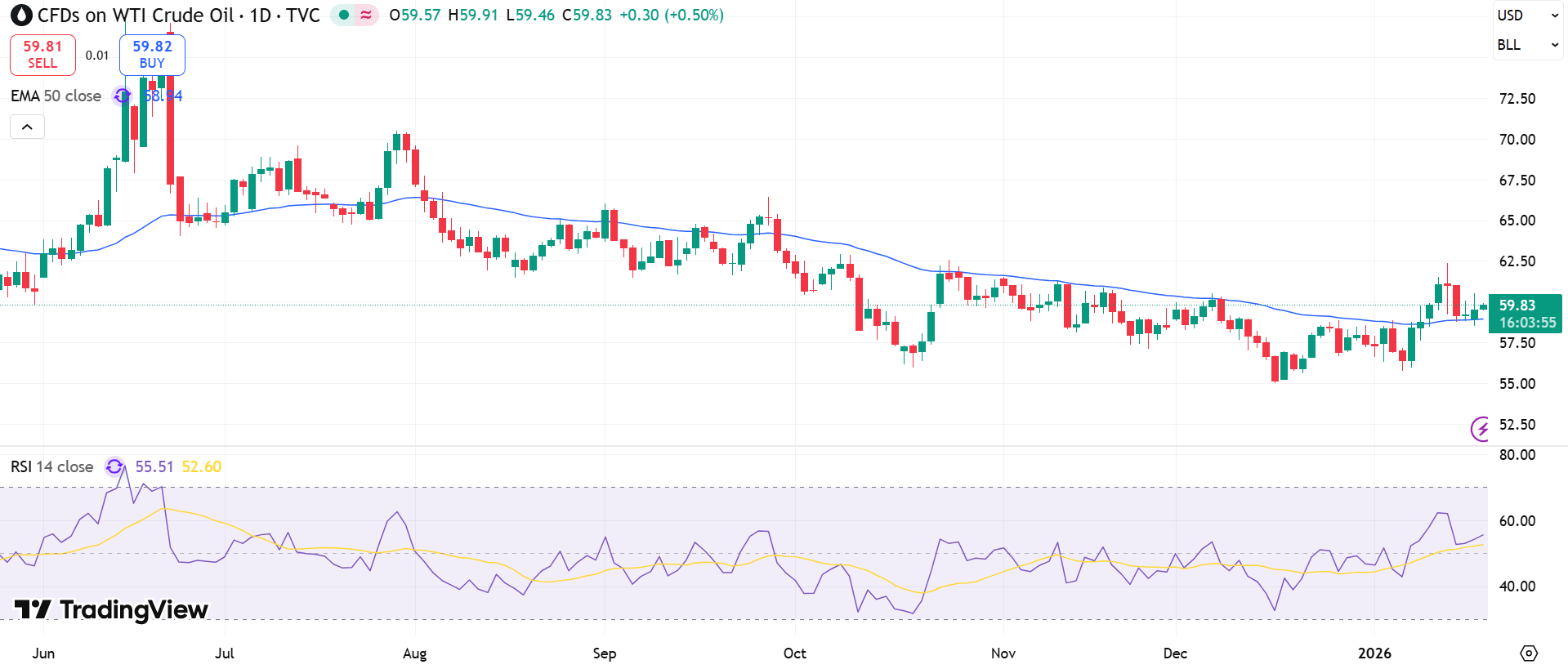
As of 01:18 GMT, Brent crude futures for March delivery slipped 1.2% to $64.16 per barrel, while U.S. West Texas Intermediate (WTI) crude fell 1% to $59.75 per barrel. The declines erased part of Tuesday’s 1.5% rally, which had been supported by stronger-than-expected Chinese economic growth data.
Market participants remain sensitive to shifts in geopolitical risk, macroeconomic signals, and supply expectations. Oil prices have struggled to sustain upward momentum this year, as concerns about slowing global demand continue to outweigh short-term supply disruptions.
Greenland Dispute Fuels Trade Uncertainty
Investor sentiment deteriorated after U.S. President Donald Trump renewed efforts to assert control over Greenland, a semi-autonomous territory under Danish sovereignty. The move has unsettled markets by raising fresh doubts over the stability of U.S.–European Union relations.
The U.S. administration has threatened 10% tariffs on imports from eight European countries, escalating fears of a broader trade conflict. European officials have responded sharply, warning against unilateral actions that could undermine economic cooperation and growth.
With Trump scheduled to address the World Economic Forum in Davos, traders remain wary that confrontational rhetoric could spill into trade policy, potentially dampening industrial activity and energy consumption across major economies.
Oil demand is particularly vulnerable to trade disruptions, as slower manufacturing output and weaker transport activity often translate into reduced fuel usage. As a result, geopolitical tensions have reinforced a risk-off mood across commodity markets.
IEA Report Expected to Signal Oversupply
Attention is now firmly focused on the IEA’s monthly oil market report, due later Wednesday, which is expected to underscore persistent oversupply risks. Analysts broadly anticipate the agency will project that global oil supply growth will exceed demand growth in 2026 and beyond, keeping downward pressure on prices.
Key factors influencing the outlook include rising non-OPEC production, cautious demand recovery in Europe, and efficiency gains in energy consumption. The IEA is also expected to release updated projections extending to 2027, offering longer-term guidance to energy markets.
Additional market drivers include:
- Kazakhstan halting output at Tengiz and Korolev oilfields due to power issues
- Reuters estimates the shutdown may last 7–10 days
- Temporary disruptions offering only limited price support
Together, these elements suggest oil markets remain structurally fragile, with prices increasingly shaped by policy decisions and long-term supply dynamics rather than short-lived shocks.

