

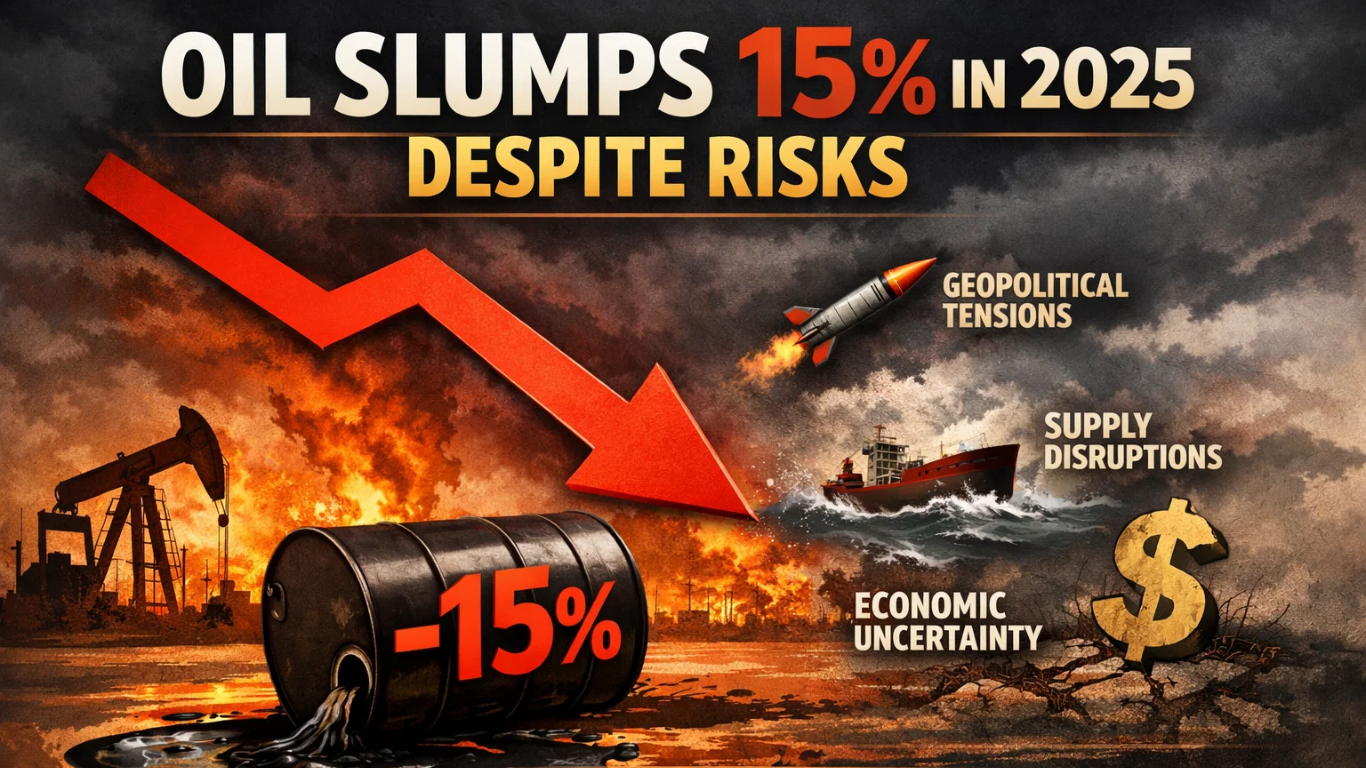
Oil prices edged slightly higher in midweek trading, yet global benchmarks remain on track for one of their weakest annual performances in years. Brent crude is poised to finish 2025 with a decline of more than 15%, marking its third consecutive yearly loss, the longest such streak on record. Futures for the March Brent contract traded near $61.44 a barrel, while U.S. West Texas Intermediate (WTI) hovered around $58.06, both posting marginal daily gains.
Despite short-term price stability, the broader trend reflects persistent oversupply. According to LSEG data, average oil prices in 2025 are the lowest since 2020, underlining how production growth has outpaced demand even amid geopolitical shocks.
BNP Paribas forecasts Brent could slide to $55 per barrel in early 2026 before stabilizing closer to $60 later in the year. Analyst Jason Ying points to U.S. shale producers as a key factor, noting that many hedged output at higher prices, making supply less sensitive to market downturns.
Geopolitics Lift Risk Premium, Not Prices
Oil markets opened 2025 with strong momentum after the outgoing U.S. administration imposed tougher sanctions on Russia, disrupting exports to major buyers such as China and India. Prices were further supported by escalating geopolitical tensions, including:
- Drone attacks damaging Russian energy infrastructure
- Disruptions to Kazakhstan’s oil exports
- A brief but intense Iran-Israel conflict threatening the Strait of Hormuz
- Ongoing instability involving Yemen and Gulf producers
These developments injected risk premiums into crude markets but failed to offset the structural supply surplus. Additional pressure came from renewed U.S. restrictions on Venezuelan oil exports and warnings of further action against Iran.
Analysts note that while geopolitics can spark short-term rallies, they have not reversed the dominant bearish trend driven by production growth and weaker demand expectations.
OPEC+ Strategy and Supply Imbalance

The OPEC+ alliance has added roughly 2.9 million barrels per day to the market since April and has agreed to pause further output hikes through the first quarter of 2026. Its next policy meeting is scheduled for January 4.
Forecasts suggest supply will continue to exceed demand next year:
- International Energy Agency: 3.84 million bpd surplus
- Goldman Sachs: around 2 million bpd surplus
Morgan Stanley strategist Martijn Rats says meaningful production cuts would likely require prices to fall into the low $50 range. If current levels persist, OPEC+ may resume unwinding cuts after the first-quarter pause.
Still, some analysts argue that geopolitical risk provides a price floor. JTD Energy’s John Driscoll describes the global environment as highly volatile, noting that political uncertainty — particularly involving U.S. leadership and Middle East tensions — could limit further downside.

