
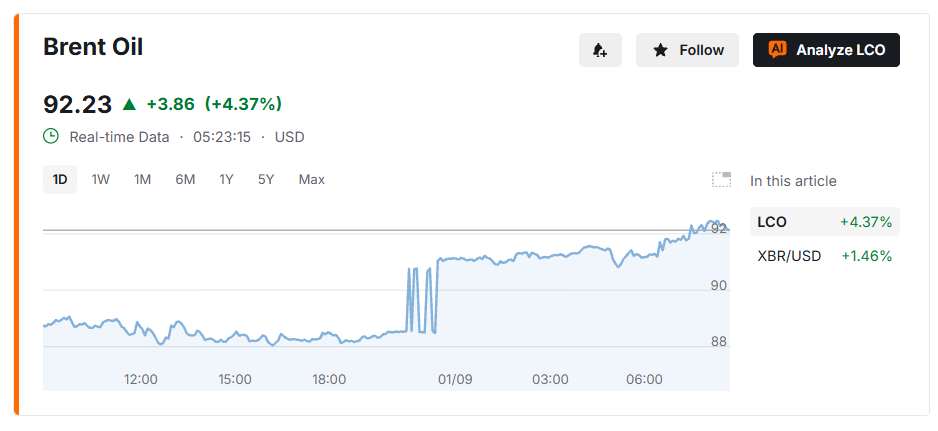
Oil prices rose Tuesday as renewed U.S.-Iran fighting revived fears of supply disruptions from the Middle East. Brent crude climbed 0.7% to $91.15 a barrel by 0640 GMT, while WTI gained 0.8% to $86.46. Both benchmarks extended Monday’s rally, when Brent closed up 2.7% and WTI settled 2.8% higher — their strongest levels in roughly a week — after the U.S. and Iran exchanged direct strikes for the first time in a month.
Trump Threatens Further Strikes on Iran
President Trump threatened additional strikes against Iran on Monday, escalating a conflict that had recently cooled into more of an economic standoff. Tim Waterer, chief market analyst at KCM Trade, said the renewed hostilities put Iranian retaliation back on the table, raising the risk of damage to Gulf energy infrastructure and fresh disruption to shipping through the Strait of Hormuz — pressure he said is now showing up directly in crude prices.
Shipping data underscores how thin traffic through the strait has become. Kpler tracked just five visible commodity vessels transiting Hormuz on Monday, well below the 10-day average of roughly 14, and none of the five were liquid tankers. Mediation efforts by Qatar and Oman to reopen the waterway — which carried about a fifth of global oil supply before Iran shut it following U.S. and Israeli strikes on February 28 — have yet to produce results.
The risk to shipping remains active: the UK Maritime Trade Operations agency reported Tuesday that a tanker leaving the strait was struck by three projectiles, though no casualties or environmental damage were reported.
Inventory Buffers Are Running Thin
Flow data adds another layer of concern. ANZ analysts noted satellite tracking shows roughly 6 million barrels per day still moving through Hormuz — well below pre-conflict volumes — while the market’s remaining cushions are wearing down:
- U.S. inventories are approaching minimum operating levels.
- China’s import restraint faces a test as seasonal demand rises.
- U.S. Strategic Petroleum Reserve stockpiles fell about 3.1 million barrels last week to 286.6 million barrels.
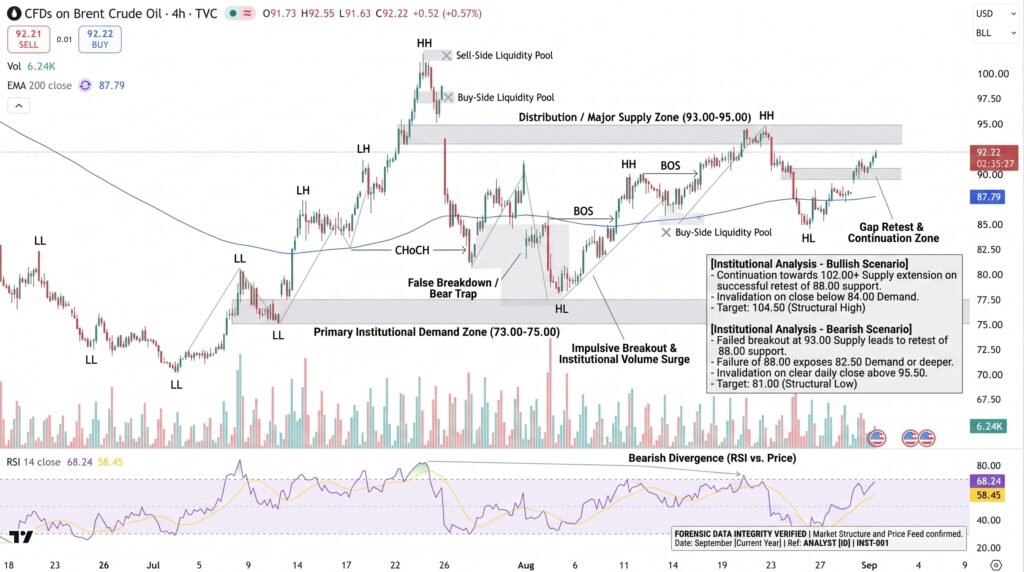
Reuters’ August survey of analysts projects oil will stay above $80 a barrel through 2026 as shipping disruptions persist, a forecast that looks increasingly conservative given Tuesday’s price action.
Conclusion
Tuesday’s gains reflect a market pricing in the real possibility that a month-long lull in U.S.-Iran hostilities has ended rather than paused. With Hormuz traffic already running below average, mediation stalled, and reserve buffers thinning on both sides of the Pacific, oil prices are likely to stay sensitive to every new incident in the strait — whether it’s a presidential threat, a tanker strike, or the next round of retaliation.
Sources & Methodology
Primary-source standard: Market-moving facts should link to original data releases, regulator notices, company filings or official project announcements whenever available. Secondary reporting is used for additional context, not as a substitute for original evidence.
Page last reviewed: