
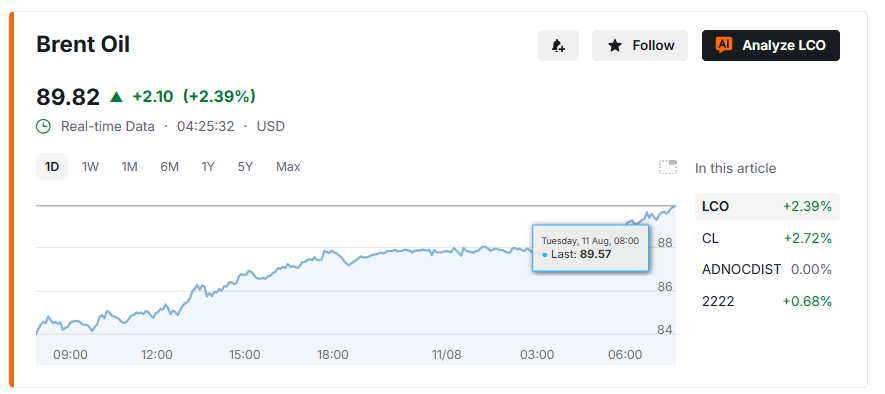
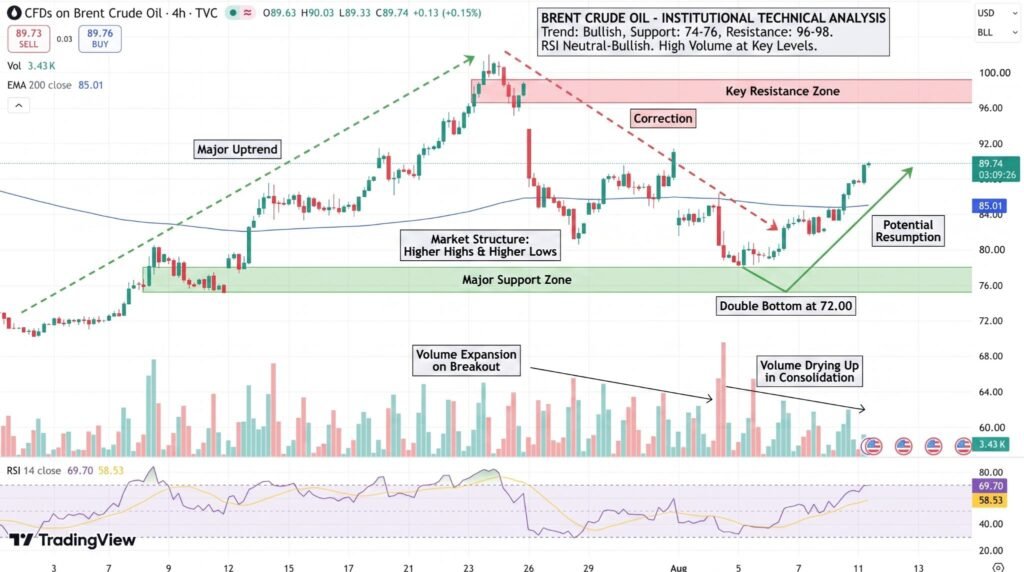
Oil prices rose more than 2% on Tuesday to their highest level in over a week, as hopes for a U.S.-Iran deal to reopen the Strait of Hormuz faded further after President Trump demanded compensation from Tehran. Brent crude futures rose $1.92, or 2.19%, to $89.64 a barrel by 08:05 GMT, while WTI crude gained $1.91, or 2.33%, to $84.04 a barrel, both benchmarks trading at their highest levels since July 31. The advance extended a rally that began Monday, when both contracts jumped roughly 5% on the same standoff.
Compensation Demands Deepen the Standoff
Monday’s surge followed Trump’s response to Iran’s conditions for a peace deal: a demand that Tehran pay compensation for people killed in wars, attacks, and protests, a condition Iran had itself raised as part of its own terms for reopening the strait. Trump told Axios the U.S. is only “semi-negotiating” with Iran and signaled Washington would allow economic pressure on Tehran to continue building. He later said the U.S. maintains control of the strait and had swept the waterway for Iranian mines, while separately acknowledging that Iran “can make trouble” in the passage.
Iranian Foreign Minister Abbas Araghchi said Sunday that Tehran is not currently engaged in direct talks with the U.S., adding that negotiations won’t resume while Washington remains in breach of an interim agreement signed in June. Iran’s Foreign Ministry has said the U.S. naval blockade must be lifted before the necessary conditions for reopening Hormuz exist, even as Iran and Oman continue separate bilateral talks on new shipping routes through the strait.
“There’s no clear path to a solution and to a full reopening of the strait at this point in time, and that’s adding renewed upside pressure on prices,” said Saxo Bank head of commodity strategy Ole Hansen, noting a meaningful level of ongoing supply disruption.
Shipping Data Confirms Constrained Flows
Vessel traffic through the Strait of Hormuz fell to six ships on Monday, compared with a 10-day average of roughly 11, according to shipping data. Barclays analysts noted that crude oil and refined product net exports through the strait averaged 3 million barrels per day in the week ending August 7, down from 4.4 million barrels per day the previous week. Before the Iran conflict began in late February, roughly one-fifth of global daily oil and liquefied natural gas supplies moved through the waterway.
Saudi Aramco has pushed back the restart of its 400,000-barrel-per-day Jazan refinery to August 30 after Houthi forces claimed two attacks on the facility on Sunday. Tim Waterer, chief market analyst at KCM Trade, said the chokepoint risk extends beyond Hormuz to the Bab el-Mandeb strait as well, noting that even intermittent restrictions or the threat of further incidents keep insurance costs elevated and force longer shipping routes, constraining energy flows in the near term.
- Vessel traffic through Hormuz: 6 ships Monday versus a 10-day average of 11
- Crude and refined product exports through the strait: 3 million bpd for the week ending August 7, down from 4.4 million bpd
Separately, Abu Dhabi National Oil Company issued its eighth spot crude tender since the start of June, part of an ongoing effort to move oil out from inside the strait as it continues seeking alternative routes to reach international buyers.
Conclusion
Tuesday’s rally shows a market pricing in a prolonged standoff rather than a near-term resolution, as compensation demands from both sides push the two governments further from common ground rather than closer to it. With shipping traffic already running below its 10-day average and Aramco’s refinery restart pushed back three weeks, the risk premium built into current prices reflects genuine physical disruption, not just diplomatic uncertainty. Barring a breakthrough on the compensation dispute specifically, oil is likely to stay elevated as long as Hormuz traffic remains constrained and the broader conflict shows no sign of a negotiated exit.
Sources & Methodology
Primary-source standard: Market-moving facts should link to original data releases, regulator notices, company filings or official project announcements whenever available. Secondary reporting is used for additional context, not as a substitute for original evidence.
Page last reviewed: