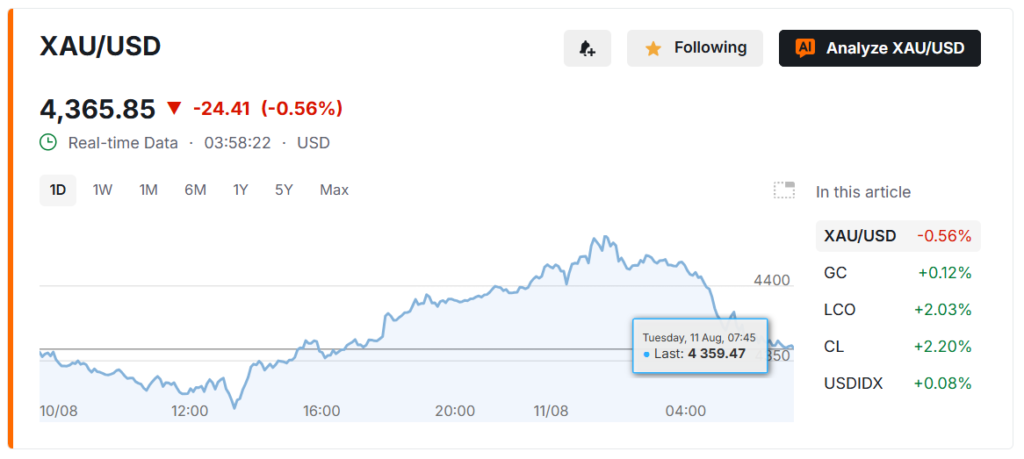
Gold extended its rally Tuesday, holding near its highest level in more than two months as renewed buying outweighed pressure from a firmer dollar, rising Treasury yields, and climbing energy prices. Spot gold rose 0.4% to $4,407.79 an ounce as of 00:56 ET, while gold futures gained 1.1% to $4,467.59. Spot silver fell 0.5% to $65.41 an ounce, and platinum edged up 0.2% to $1,761.10. The advance follows a 2.4% jump on Friday, when data showed U.S. nonfarm payrolls unexpectedly declined in July, and gold closed Monday near $4,390, its highest daily close in nearly 10 weeks.
Rally Defies Usual Headwinds
The advance has drawn attention because it has come despite a stronger dollar, higher Treasury yields, and rising energy prices, three factors that would typically weigh on non-yielding bullion. Tony Sycamore, senior market analyst at IG, attributed the resilience to a combination of fear-of-missing-out buying among investors who missed gold’s earlier slide toward $4,000, short-covering by speculative accounts, and renewed safe-haven demand.
Markets are now awaiting Wednesday’s U.S. Consumer Price Index and Thursday’s producer price index for clearer signals on the Federal Reserve’s rate path. As of early August, CME FedWatch data put the odds of a rate increase at the Fed’s September 16 meeting near 54%, alongside odds exceeding 80% for a hike by December, though these probabilities have shifted with each fresh data release since Friday’s jobs report. Gold typically loses some of its appeal when interest rates rise because it generates no yield of its own.
China Deepens Its Gold Buying Streak
Central bank demand has added a structural layer of support. The People’s Bank of China added roughly 20 tonnes of gold to its reserves in July, its largest monthly purchase since October 2023, extending its buying streak to 21 consecutive months. The addition lifted China’s official reserves to about 76.08 million ounces, worth over $306 billion at current prices, and brought year-to-date net additions to roughly 60 tonnes. The pace of PBOC purchases has accelerated each month since March, reinforcing a broader pattern of central bank accumulation that has underpinned gold demand even during periods of falling prices.
Geopolitical uncertainty around the Strait of Hormuz has added a separate layer of support. Iran has said it is nearing a final shipping-lane agreement with Oman, though Tehran maintains the U.S. must meet additional conditions before the strait fully reopens. That standoff has pushed oil prices higher again, complicating the inflation outlook and limiting the Fed’s room to ease policy even as labor-market data points toward a softer path.
Conclusion
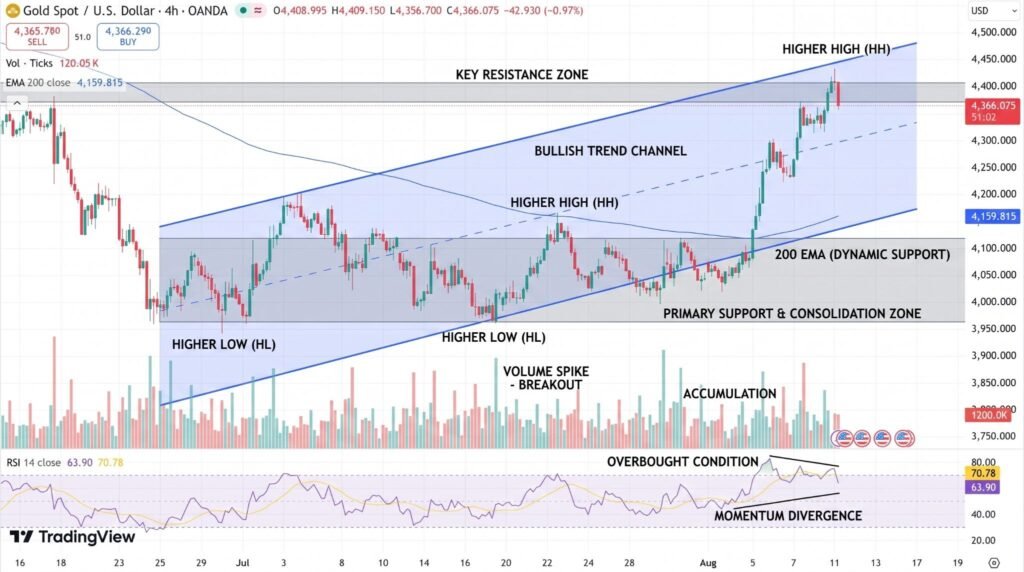
Gold’s advance past the $4,400 level reflects the convergence of three distinct forces: a labor market weak enough to unsettle rate expectations, a geopolitical standoff keeping energy prices elevated, and a central bank buyer in China showing no sign of slowing its accumulation regardless of price. Sycamore said the rebound from June’s low near $3,942 has put gold on course to test resistance around $4,460 to $4,500, a zone reinforced by the 200-day moving average near $4,495. A sustained break above that range, he said, could open the path toward $5,000, though Wednesday’s inflation data will likely determine whether that test comes this week or gets pushed further out.
Sources & Methodology
Primary-source standard: Market-moving facts should link to original data releases, regulator notices, company filings or official project announcements whenever available. Secondary reporting is used for additional context, not as a substitute for original evidence.
Page last reviewed: