
Pi Network (PI) rose nearly 2% on Friday, stabilizing around $0.0819 after losing approximately 13% over the previous seven days. The modest recovery comes as the Pi Core Team explores integrating Open Standard’s OUSD stablecoin into the ecosystem to expand potential payment and financial applications. The initiative could introduce additional utility while preserving PI’s role as the network’s native token. However, the technical picture remains weak: PI trades below its major moving averages, and a break beneath the $0.0800 support area could expose the token to further losses.
OUSD Integration Could Expand Pi Utility
According to the supplied report, the Pi Core Team outlined plans to explore OUSD, a stablecoin designed to maintain a value pegged to the US dollar. The initiative could support user rewards and broaden financial applications across the Pi ecosystem.
Stablecoins are cryptocurrencies designed to track the value of an underlying asset, commonly a fiat currency such as the US dollar. Their relatively stable pricing can make them useful for payments and transactions where users want to reduce exposure to the volatility associated with conventional cryptocurrencies.
For Pi Network, potential integration could create additional economic activity without replacing PI as the ecosystem’s native token. The team would still need to establish appropriate integration principles, utility requirements and compliance safeguards before broader adoption.
The proposal does not establish that OUSD has already been fully integrated or that demand for PI will automatically increase. Its eventual impact will depend on implementation, user adoption and the practical applications that become available.
PI Price Analysis: $0.080 Support at Risk
PI traded near $0.0819 on Friday, remaining below its 50-day, 100-day and 200-day exponential moving averages (EMAs) at $0.0898, $0.0981 and $0.1240, respectively. This positioning suggests sellers retain control of the broader trend despite the latest rebound.
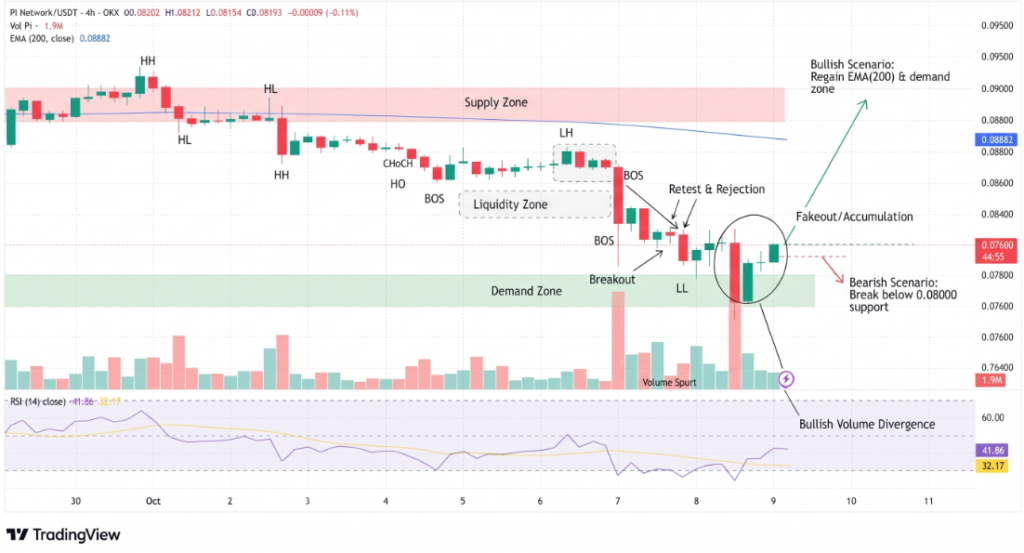
The immediate support level is around $0.0801, corresponding to the July 31 low. A confirmed daily close below this threshold could expose the August swing low near $0.0704. A break beneath that level would leave PI searching for a new price floor.
Momentum indicators also reflect persistent weakness. The Relative Strength Index (RSI) stands near 38, indicating subdued buying momentum without reaching the conventional oversold threshold of 30. Meanwhile, the Moving Average Convergence Divergence (MACD) remains below zero and its signal line, with a negative histogram indicating continued bearish pressure.
Key levels to watch include:
- $0.0801: Immediate support and downside trigger.
- $0.0704: Previous swing low and potential support.
- $0.0866: 23.6% Fibonacci retracement resistance.
- $0.0898–$0.0981: Resistance range defined by the 50-day and 100-day EMAs.
- $0.1049 and $0.1240: Higher recovery hurdles.
A sustained move above $0.0866 and $0.0898 would provide an initial sign of improving momentum, although the broader trend would remain challenged below the higher moving averages.
Conclusion
Pi Network’s proposed OUSD integration offers a potential route to broader ecosystem utility, but the announcement has yet to establish a measurable increase in PI demand. For now, price action remains the immediate concern. Holding $0.0801 could allow the token to consolidate, while a confirmed breakdown may expose $0.0704. A recovery above $0.0898 would help ease near-term selling pressure. Investors will need to assess both the stablecoin proposal’s implementation progress and PI’s ability to reclaim key technical levels.
Sources & Methodology
Primary-source standard: Market-moving facts should link to original data releases, regulator notices, company filings or official project announcements whenever available. Secondary reporting is used for additional context, not as a substitute for original evidence.
Page last reviewed: