Tencent shares slid 1.79% to HK$438.40 as investors weighed record RMB52.8 billion CapEx, negative free cash flow of RMB13.8 billion and Mizuho’s target cut to HK$560 after solid but AI-heavy Q2 2026 results (revenue +11% to RMB204.8 billion).
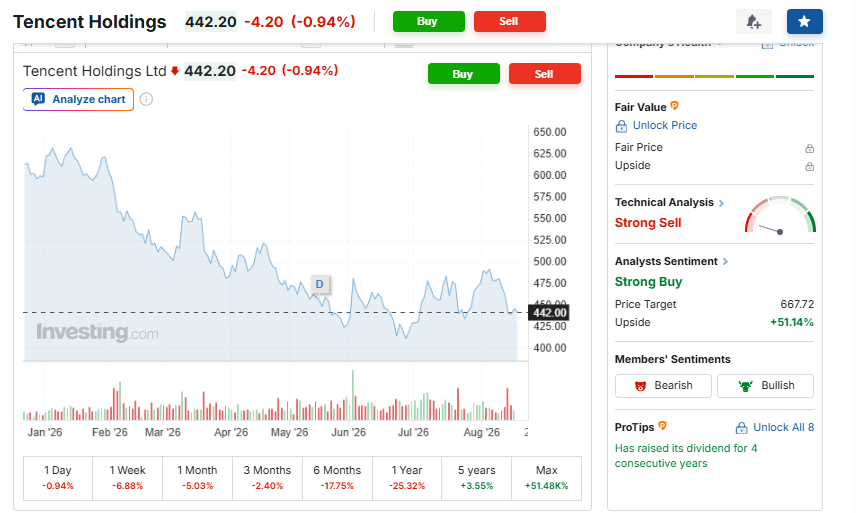
Tencent Holdings (0700.HK) shares fell 1.79% to HK$438.40 during Tuesday’s Hong Kong session, extending post-earnings pressure since the company’s second-quarter 2026 results released on August 12. Revenue rose 11% year-on-year to RMB204.8 billion and modestly beat estimates, but investors focused on record capital expenditure of RMB52.8 billion (up 176% YoY), which drove free cash flow negative at RMB13.8 billion, and the unclear timeline for returns on accelerating AI investments.
Tencent Q2 Revenue Rises 11% to RMB204.8bn as CapEx Hits RMB52.8bn and FCF Turns Negative
Tencent reported total revenue of RMB204.8 billion for the quarter ended June 30, 2026, up 11% from RMB184.5 billion a year earlier and ahead of consensus estimates around RMB202–203 billion. Gross profit rose 13% to RMB118.4 billion. Non-IFRS operating profit increased 9% to RMB75.6 billion (margin 37%, down from 38%), while excluding new AI products (primarily Hy, Yuanbao, CodeBuddy, WorkBuddy and Xiaowei) it climbed 19% to RMB86.1 billion with margin expanding to 42%. IFRS profit attributable to equity holders was RMB56.0 billion, up just 0.7%.
Marketing services (advertising) revenue surged 22% to RMB43.6 billion. Value-added services rose 8% to RMB98.4 billion, with domestic games up 17% to RMB47.3 billion (helped by titles including Honor of Kings and Delta Force) but international games down 0.8% to RMB18.6 billion—the first year-on-year decline since early 2022. FinTech and business services grew 9% to RMB60.3 billion; cloud growth accelerated.
Capital expenditure hit a record RMB52.8 billion (operating CapEx RMB51.8 billion, up 190% YoY and 66% QoQ), focused on AI infrastructure for model upgrades (including Hy3), inference for WorkBuddy and CodeBuddy, WeChat AI initiatives, and external cloud demand. This pushed free cash flow to negative RMB13.8 billion (operating cash flow RMB52.7 billion offset by CapEx payments of RMB59.3 billion plus other items). Excluding AI-related compute prepayments, FCF would have been positive RMB37.6 billion. Net cash fell 22% YoY to RMB58.2 billion; total cash stood at RMB511.2 billion.
Mizuho cut its price target to HK$560 from HK$610 while maintaining a Neutral rating. The brokerage left fiscal 2026 and 2027 earnings estimates largely unchanged but reduced valuation multiples to 11x 2027 EBITDA (from 12x) and 16x 2027 earnings (from 17.5x), citing compressed AI-sector valuations and a less clear path to stronger returns despite resilient core franchises. It highlighted advertising strength, faster cloud growth and solid progress with in-house models (Hy3 ranking among the top three globally on OpenRouter by token usage), but noted Tencent is not a leader in coding assistants or AI-native video—categories with clearer subscription monetization—and flagged the international gaming decline.
Tencent Shares Under Pressure as Investors Question AI Returns Amid Record CapEx and Negative Free Cash Flow
Investors have shifted focus from whether Tencent is investing enough in AI to whether the heavy spending can generate adequate returns in a reasonable timeframe. The combination of record CapEx, negative free cash flow and a lower valuation framework from Mizuho (rather than an earnings downgrade) reinforced concerns about cash generation and return on AI investment. Hong Kong technology stocks remained under pressure amid a broader risk-off tone in global technology shares, adding to selling in Chinese internet names. Shares had already dropped sharply in the days after the August 12 results (including a 4.46% decline on August 13), and the latest session extended that post-earnings weakness. Market capitalization stood near HK$3.95 trillion.
Tencent Accelerates AI Push as Shares Trade in HK$411–683 Range with Negative YTD Performance
Tencent is accelerating investment across intelligence (models such as Hy/Hunyuan), applications (WorkBuddy, CodeBuddy, Yuanbao, Xiaowei and WeChat AI features) and infrastructure to build an “AI-empowered” company. Management has described the CapEx as strategic, noting downside protection because excess capacity can be monetized via Tencent Cloud or rented externally, and has indicated spending intensity is not expected to remain this elevated every year. Core franchises (WeChat, domestic games, advertising) remain resilient and are already benefiting from AI enhancements, providing financial support for the new initiatives. However, the scale and timing of monetization—particularly outside advertising and cloud—remain key uncertainties for a market that has grown more sophisticated in assessing AI returns. The stock’s 52-week range is roughly HK$411–683, and year-to-date performance has been negative.
Investors Eye Q3 CapEx, AI Monetization and Path to Positive Free Cash Flow for Tencent
Investors will watch Q3 CapEx levels, evidence of AI monetization (especially subscription revenue from tools and video, plus further advertising/cloud gains), progress on Hunyuan model upgrades, and any clarification on the path to positive free cash flow and higher returns. Broader sentiment toward Hong Kong and Chinese technology stocks, plus global AI valuation trends, will also influence the shares. Consensus targets still imply meaningful upside from current levels, though some brokers have trimmed multiples or targets in response to the investment cycle.
Sources & Methodology
Primary-source standard: Market-moving facts should link to original data releases, regulator notices, company filings or official project announcements whenever available. Secondary reporting is used for additional context, not as a substitute for original evidence.
Page last reviewed: