
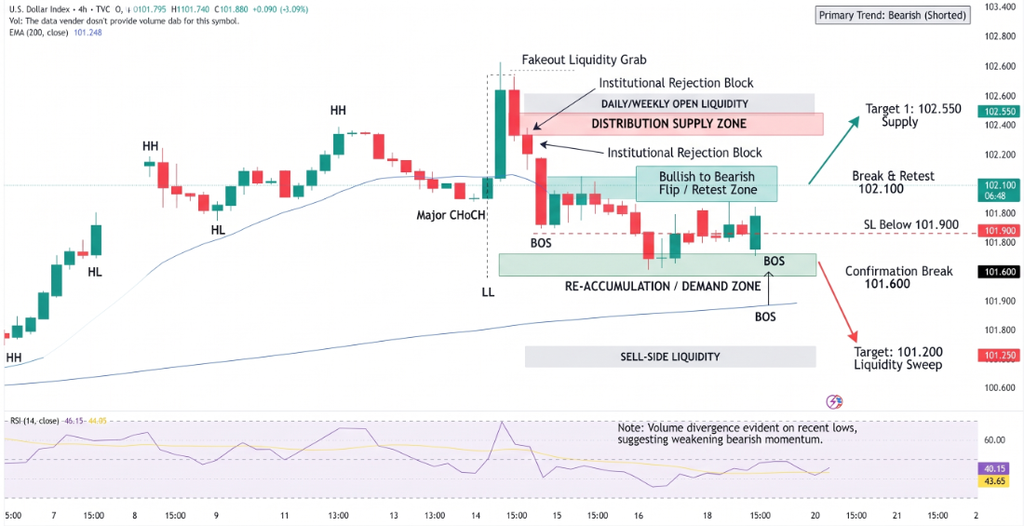
The US Dollar Index (DXY) is losing momentum after trading near 101.80 during European hours, with investors weighing technical support against uncertainty over Federal Reserve policy. The index, which measures the dollar against six major currencies, is testing the lower boundary of an ascending channel near 101.70. Holding this trendline could preserve the short-term recovery, but a decisive break would expose lower support levels. Meanwhile, Federal Reserve Chair Kevin Warsh’s cautious, data-dependent comments have limited the dollar’s ability to extend its recent gains.
DXY Tests Critical Channel Support
The dollar index remains above its 50-day Exponential Moving Average (EMA) at 100.94, suggesting that the broader recovery has not yet been invalidated. However, the nine-day EMA at 101.98 is acting as immediate resistance, keeping buyers from establishing stronger upward momentum.
The 14-day Relative Strength Index (RSI) stands near 55. This indicates moderately positive momentum without signaling overbought conditions. The next move will depend partly on whether buyers can push the index above its short-term moving average or sellers can force a break below channel support.
The main technical levels are:
- Immediate support: 101.70, near the ascending channel’s lower boundary.
- Secondary support: 100.94, at the 50-day EMA.
- Initial resistance: 101.98, at the nine-day EMA.
- Major resistance: 102.94, the reported October 14 high.
- Extended upside target: 103.90, near the channel’s upper boundary.
A sustained move above 101.98 would strengthen the recovery case and bring 102.94 into focus. A confirmed break below 101.70, by contrast, could shift attention toward 100.94 and potentially the August 20 low of 98.56.
Warsh Keeps Fed Policy Data-Dependent
Federal Reserve Chair Kevin Warsh has emphasized price stability, structural investment growth and the economic implications of artificial intelligence while avoiding firm commitments on upcoming interest-rate decisions. His remarks leave markets dependent on incoming inflation, employment and growth data rather than a clearly signaled policy path. Recent coverage of Warsh’s comments noted that the dollar faced renewed pressure after he declined to prejudge future meetings.
The FXS Fed Sentiment Index remained unchanged at 127.51, while the FXS Speechtracker scored Warsh’s remarks at 5.6 out of 10, below its historical average of 6.1. These readings suggest that the underlying policy tone remains relatively hawkish, but the latest speech provided limited additional support for the dollar.
Restrictive monetary policy can support the dollar by making US assets more attractive to international investors. However, expectations matter: if traders anticipate fewer rate increases than previously expected, the currency can weaken even when policymakers continue emphasizing inflation control.
DXY Outlook: Rebound or Breakdown?
The dollar’s next directional signal will likely come from the interaction between price action and Federal Reserve expectations. A break above 101.98 would improve the near-term outlook, while a sustained move toward 102.94 could confirm renewed buying interest. Failure at 101.70 would instead expose the 50-day EMA at 100.94, with 98.56 representing a deeper downside reference.
Conclusion
DXY remains at a technical crossroads. The ascending channel offers a potential foundation for recovery, but resistance near 101.98 and uncertainty over Fed policy are limiting gains. Traders should watch confirmed breaks of support and resistance alongside incoming US economic data rather than treating either scenario as certain.
Sources & Methodology
Primary-source standard: Market-moving facts should link to original data releases, regulator notices, company filings or official project announcements whenever available. Secondary reporting is used for additional context, not as a substitute for original evidence.
Page last reviewed: