
The US Dollar Index (DXY) hovered near 101.70 on Thursday as declining Treasury yields offset expectations of another Federal Reserve interest-rate increase later this year. The index remained above a nearly three-week low reached on Tuesday, reflecting competing pressures from monetary policy expectations and geopolitical uncertainty. Investors expect the Fed to keep rates unchanged at its October 27–28 meeting, while persistent inflation risks linked to volatile oil prices have strengthened bets on a December hike. Upcoming US inflation and economic growth figures could determine the dollar’s next direction.
Treasury Yields Limit Dollar Gains
US Treasury yields have retreated from recent multiyear highs, reducing the dollar’s relative appeal to investors seeking higher returns. Bond yields and prices generally move in opposite directions, while lower yields can weaken demand for dollar-denominated assets when other factors remain unchanged.
Markets increasingly anticipate that the Federal Reserve will leave its benchmark interest rate unchanged next week. However, traders are still pricing in approximately a 90% probability of a rate increase in December, according to the supplied market figures.
Higher interest rates typically support a currency by increasing the potential return on deposits and other assets denominated in that currency. The prospect of tighter policy therefore continues to provide some support for the dollar, limiting its recent decline.
Geopolitical risks are also influencing investor positioning. Iranian Foreign Minister Abbas Araghchi said Tehran would consider renewed diplomacy if Washington demonstrated a genuine commitment to resolving the conflict. Meanwhile, The New York Times reported plans for possible additional US-Israeli strikes against Iran following the US midterm elections.
These developments could sustain demand for the dollar as a perceived safe-haven asset, even as lower Treasury yields weigh on its momentum.
Fed Decision and US Data in Focus
Investors are preparing for the Federal Open Market Committee’s October 27–28 meeting. The decision will be important, but guidance about future policy may have a greater influence on currency markets if policymakers leave rates unchanged.
Attention will then turn to two major US economic releases scheduled for October 29: September’s Personal Consumption Expenditures (PCE) Price Index and the advance estimate of third-quarter gross domestic product (GDP). The Bureau of Economic Analysis confirms both releases are scheduled for 8:30 a.m. Eastern Time.
The PCE index measures changes in prices paid for consumer goods and services and is a key inflation gauge used by the Fed. GDP measures the value of goods and services produced across the economy.
Traders will watch for:
- Inflation: Stronger-than-expected PCE figures could reinforce rate-hike expectations.
- Economic growth: Resilient GDP could give policymakers more room to maintain restrictive policy.
- Fed guidance: A more hawkish outlook could support the dollar, while a cautious tone could pressure it.
DXY Technical Levels and Outlook
On the four-hour chart, the near-term technical picture remains cautiously positive while the index holds above its 200-period Simple Moving Average (SMA). However, the recovery faces resistance at the 23.6% Fibonacci retracement near 101.92.
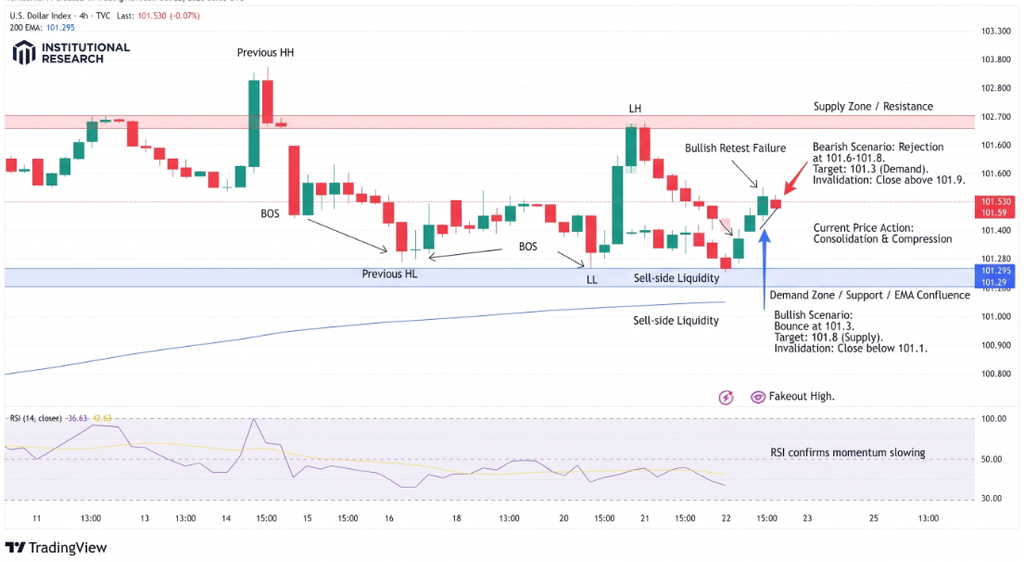
A sustained move above 101.92 could strengthen the recovery and open the way toward higher retracement levels. On the downside, initial support lies around the 38.2% retracement at 101.28, followed by the 200-period SMA near 101.00. A break below the moving average would weaken the bullish technical outlook.
Conclusion
The DXY remains caught between falling Treasury yields and expectations of tighter Federal Reserve policy in December. Geopolitical tensions are providing additional support, but the next decisive move may depend on the Fed’s guidance and Thursday’s PCE inflation and GDP releases. A break above 101.92 would improve the short-term technical outlook, while a decline below 101.00 would increase downside risks.
Sources & Methodology
Primary-source standard: Market-moving facts should link to original data releases, regulator notices, company filings or official project announcements whenever available. Secondary reporting is used for additional context, not as a substitute for original evidence.
Page last reviewed: