
The US Dollar Index (DXY) edged higher on Wednesday, October 21, recovering from a nearly three-week low but struggling to establish strong bullish momentum near 101.75–101.80. Uncertainty surrounding U.S.-Iran negotiations, elevated oil prices and expectations for further Federal Reserve tightening are supporting the dollar. However, technical indicators remain mixed, leaving traders cautious ahead of the Fed’s October 27–28 policy meeting. A sustained break above the 23.6% Fibonacci retracement at 101.90 could signal renewed strength, while a decline below 101.25 would expose deeper support levels.
Iran Tensions and Fed Expectations Support DXY
The dollar is benefiting from geopolitical uncertainty as investors assess whether diplomatic efforts can ease tensions between Washington and Tehran. Pakistan and Qatar remain involved in mediation efforts, but reports of progress have been countered by continued disagreements over the terms of a potential settlement. The uncertainty is particularly important for energy markets because disruptions around the Strait of Hormuz threaten a major route for global oil shipments.
Higher oil prices are adding to concerns about persistent inflation, potentially strengthening expectations that the Federal Reserve will maintain a restrictive monetary policy. Interest-rate expectations matter for the dollar because higher U.S. yields can make dollar-denominated assets more attractive relative to those in other economies.
Recent market reporting indicates that traders continue to anticipate a possible December rate increase, although expectations for the October decision remain more divided. A Vantage Markets analysis published Wednesday cited an approximately 94% probability of a December hike, while other market reports have shown different estimates as expectations shift. These figures represent futures-implied probabilities, not confirmed Fed decisions.
DXY Technical Analysis: 101.90 in Focus
The four-hour technical outlook is neutral to slightly bullish. DXY remains above its 200-period exponential moving average (EMA), but momentum indicators suggest buyers have yet to establish firm control.
The Relative Strength Index (RSI) stands at 44.57, below the neutral 50 threshold, indicating that bearish momentum has not fully disappeared. Meanwhile, the MACD indicator is hovering around zero, with a largely flat histogram reflecting limited directional strength.
The first major test is 101.90, the 23.6% Fibonacci retracement of the recent corrective decline. A sustained move above this level would strengthen the recovery case and bring the previous cycle high at 102.92 into view.
Important levels to monitor include:
- 101.90: Initial resistance and bullish confirmation threshold.
- 102.92: Previous cycle high and potential upside target.
- 101.25: Support near the 38.2% retracement and 200-period EMA.
- 100.76: The 50% retracement and next downside reference.
- 100.25: The 61.8% retracement level.
- 99.52 and 98.59: Deeper support levels if selling accelerates.
US Dollar Index Forecast: Key Risks Ahead
A decisive break above 101.90 could encourage additional buying and shift attention toward 102.92. However, failure to clear resistance may leave DXY trapped in a consolidation range, particularly if diplomatic developments reduce demand for safe-haven assets or U.S. rate expectations weaken.
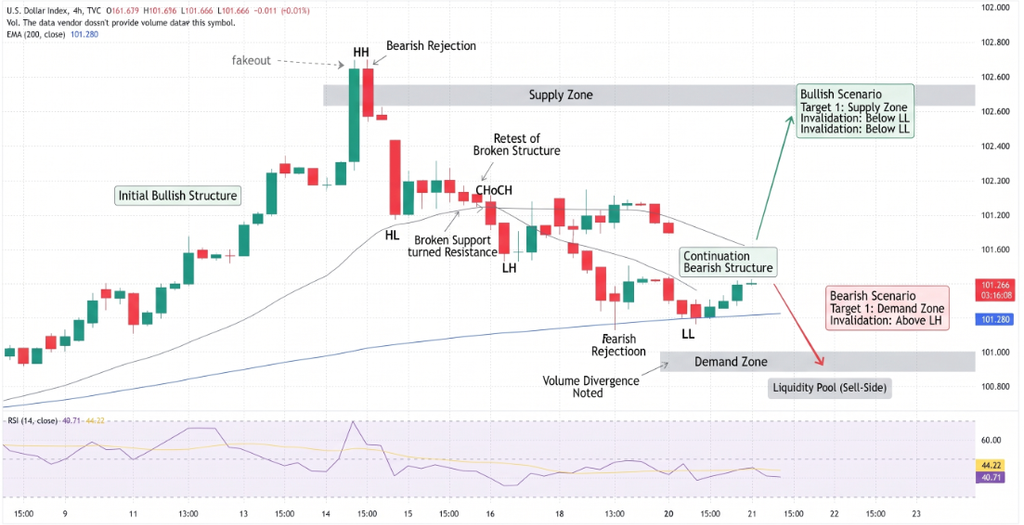
On the downside, a move below 101.25 would undermine the near-term recovery and expose 100.76, followed by 100.25. Further weakness could bring 99.52 into focus, with 98.59 marking a deeper reference point.
Conclusion
DXY’s recovery near 101.75 remains fragile despite geopolitical support and expectations of tighter monetary policy. A confirmed break above 101.90 would strengthen the bullish case toward 102.92, while a decline below 101.25 would favor renewed selling. The Fed’s policy decision and developments in U.S.-Iran negotiations remain important catalysts for the next directional move.
Sources & Methodology
Primary-source standard: Market-moving facts should link to original data releases, regulator notices, company filings or official project announcements whenever available. Secondary reporting is used for additional context, not as a substitute for original evidence.
Page last reviewed: