
The Australian Dollar advanced against the US Dollar on Wednesday, rising 0.26% to around 0.7015 in early European trading as renewed inflation concerns strengthened expectations that the Reserve Bank of Australia (RBA) could keep monetary policy restrictive. RBA Deputy Governor Andrew Hauser warned that Australia’s inflation outlook had deteriorated from previous forecasts. Meanwhile, cautious trading in the US Dollar ahead of the Federal Reserve’s upcoming policy decision provided additional support for the currency pair. Technically, AUD/USD is holding above a key moving average, although resistance near 0.7020 could determine whether the latest advance develops into a sustained bullish reversal.
RBA Inflation Warning Supports the Aussie
Hauser’s remarks put Australian inflation back at the center of currency-market attention. Speaking at a Sydney investment conference, the deputy governor said the inflation outlook looked materially worse than the RBA had projected in August. Higher oil prices, persistent domestic price pressures and strong investment linked to artificial intelligence are among the factors complicating the central bank’s efforts to bring inflation under control.
The RBA faces a difficult balance: higher interest rates could help contain inflation but also weigh on household spending, employment and economic growth. Hauser acknowledged that monetary tightening was slowing activity, while inflation risks had nevertheless increased. His comments do not guarantee another rate hike, but they leave the door open to further action if incoming data remain unfavourable.
The US Dollar, meanwhile, is trading cautiously as investors await the Federal Reserve’s next decision. Markets broadly expect the Fed to maintain its policy rate in the 3.75%-4.00% range, according to the supplied market outlook. A steady policy decision could limit immediate support for the Greenback, although the direction of US Treasury yields and the Fed’s assessment of inflation will remain important for AUD/USD.
AUD/USD Forecast: Key Levels to Watch
The daily chart suggests that the pair’s short-term bias is improving, but the technical picture does not yet confirm a decisive reversal. AUD/USD trades near 0.7014, just above its 20-period exponential moving average (EMA) at 0.6995. This average tracks recent price behaviour and can act as dynamic support during an advance.
The 14-day Relative Strength Index (RSI) stands at 50.96, close to the neutral 50 threshold. That reading indicates balanced momentum rather than strong buying pressure, leaving room for further gains if resistance breaks.
Key technical levels include:
- 0.7020: Immediate resistance at a descending trend line.
- 0.6995: Initial support at the 20-period EMA.
- 0.6904–0.6903: A broader support zone formed by two rising trend lines.
- 0.7138: Higher descending trend-line resistance if bullish momentum strengthens.
A sustained move above 0.7020 would improve the case for a bullish reversal, although the higher resistance line near 0.7138 remains a more substantial obstacle. Conversely, a drop below 0.6995 would weaken the immediate outlook and expose the lower trend-line support zone.
Fed Policy and Inflation Data in Focus
The next move will depend on whether Australian inflation concerns continue to support the Aussie and whether US data shift expectations for Federal Reserve monetary policy. Investors will also watch upcoming Australian inflation releases for evidence that price pressures are becoming more persistent.
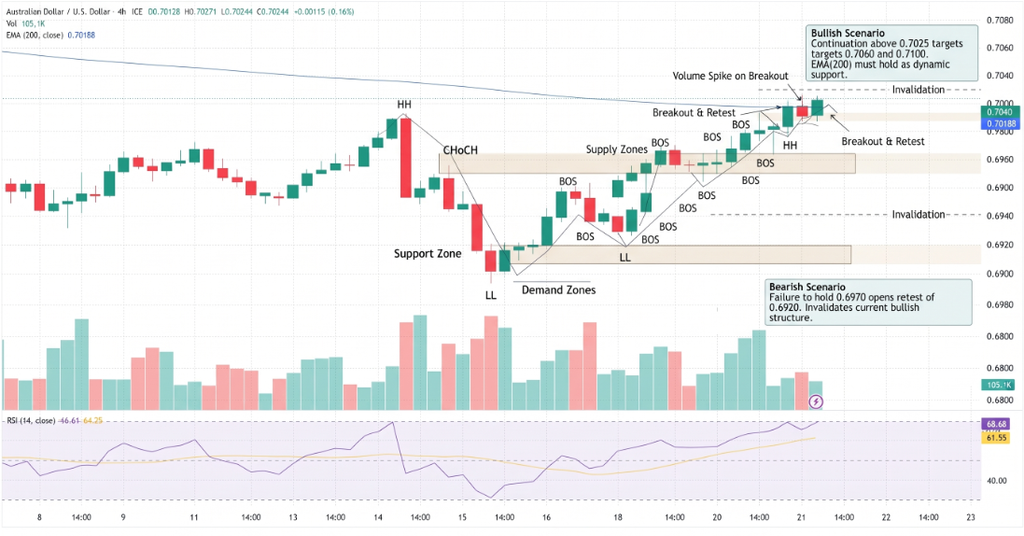
For now, AUD/USD has a constructive short-term setup, but momentum remains moderate. A confirmed break above 0.7020 would strengthen the bullish case, while a fall beneath 0.6995 would put the recovery at risk.
Conclusion
AUD/USD has climbed to around 0.7015 as the RBA’s worsening inflation outlook supports expectations of a cautious policy stance. The pair remains above its 20-period EMA, but the RSI is neutral and resistance near 0.7020 has yet to give way. Traders will look for a decisive breakout and fresh inflation evidence before treating the move as a confirmed bullish reversal.
Sources & Methodology
Primary-source standard: Market-moving facts should link to original data releases, regulator notices, company filings or official project announcements whenever available. Secondary reporting is used for additional context, not as a substitute for original evidence.
Page last reviewed: