
The EUR/USD currency pair traded near 1.1225 on Wednesday as French political unrest and fiscal concerns pressured the euro against the U.S. dollar. The pair remained below key moving averages, reinforcing its bearish short-term technical outlook. Investors also awaited comments from European Central Bank (ECB) officials for clues about monetary policy, while Federal Reserve Chair Kevin Warsh’s cautious approach to future rate decisions kept the dollar outlook dependent on incoming economic data.
French Turmoil Pressures the Euro
France’s political instability has become a significant concern for euro traders. Authorities are preparing additional security measures ahead of planned weekend protests after violence exposed weaknesses in the government’s response. Prime Minister Sébastien Lecornu has also indicated that curfews could be introduced where necessary.
The unrest adds to existing concerns about France’s public finances and political outlook. Tommy von Brömsen, an FX strategist at Handelsbanken, said the country’s problems could continue to weigh on the euro. Persistent uncertainty may make investors more cautious about holding European assets.
The European Central Bank is another focus for currency markets. Traders are monitoring speeches from President Christine Lagarde, Philip Lane, Joachim Nagel and Piero Cipollone for guidance on inflation and interest rates.
The dollar, meanwhile, is being shaped by expectations for U.S. monetary policy. Warsh declined to commit to a specific path for interest rates during the IMF’s annual meetings, emphasizing that he does not prejudge future policy decisions. A cautious Fed stance leaves traders focused on inflation, growth and employment data.
EUR/USD Forecast: Key Levels to Watch
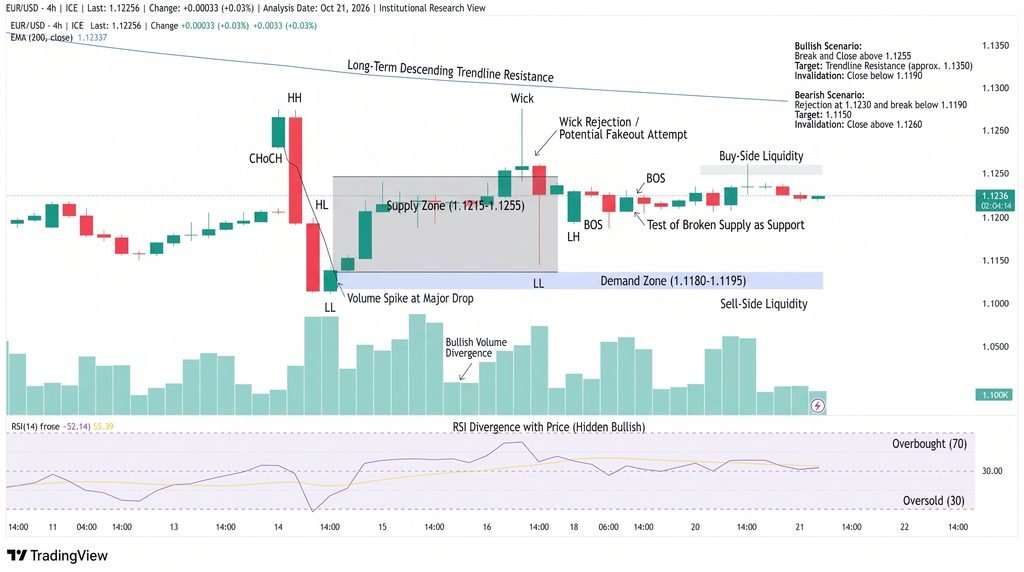
United Overseas Bank (UOB) expects EUR/USD to remain range-bound in the near term, with its broader trading range set between 1.1160 and 1.1280. That outlook suggests consolidation may continue unless economic or political developments trigger a sustained breakout.
The daily chart remains bearish, with the pair trading below the 20-day Bollinger moving average and the 100-day simple moving average (SMA). The 14-day Relative Strength Index (RSI) stands at 39.6, indicating negative momentum without reaching the conventional oversold threshold of 30.
Key technical levels include:
- 1.1185: Initial support, corresponding to the October 19 low.
- 1.1115: Lower Bollinger Band support.
- 1.1000: Psychological support if selling accelerates.
- 1.0951: May 12, 2025, low and a deeper downside reference.
- 1.1252: Initial resistance near the 20-day Bollinger average.
- 1.1390–1.1460: Upper Bollinger Band and 100-day SMA resistance zone.
A sustained break below 1.1185 could expose the pair to further losses. Conversely, a recovery above 1.1252 would ease immediate selling pressure, although stronger confirmation would be needed to challenge higher resistance.
Fed and ECB Policy Set the Direction
Interest-rate expectations remain central to the euro-dollar outlook. If U.S. inflation stays persistent, markets could anticipate tighter Fed policy, supporting the dollar. Conversely, weaker U.S. data or a more cautious policy outlook could provide relief for EUR/USD.
The euro also needs a clearer domestic outlook. Continued French unrest or worsening fiscal concerns could limit demand, while reassuring ECB comments might help stabilize the currency.
Conclusion
EUR/USD remains under pressure near 1.1225 as French political risks combine with a bearish technical setup. The 1.1185 support level and 1.1252 resistance are the immediate thresholds to watch. A break in either direction could determine the next move, while ECB commentary, Fed expectations and developments in France remain critical drivers.
Sources & Methodology
Primary-source standard: Market-moving facts should link to original data releases, regulator notices, company filings or official project announcements whenever available. Secondary reporting is used for additional context, not as a substitute for original evidence.
Page last reviewed: