
The US Dollar weakened on Friday as investors questioned whether Washington can deliver credible fiscal consolidation while the Treasury attempts to contain pressure in the bond market. MUFG strategist Derek Halpenny sees limited scope for a sustained Dollar rebound, particularly as stronger Japanese inflation reinforces expectations for another 25-basis-point Bank of Japan rate increase in September. At the same time, geopolitical risks in the Middle East continue to support demand for the Dollar as a defensive currency, limiting how far pairs such as EUR/USD can advance in the short term.
Fiscal Concerns Weigh on Dollar
MUFG’s latest US Dollar outlook focuses heavily on the worsening U.S. fiscal position and the Treasury’s attempts to reduce stress in long-term government debt markets. Treasury Secretary Scott Bessent has signaled a stronger focus on fiscal consolidation after the government expanded its long-dated bond-buyback program. The Treasury recently increased the size of certain operations from $2 billion to at least $4 billion per buyback in an effort to improve liquidity and reduce pressure on longer-term borrowing costs. Markets remain unconvinced that those steps address the underlying fiscal problem.
The U.S. budget deficit remains above 6% of GDP, annual federal interest expenses are around $1.2 trillion, and total government debt has exceeded $40 trillion, according to Reuters. Those numbers explain why investors are demanding more evidence of lasting spending restraint rather than relying solely on debt-management measures.
The initial bond-market reaction has also faded. After Treasury’s intervention helped push the 30-year Treasury yield lower, it recovered toward 5.25%, indicating that investors remain concerned about government borrowing, inflation and debt supply.
Japan CPI Boosts BoJ Hike Bets
Japan’s latest inflation figures strengthen the case for additional monetary tightening. Government data showed that Japan’s core CPI, which excludes fresh food, increased 1.8% year over year in July, matching economists’ expectations and accelerating from 1.6% in June. A narrower measure excluding both fresh food and energy rose even faster:
- Core CPI: 1.8% YoY
- Core-core CPI: 1.9% YoY
- June core CPI: 1.6% YoY
- Current BoJ policy rate: 1.0%
The core-core measure accelerated from 1.7% in June, while service-sector inflation increased to approximately 1.2%. Wholesale inflation has also remained elevated, rising 7.2% in July, adding to expectations that higher input costs could eventually reach consumers.
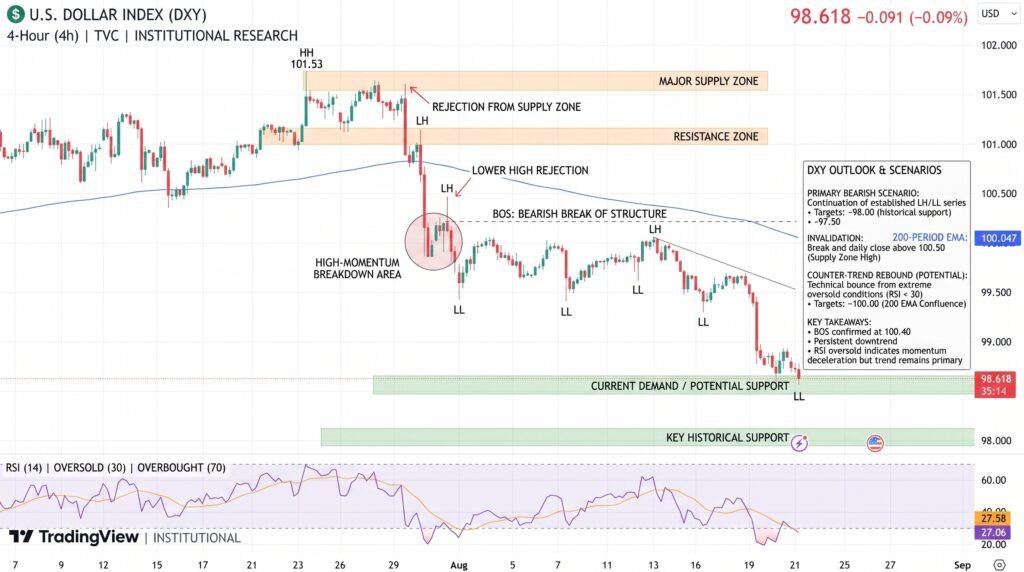
MUFG believes the data supports a 25bp Bank of Japan rate hike at the September 17-18 meeting, which would take the policy rate from 1.00% to 1.25%. Reuters reporting similarly notes that market expectations for a September hike have strengthened following the inflation release.
A more hawkish Bank of Japan would normally provide support for the Japanese Yen, particularly if U.S. yields continue to face pressure.
EUR/USD Upside Remains Limited
Dollar weakness has helped EUR/USD trade around 1.1680, extending its advance for a third consecutive session on Friday. MUFG, however, does not expect the pair to rise indefinitely. The main constraint is the continuing Middle East conflict, which has kept oil and European natural-gas prices elevated. Higher energy costs represent a larger economic risk for Europe because the region remains heavily dependent on imported energy.
The geopolitical backdrop also tends to generate defensive demand for the Dollar. Brent crude recently traded as high as $94.71 amid renewed tensions and expectations for tougher U.S. sanctions on Iran.
Conclusion
The Dollar currently faces pressure from two directions: doubts over the credibility of U.S. fiscal consolidation and growing expectations for tighter monetary policy in Japan. Treasury buybacks may temporarily reduce stress in the bond market, but they do not resolve a deficit above 6% of GDP or federal debt exceeding $40 trillion. Japan’s 1.8% core inflation and 1.9% core-core CPI strengthen the case for a September BoJ hike. Even so, persistent Middle East risks and higher European energy costs should prevent an unchecked Dollar decline. For EUR/USD, that leaves additional upside possible but increasingly difficult above current levels.
Sources & Methodology
Primary-source standard: Market-moving facts should link to original data releases, regulator notices, company filings or official project announcements whenever available. Secondary reporting is used for additional context, not as a substitute for original evidence.
Page last reviewed: