
USD/JPY traded around 159.00 on Friday, holding below an important short-term technical barrier as traders assessed stronger Japanese inflation and renewed volatility in U.S. bond markets. Japan’s core inflation accelerated to 1.8% in July, reinforcing expectations that the Bank of Japan could maintain its tightening bias. At the same time, the U.S. Treasury is expanding long-dated bond buybacks in an effort to improve market liquidity after a sharp increase in borrowing costs. Together, those factors have limited fresh upside in USD/JPY near the psychologically important 160 level.
Japan CPI Supports BoJ Rate Outlook
Japan’s core Consumer Price Index, which excludes volatile fresh-food prices, rose 1.8% year over year in July, matching economists’ forecasts and accelerating from 1.6% in June.
A separate inflation measure excluding both fresh food and energy increased 1.9% YoY, according to government data. The figures are significant because the Bank of Japan continues to assess whether inflation is sufficiently durable to justify additional interest-rate increases.
The BoJ’s next policy meeting is scheduled for September 17-18, making the inflation report an important input for policymakers.
Rabobank maintains a three-month USD/JPY forecast of 158, based partly on an expectation that the BoJ will accelerate the pace of rate increases. The bank nevertheless cautions that another near-term test above current levels cannot be ruled out.
Treasury Buybacks Pressure Dollar
The U.S. Dollar has also faced pressure from a major change in Treasury debt-management operations. The U.S. Treasury Department announced that it will at least double liquidity-support buybacks for 10- to 30-year Treasury securities. Maximum purchases will increase from $2 billion to at least $4 billion per operation, beginning September 9.
The announcement initially pushed long-term Treasury yields lower. The 30-year yield, which had reached 5.34%, fell toward 5.18%-5.20% as markets reacted to the larger buyback program. The Dollar also weakened following the announcement.
However, the impact has already begun to fade. By Friday, the 30-year yield had returned toward 5.25%, showing that concerns about inflation, fiscal deficits and government debt remain significant.
USD/JPY Faces 159.59 EMA Test
Technically, USD/JPY remains below its 20-day exponential moving average at approximately 159.59, keeping the short-term structure slightly bearish.
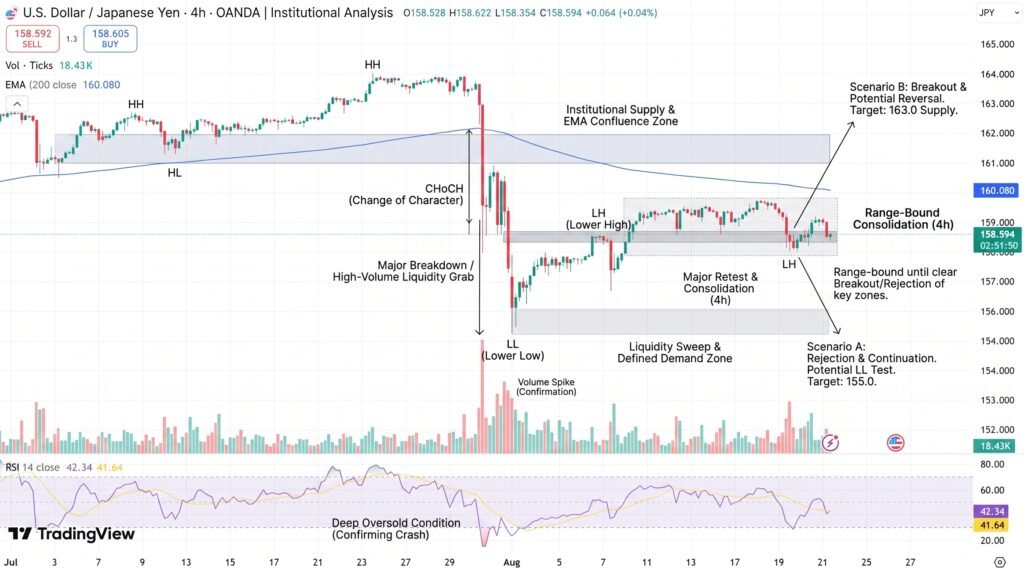
The Relative Strength Index stands near 43.5, below the neutral 50 level but comfortably above oversold territory. This suggests moderate selling pressure rather than an extreme bearish condition.
Key levels include:
- 159.59: 20-day EMA and immediate resistance.
- 160.00: Major psychological resistance.
- 158.00: August 20 low and first major support.
- 156.68: August 7 low and deeper downside support.
A daily close above 159.59 would weaken the bearish bias and reopen the path toward 160. Conversely, a break below 158.00 would increase the probability of a move toward 156.68.
Conclusion
USD/JPY remains caught between competing monetary and bond-market forces. Japan’s 1.8% core inflation rate keeps further BoJ tightening in consideration, while expanded U.S. Treasury buybacks have added pressure to long-term yields and the Dollar. Technically, however, the clearest signal remains the 20-day EMA at 159.59. Until USD/JPY closes decisively above that level, upside momentum remains limited. A break below 158 would shift attention toward 156.68, while a sustained move above 159.59 would put the 160 barrier back in focus.
Sources & Methodology
Primary-source standard: Market-moving facts should link to original data releases, regulator notices, company filings or official project announcements whenever available. Secondary reporting is used for additional context, not as a substitute for original evidence.
Page last reviewed: