The USD/CAD pair trades near 1.4280, extending its advance above 1.4250 as weaker oil prices pressure the Canadian Dollar. Canada’s role as a major crude exporter makes the Canadian Dollar particularly sensitive to energy prices. At the same time, a sharply weaker U.S. jobs report has reduced expectations for an October Federal Reserve rate hike, creating a counterweight to the pair’s bullish momentum.
Oil weakness supports USD/CAD
Lower crude prices are providing a fundamental lift to USD/CAD. Rising Middle Eastern exports and planned releases of emergency oil supplies by G7 nations have increased expectations of greater supply, weighing on crude prices and reducing support for the commodity-linked Canadian currency.
The currency pair, however, faces a more complicated U.S. monetary-policy backdrop. The September nonfarm payrolls report showed only 29,000 jobs were added, compared with the 90,000 economists had expected. August payroll growth was also revised down to 133,000 from 162,000, while July was revised from a 21,000 gain to a 10,000 decline. The unemployment rate rose to 4.2%.
- September payrolls: +29,000
- Unemployment rate: 4.2%
- August payroll revision: 133,000
Fed split keeps dollar outlook volatile
The weak labor data has sharply reduced expectations for an October Fed hike. Market pricing on Monday put the probability of an increase below 20%, down from roughly 70% earlier in the previous week.
Still, the policy outlook is not uniformly dovish. Dallas Fed President Lorie Logan said the federal-funds target range may need to rise by another 50 basis points or more to make policy “modestly restrictive.” The Fed currently targets a 3.75%-4.00% range.
That divergence matters for USD/CAD. Softer U.S. employment data limits the dollar’s upside, while hawkish Fed commentary can preserve demand for the greenback. Canada’s policy rate, meanwhile, remains at 2.25%, with the Bank of Canada scheduled to announce its next decision on October 28.
USD/CAD technical levels in focus
Technically, USD/CAD retains a bullish structure. The pair remains above its 100-day simple moving average and the 20-day Bollinger middle band. Yet the Relative Strength Index at 79.3 signals an extremely overbought market, increasing the probability of consolidation or a corrective decline.
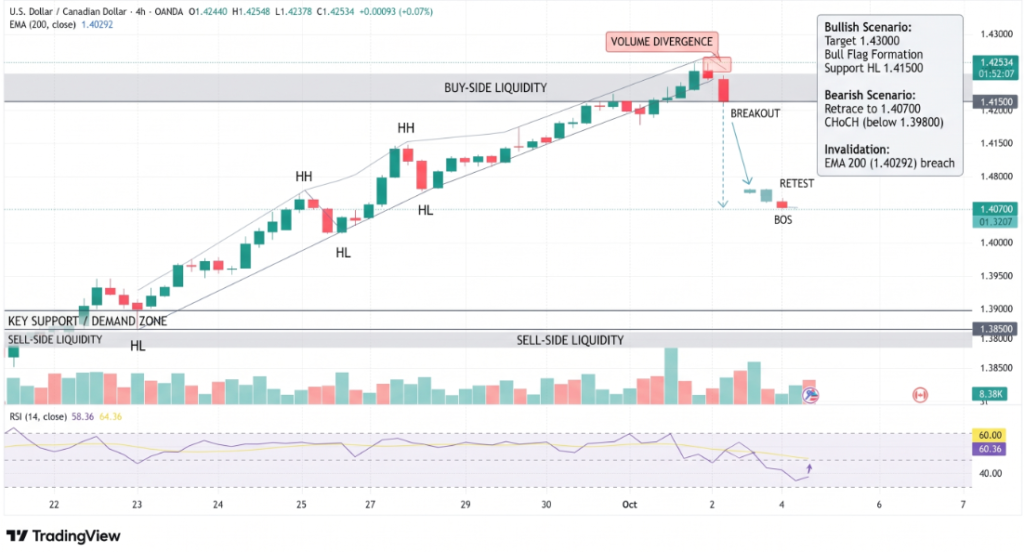
The immediate ceiling is the upper Bollinger Band near 1.4350-1.4352. A sustained break could expose 1.4415, followed by 1.4542. On the downside, initial support stands at 1.4221, with deeper levels at 1.4129 and 1.4045.
The 1.4000 area remains the major technical dividing line because it combines psychological significance with the 100-day SMA.
Conclusion
USD/CAD remains bullish above 1.4250, but the rally is becoming technically stretched. Falling oil prices favor the pair, while weak U.S. employment data argues against an immediate Fed hike. A break above 1.4350 would strengthen the bullish case, whereas a move below 1.4221 would increase the risk of a deeper correction.
Sources & Methodology
Primary-source standard: Market-moving facts should link to original data releases, regulator notices, company filings or official project announcements whenever available. Secondary reporting is used for additional context, not as a substitute for original evidence.
Page last reviewed: