
The USD/JPY pair is consolidating below 158.00 after rebounding from levels under 157.00 following softer U.S. employment data. The pair remains supported by a firm US Dollar, but gains are facing resistance as investors reassess the outlook for U.S. and Japanese monetary policy. The dollar has recently climbed to its highest level since April 2025, while the yen remains sensitive to expectations for additional Bank of Japan (BoJ) tightening and possible official intervention.
The BoJ currently guides its overnight call rate around 1.25% after its September policy adjustment. Policymakers are also signaling greater willingness to respond to persistent inflation pressures, keeping the possibility of another increase on the market’s radar. The central bank’s next policy meeting is scheduled for October 29–30.
Yen Risks Limit Dollar Upside
The policy gap remains important for USD/JPY. Higher U.S. yields and a resilient dollar can support the pair, but expectations for additional Japanese rate increases can strengthen the yen and reduce the appeal of the carry trade. Japan has also demonstrated its willingness to act when yen weakness becomes excessive. Reuters reported that Japan intervened in April, while September market activity included continued official warnings about excessive currency moves.
Geopolitical uncertainty provides another layer of support for the dollar because investors can seek the currency during periods of market stress. At the same time, a stronger dollar is already creating pressure across major currencies, meaning further USD/JPY gains could attract closer scrutiny from Japanese authorities.
Key levels to watch include:
- 158.74: 78.6% Fibonacci resistance and the first major upside hurdle.
- 157.49: 61.8% Fibonacci support and the first downside test.
- 156.61: 100-period SMA and 50% Fibonacci support confluence.
Technical Outlook Remains Constructive
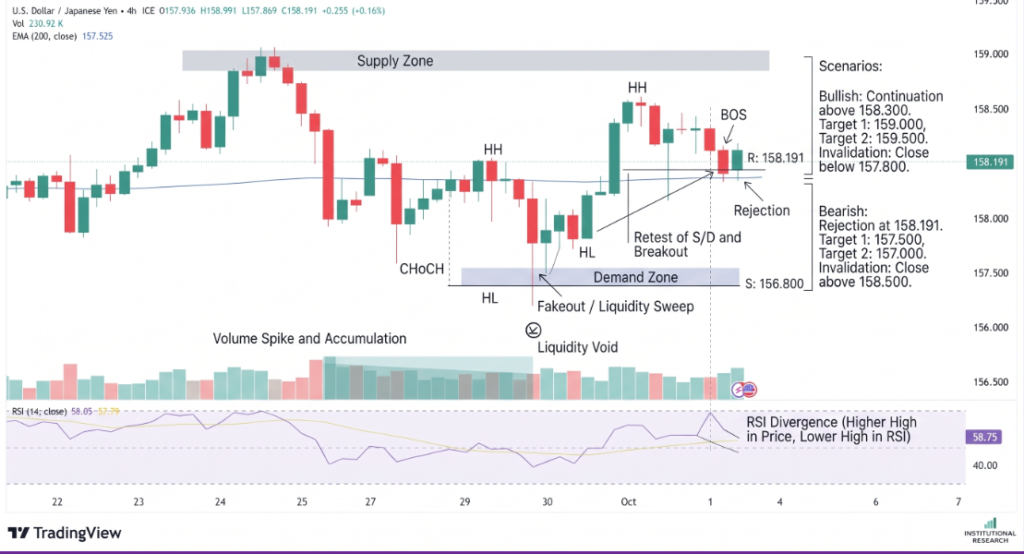
On the four-hour chart, USD/JPY retains a mildly bullish structure while trading above its 100-period Simple Moving Average and the 61.8% Fibonacci retracement. The RSI near 52 points to neutral-to-positive momentum rather than an overbought market. Meanwhile, the MACD remains close to its zero line with a slightly negative reading, suggesting that buyers have an advantage but have yet to establish strong momentum.
A sustained break above 158.74 would strengthen the bullish setup and expose the recent cycle highs. Conversely, a decisive move below 157.49 would weaken the near-term structure and bring 156.61 into focus. A deeper decline could then target the 38.2% Fibonacci level at 155.73, followed by the 23.6% retracement at 154.64.
Conclusion
USD/JPY remains biased higher while it holds above key technical support, but the path toward fresh highs is becoming more complicated. The 158.74 resistance level is the immediate test for buyers, while BoJ tightening expectations and intervention concerns could limit further yen weakness. A break of 158.74 would favor another advance, whereas a fall below 157.49 would shift attention toward 156.61 and lower support levels.
Sources & Methodology
Primary-source standard: Market-moving facts should link to original data releases, regulator notices, company filings or official project announcements whenever available. Secondary reporting is used for additional context, not as a substitute for original evidence.
Page last reviewed: