
The USD/JPY pair is holding near 157.60 after retreating 0.3% as the US dollar weakened ahead of September’s Nonfarm Payrolls report. The pair remains above its 20-day exponential moving average at 157.26, keeping the short-term structure supported despite the pullback. At the same time, stronger-than-expected inflation in Tokyo has reinforced attention on the Bank of Japan and the possibility of further policy normalization. The next major catalyst is the US jobs report, which could alter expectations for Federal Reserve policy and Treasury yields.
US Jobs Data Sets Dollar Direction
The September US employment report was scheduled for release on Friday at 8:30 a.m. Eastern Time, or 12:30 GMT. The latest consensus estimate called for nonfarm payrolls to increase by 90,000, down from 162,000 in August, while the unemployment rate was expected to remain at 4.1%. Reuters reported the same consensus ahead of the release.
The August report showed payroll employment rising by 162,000, with unemployment unchanged at 4.1%. Average hourly earnings increased 0.3% in August and were up 3.1% from a year earlier.
For USD/JPY, the significance extends beyond the headline payroll number. A stronger labor-market result could support expectations for tighter US monetary policy and lift demand for the dollar, while a weaker reading could reduce those expectations.
The US Dollar Index was around 101.88 after reaching 102.20 on Thursday, leaving the greenback close to a recent yearly high.
Tokyo Inflation Raises BOJ Focus
Japan’s inflation data has added another variable for the yen. September Tokyo CPI showed core inflation accelerating to 2.7% year over year from 1.8% in August. A measure excluding fresh food and energy rose to 3.0%, its highest rate since August 2025.
The figures were released by Japan’s Statistics Bureau on October 2 as part of its preliminary September Tokyo CPI report.
Higher inflation can strengthen attention on future BOJ policy decisions because persistent price pressures may affect the central bank’s assessment of the appropriate policy rate. Reuters reported that the latest Tokyo inflation data increased expectations for another BOJ rate increase, potentially as early as December.
That creates a two-sided policy backdrop for USD/JPY, with US employment data influencing the dollar while Japanese inflation shapes expectations for the yen.
USD/JPY Technical Levels to Watch
On the daily chart, USD/JPY is trading around 157.61 and remains above the 20-day exponential moving average at 157.26. The Relative Strength Index is near 51.50, slightly above the neutral 50 level.
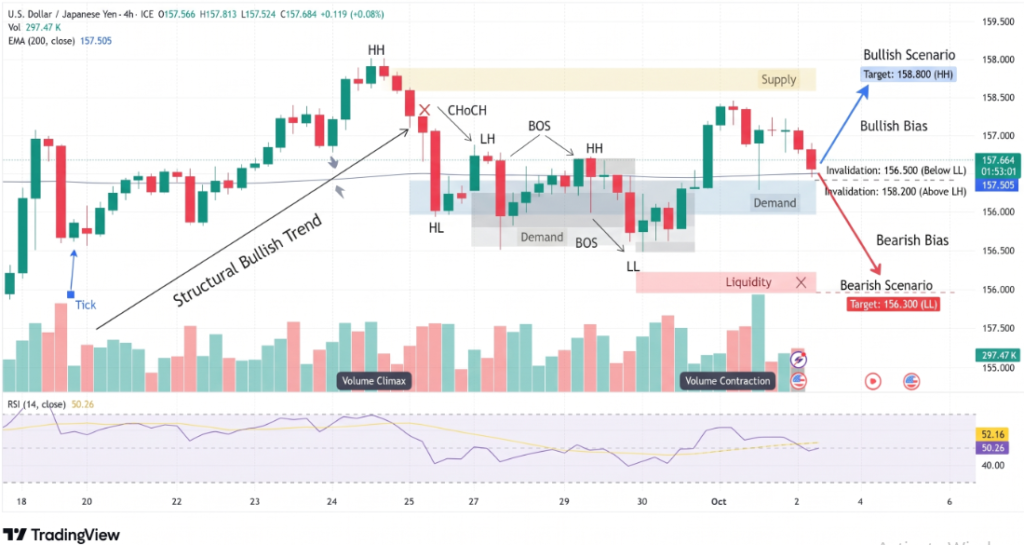
The technical structure therefore shows moderate upside momentum rather than an overextended move.
- Immediate support: 157.26
- Next support: 156.38
- Immediate resistance: 159.04
- Major resistance: 160.39
A sustained move below 157.26 would bring 156.38 into focus. On the upside, a break above 159.04 would expose 160.39, the September 2 high.
Conclusion
USD/JPY remains supported above its 20-day EMA at 157.26, but the next directional move depends on a combination of US labor data and Japanese inflation signals. The September US payrolls report could reshape Fed policy expectations, while Tokyo’s 2.7% core inflation rate keeps attention on the BOJ. Technically, 157.26 and 156.38 define the main support levels, while 159.04 and 160.39 remain the key upside barriers.
Sources & Methodology
Primary-source standard: Market-moving facts should link to original data releases, regulator notices, company filings or official project announcements whenever available. Secondary reporting is used for additional context, not as a substitute for original evidence.
Page last reviewed: