
The USD/JPY pair traded near 158.37 on Monday, October 12, as the Japanese yen remained subdued against the U.S. dollar. The exchange rate has moved within a narrow 156.38–158.51 range for nearly two weeks, leaving traders waiting for a catalyst. Wednesday’s September U.S. Consumer Price Index (CPI) report could provide that trigger by reshaping expectations for Federal Reserve interest rates. Meanwhile, the Bank of Japan (BoJ) is expected to proceed cautiously with further tightening, limiting the prospect of an immediate policy-driven rally in the yen.
US CPI Puts Dollar in the Spotlight
Markets are preparing for the September U.S. inflation report, scheduled for Wednesday, October 14. Forecasts point to annual headline inflation rising to around 3.7%, from 3.4% in August, while core CPI—which excludes food and energy—is expected to increase to 2.5%, from 2.4%. These are forecasts, not confirmed results.
The distinction between headline and core inflation matters. Higher energy prices can push headline inflation upward, while core inflation can provide clues about broader price pressures. A stronger-than-expected reading could reinforce expectations that the Fed will keep monetary policy restrictive for longer, supporting the dollar against the yen. A softer report could have the opposite effect.
Recent Fed discussions have emphasized the risk of inflation remaining above the central bank’s 2% target. Investors will therefore examine the CPI figures for evidence that price pressures are either easing or becoming more persistent. The result could determine whether USD/JPY breaks out of its current range or continues consolidating.
BoJ Policy Limits Yen Recovery
Japan presents a different policy picture. Analysts at Rabobank argue that the BoJ has reached a point where it can increasingly focus on stabilizing inflation around its target. However, they caution that this shift does not necessarily mean consecutive interest-rate increases are imminent.
The BoJ raised its policy rate in September, bringing it to 1.25%, according to recent reporting. Policymakers remain divided over the pace of additional tightening, with concerns about economic growth and household spending weighing against the need to contain inflation.
This policy gap between Japan and the United States remains important for the currency pair. If U.S. rates stay elevated while Japanese rates rise gradually, the dollar could retain a yield advantage. However, changing Fed expectations or increased concern about Japanese currency intervention could limit further gains in USD/JPY.
USD/JPY Forecast: 159.04 Resistance
On the daily chart, USD/JPY trades above its 20-day Exponential Moving Average (EMA) at 157.66, preserving a constructive near-term bias. The 14-day Relative Strength Index (RSI) stands at 56.28, indicating moderately positive momentum without reaching overbought territory.
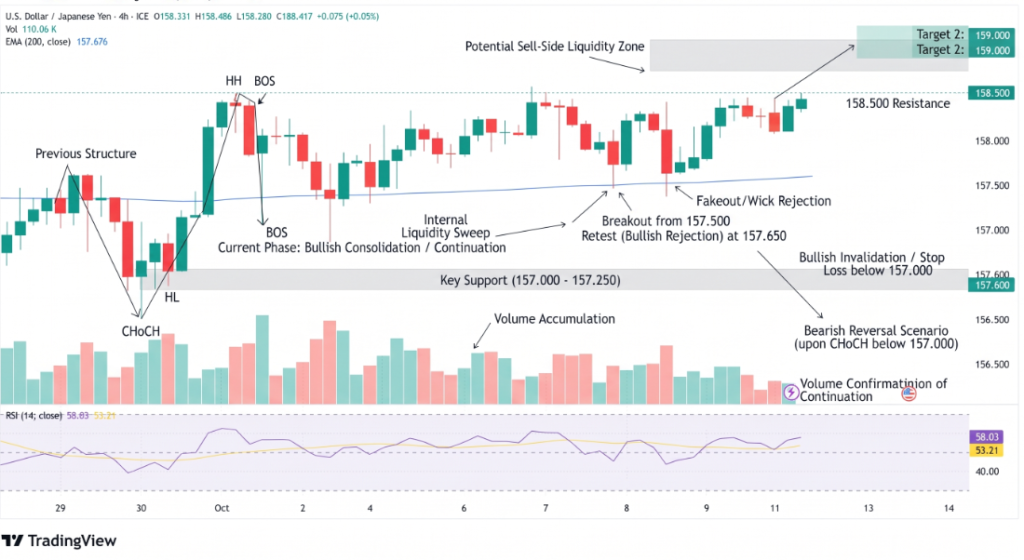
Key technical levels include:
- 158.51: Upper boundary of the recent trading range.
- 159.04: September 24 high and major resistance.
- 157.66: 20-day EMA and initial support.
- 156.38: Lower boundary of the two-week range.
A sustained move above 158.51 could bring 159.04 into focus. Conversely, a daily close below 157.66 would weaken the recovery and increase the risk of a retest of 156.38.
Conclusion
USD/JPY remains range-bound as traders await U.S. inflation data and assess the BoJ’s next policy move. A hotter CPI reading could support the dollar, while softer inflation may give the yen room to recover. Technically, 159.04 remains the key upside hurdle, while 157.66 is the first support to watch. A confirmed break from the 156.38–158.51 range would provide a clearer signal of the pair’s next direction.
Sources & Methodology
Primary-source standard: Market-moving facts should link to original data releases, regulator notices, company filings or official project announcements whenever available. Secondary reporting is used for additional context, not as a substitute for original evidence.
Page last reviewed: