
XRP hovered near $1 on Wednesday, August 19, as traders weighed a White House meeting bringing together crypto executives, prediction-market leaders, and top federal regulators. Bitcoin climbed above $64,200 in a broader recovery, while Ethereum consolidated near $1,919. The gathering, set for the Eisenhower Executive Office Building, arrives as Congress remains deadlocked on the CLARITY Act and precedes the CFTC’s first Innovation Advisory Committee session on Thursday. XRP spot ETFs, meanwhile, logged $5.81 million in fresh inflows on August 18.
White House Meeting Draws Industry Chiefs
President Donald Trump is expected to attend a Wednesday roundtable at the Eisenhower Executive Office Building alongside SEC Chairman Paul Atkins and CFTC Chairman Michael Selig. Executives from Coinbase, Ripple, Gemini, Kalshi, and Polymarket are on the expected attendee list, along with representatives from Nasdaq, the New York Stock Exchange, CME Group, and the Depository Trust and Clearing Corporation. DTCC’s inclusion has drawn particular attention given its central role in clearing and settling US securities transactions. No formal agenda has been published, but the meeting is widely viewed as a precursor to Thursday’s inaugural session of the CFTC’s Innovation Advisory Committee, a 35-member panel set to discuss crypto regulation, artificial intelligence, and prediction markets.
The gathering also lands amid a stalled push in Congress, where the CLARITY Act, the industry’s central market-structure bill, remains stuck in the Senate after lawmakers left for August recess without a vote. A procedural vote is now scheduled for September 15.
XRP Technical Levels Point to Recovery
XRP gained 0.02% over the latest four-hour period, holding just below the psychological $1 level while staying above support at $0.99. The token has struggled to build on brief pushes higher, with $1.03 and $1.05 standing as the next resistance levels on any rebound attempt.
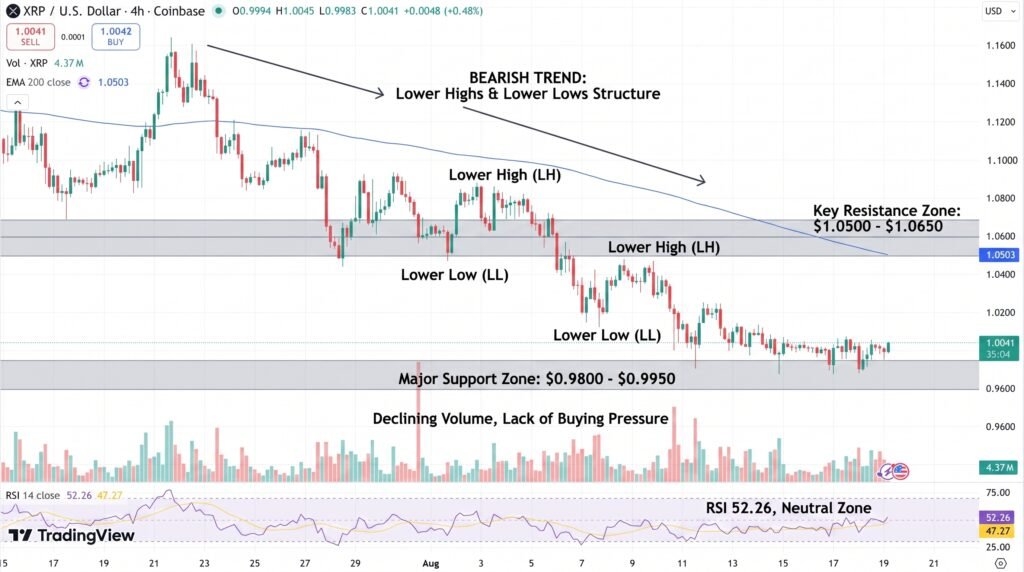
The Relative Strength Index reads 47.03, a level that leans bearish without reaching oversold territory. The MACD line sits at negative 0.0016, above its signal line at negative 0.0022, producing a positive histogram reading of 0.0006 that suggests bearish momentum is beginning to fade even as the broader structure stays weak.
- Support to hold: $0.99, with a break risking a slide toward $0.97
- Resistance ahead: $1.03, then $1.05 for a more convincing breakout
- Momentum signal: RSI at 47.03, MACD histogram turning positive
XRP ETFs Post $5.81M in Daily Inflows
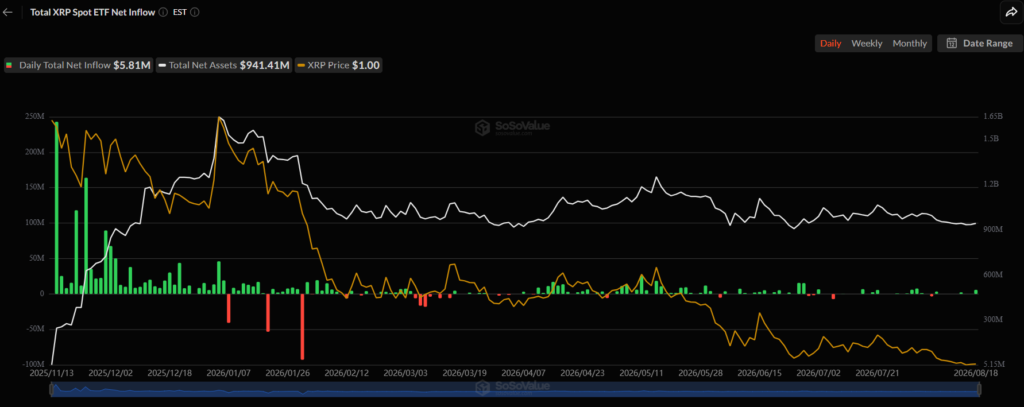
US spot XRP ETFs recorded $5.81 million in net inflows on August 18, marking a return to buying after a stretch of thin institutional demand. Bitwise led with $2.24 million, followed by Grayscale at $1.94 million and Franklin Templeton at $1.63 million. Canary Capital and 21Shares reported no flows for the session. Total net assets across the XRP ETF complex stood at approximately $941.41 million, equal to roughly 1.50% of XRP’s market capitalization, while trading volume for the session reached $10.49 million. Cumulative XRP ETF inflows since launch now stand near $1.51 billion, even as the token’s price has lagged that steady institutional demand.
Conclusion: A Policy-Driven Setup
XRP’s setup remains tightly bound to two forces: the outcome of Wednesday’s White House meeting and whether the $0.99 support level continues to hold. A defended $0.99 floor would give the token another opportunity to test $1.03 and, eventually, $1.05, a close that would meaningfully improve the near-term chart. A breakdown below $0.99 would shift focus toward $0.97 and reinforce the bearish structure that has defined trading since the CLARITY Act stalled in Congress. With regulatory clarity still pending and ETF demand only beginning to stabilize, XRP’s next move will likely hinge on policy signals as much as price action.
Sources & Methodology
Primary-source standard: Market-moving facts should link to original data releases, regulator notices, company filings or official project announcements whenever available. Secondary reporting is used for additional context, not as a substitute for original evidence.
Page last reviewed: