
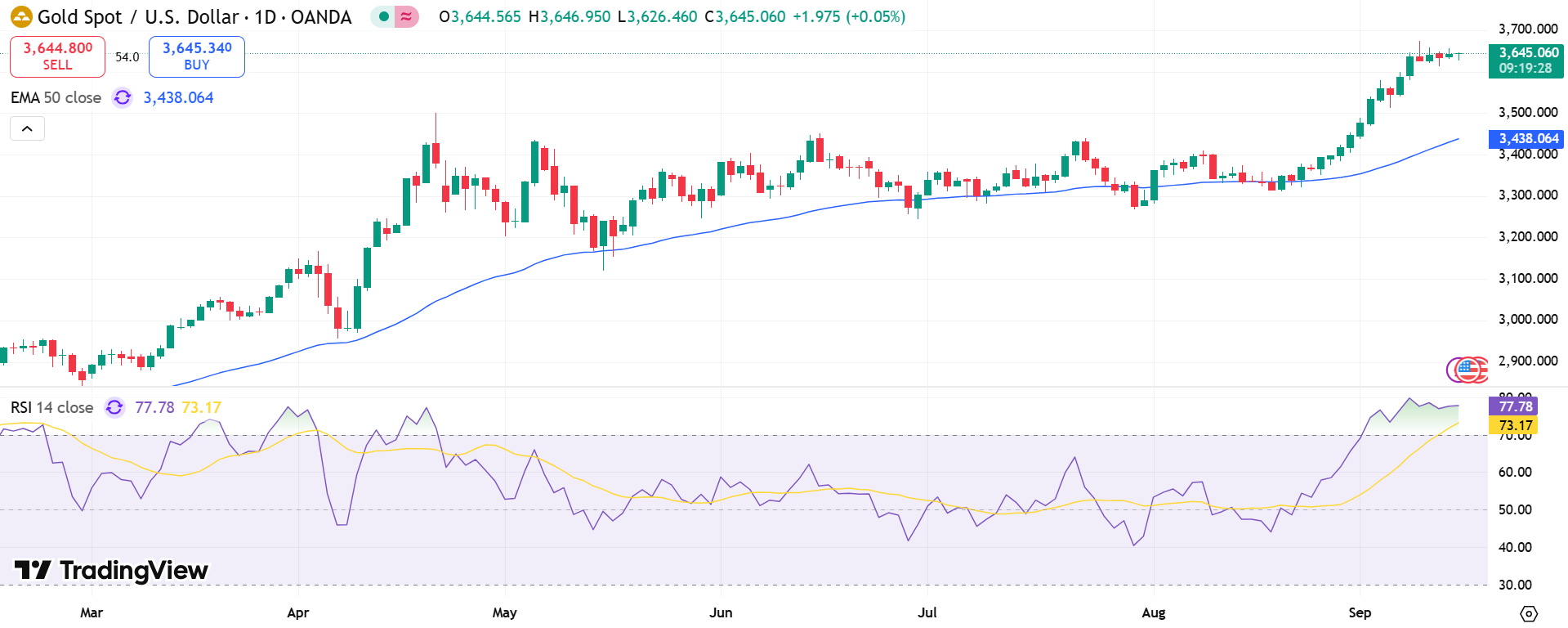
Gold traded close to its record highs on Monday, extending a remarkable rally that has lifted prices nearly 40% since the start of 2024. Spot gold rose 0.1% to $3,645.03 per ounce in Asian markets, only a fraction below last week’s all-time high of $3,673.95. U.S. gold futures slipped 0.1% to $3,682.70 per ounce.
The gains reflect mounting expectations that the Federal Reserve will cut interest rates this week. According to CME FedWatch data, traders assign more than a 96% probability to a 25-basis-point reduction, with some market participants betting on a deeper cut.
The momentum marks gold’s fourth consecutive weekly advance, adding 1.5% over the past week alone. Analysts attribute the rally to heightened safe-haven demand, fueled by geopolitical tensions and uncertainty over U.S. trade policy.
Labor Market Weakness Supports Gold
The case for monetary easing has strengthened as U.S. labor market data softens. August payrolls added just 22,000 jobs, the weakest gain in months, pushing unemployment to 4.3%. At the same time, revisions to earlier employment reports highlighted even greater weakness than previously recorded.
Although the August Consumer Price Index rose 0.4% month-on-month, keeping annual inflation at 2.9%, analysts suggest the Fed is more concerned about job market deterioration than slightly elevated price pressures.
Why gold is sensitive to rate policy:
- Lower interest rates reduce the opportunity cost of holding a non-yielding asset like gold.
- Rate cuts often pressure the U.S. dollar, boosting demand for dollar-priced metals.
- Safe-haven demand tends to rise in periods of policy uncertainty.
Metals Mixed as China Data Disappoints
While gold continues to shine, other metals showed subdued trading. Silver futures slipped 0.2% to $42.76 per ounce, and platinum held steady near $1,410.45. Copper, often seen as an economic bellwether, offered a slight rebound. London Metal Exchange futures rose 0.3% to $10,083.30 a ton, while U.S. copper futures edged 0.2% higher to $4.66 a pound.
The copper move came despite disappointing Chinese data. Industrial production in the world’s largest copper importer grew at its slowest pace in a year, while retail sales also fell short of expectations. These figures reinforced concerns over China’s slowing economic momentum, a critical factor for global commodity demand.
Sources & Methodology
Primary-source standard: Market-moving facts should link to original data releases, regulator notices, company filings or official project announcements whenever available. Secondary reporting is used for additional context, not as a substitute for original evidence.
Page last reviewed: