
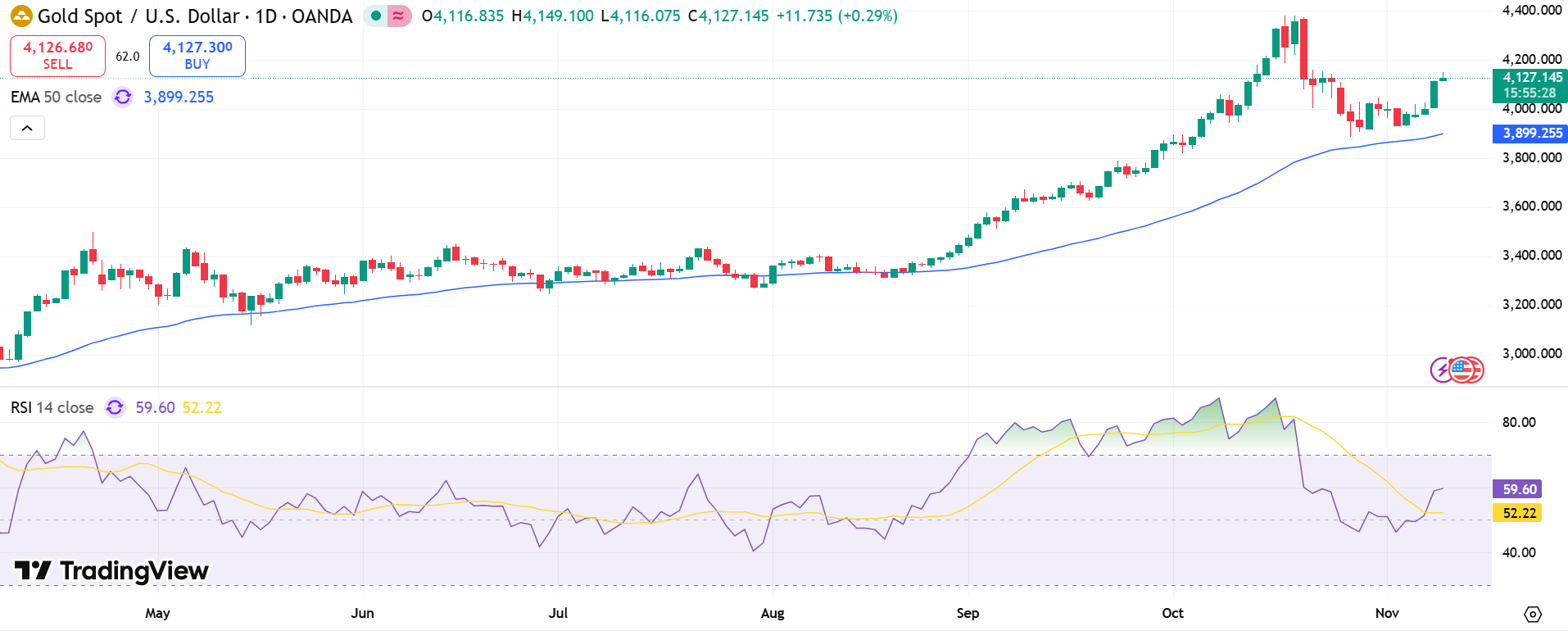
Gold prices advanced in Asian trading on Tuesday, climbing to near a three-week high as investors balanced optimism over the nearing end of the U.S. government shutdown with lingering concerns about economic and trade stability.
Spot gold gained 0.6% to $4,142.14 per ounce, while December futures rose 0.7% to $4,148.92 by late trading hours. The rally came despite continued strength in the U.S. dollar, underscoring resilient investor demand for safe-haven assets.
Lawmakers in Washington moved closer to resolving the record 41-day government shutdown, which had cast a shadow over market sentiment. The U.S. Senate passed a bill late Monday to restore funding, and the Republican-led House is expected to approve it later this week.
While risk appetite improved marginally, analysts noted that concerns about the long-term economic effects of the shutdown and trade uncertainty kept gold prices buoyant.
Investor Demand Defies Dollar Strength
Gold’s strong performance reflects investors’ continued preference for safety amid policy ambiguity and global trade tensions. The yellow metal’s return above the $4,000/oz psychological threshold highlights steady demand despite improving political stability.
Other precious metals mirrored gold’s advance:
- Platinum rose 0.7% to $1,587.48/oz
- Silver climbed 0.9% to $50.97/oz
Market analysts emphasized that these gains signal investors’ hesitancy to shift fully into riskier assets, particularly as the Federal Reserve remains cautious on interest rate adjustments.
Trade Policy Uncertainty Fuels Safe-Haven Appeal
Analysts from ANZ Bank attributed gold’s resilience to persistent safe-haven flows triggered by escalating uncertainty around U.S. trade policies. The Supreme Court’s scrutiny of the Trump administration’s use of the 1977 International Emergency Economic Powers Act added a new layer of unpredictability.
Former President Trump warned that overturning his tariffs could cost the government over $2 trillion in refunds, potentially disrupting fiscal stability.
Meanwhile, the prolonged shutdown has delayed key U.S. economic reports, leaving investors without crucial data to gauge growth trends. As a result, traders have scaled back expectations for another Federal Reserve rate cut in December.
Sources & Methodology
Primary-source standard: Market-moving facts should link to original data releases, regulator notices, company filings or official project announcements whenever available. Secondary reporting is used for additional context, not as a substitute for original evidence.
Page last reviewed: