
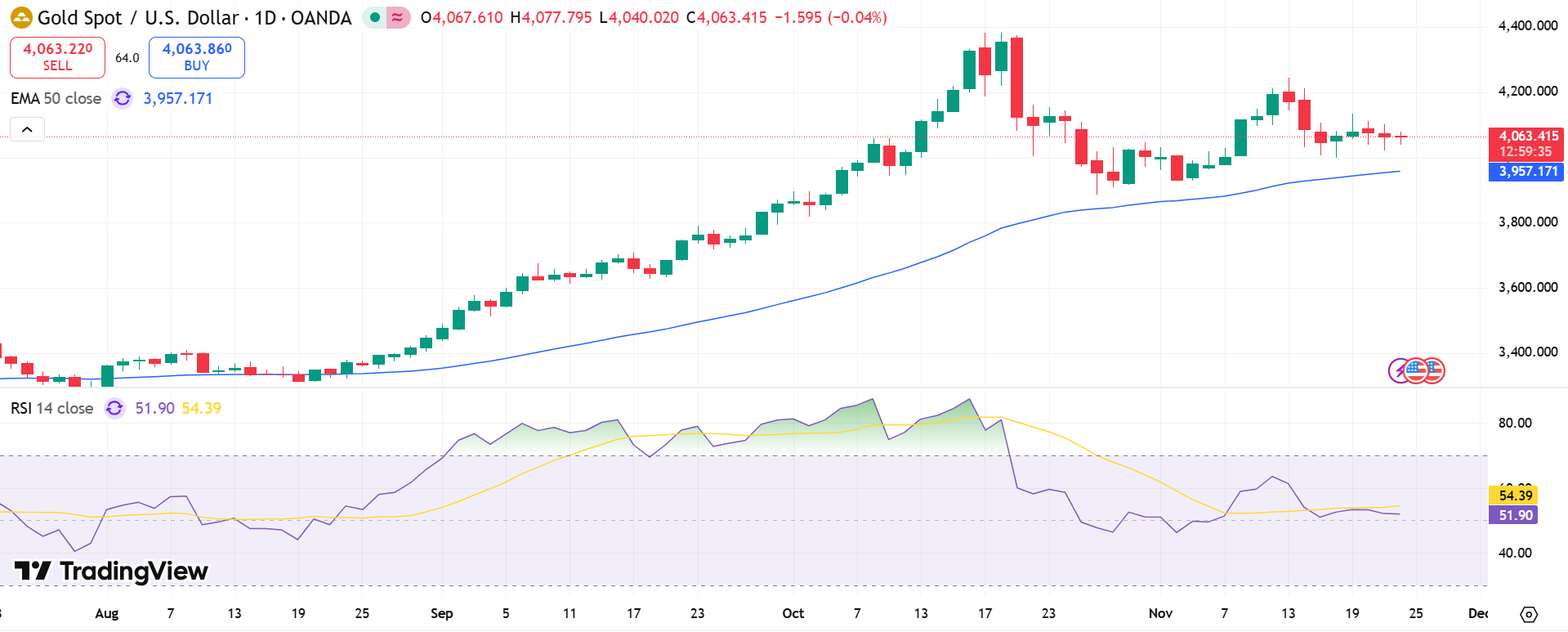
Gold prices edged lower in Asian trading on Monday as investors shifted toward riskier assets, encouraged by a sharp rise in expectations for a Federal Reserve rate cut in December. A rebound across global equities, paired with renewed diplomatic efforts between the U.S., Russia, and Ukraine, softened demand for safe-haven metals. Even so, persistent geopolitical and fiscal risks kept gold anchored above the critical $4,000 mark.
Spot gold slipped 0.3% to $4,052.53 per ounce, while December gold futures fell 0.7% to $4,086.10 by 01:07 ET (06:07 GMT). The pullback came despite ongoing concerns over global debt levels and diplomatic tensions between China and Japan, which offered pockets of support.
Investors remained cautious ahead of a major lineup of U.S. economic releases this week—data that could influence the Fed’s final rate decision for the year.
Key drivers behind the early-week decline included:
- Rising appetite for equities and risk assets
- Improved market sentiment following ceasefire discussions
- Anticipation of U.S. economic data that may shape Fed policy
Market Repricing Favors December Rate Cut
The biggest shift in market sentiment came after New York Fed Governor John Williams signaled that policymakers had room to ease rates in December. He emphasized moderating inflation pressures and rising risks to the labor market.
Traders quickly recalibrated expectations. According to CME FedWatch, the probability of a 25-basis-point cut at the December 9–10 meeting surged to 67.3%, up sharply from 39.8% just a week earlier. The pivot lifted other precious metals even as gold lagged.
- Spot platinum rose 1.4% to $1,537.65 per ounce
- Spot silver dipped slightly to $49.92385 per ounce
Lower interest rates typically support gold by reducing the opportunity cost of holding non-yielding assets. However, Monday’s early-session weakness showed that risk-on sentiment remains the dominant market force for now.
U.S. Data Flood Expected to Guide Markets
The U.S. economic calendar is packed with delayed September indicators—reports postponed by the recent government shutdown. These releases will offer crucial insight into economic momentum heading into year-end.
Data arriving this week includes:
- Industrial production and capacity utilization
- Producer Price Index (PPI) and retail sales
- Building permits, durable goods orders, and jobless claims
- Third-quarter GDP
- The PCE price index, the Fed’s preferred inflation gauge
While these figures may help clarify the economic backdrop for December, the absence of meaningful October data leaves policymakers navigating with limited visibility. Fed officials remain divided on whether additional cuts are warranted, making this week’s numbers even more influential.
Sources & Methodology
Primary-source standard: Market-moving facts should link to original data releases, regulator notices, company filings or official project announcements whenever available. Secondary reporting is used for additional context, not as a substitute for original evidence.
Page last reviewed: