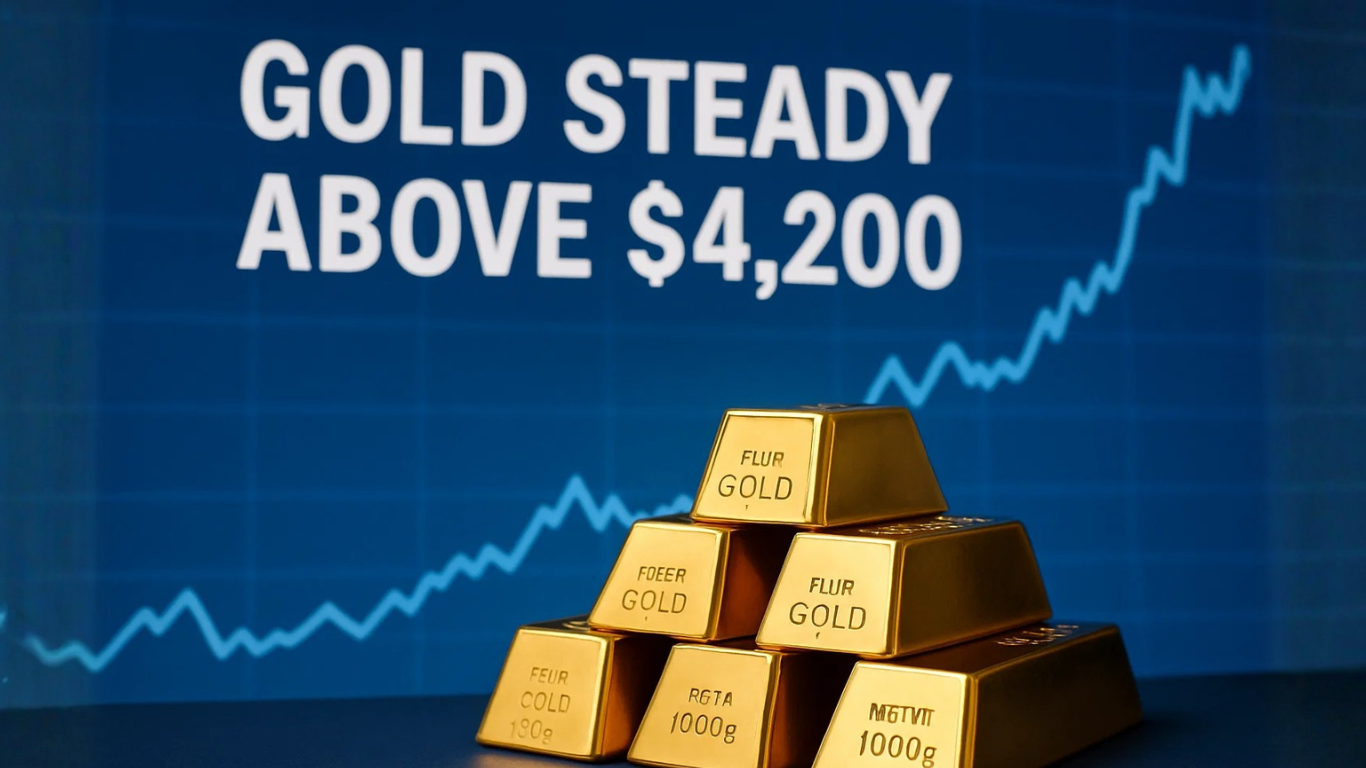
Gold prices held steady above the $4,200 mark during Wednesday’s Asian session, touching a fresh weekly high but lacking decisive follow-through buying. Traders remained cautious ahead of the Federal Reserve’s policy announcement, where markets widely expect a 25-basis-point rate cut.
The U.S. dollar, despite a brief rebound from late-October lows, struggled to regain upward traction. Growing consensus that the Fed will begin easing monetary conditions has kept the greenback on the defensive and provided a supportive backdrop for bullion.
On the daily chart, XAU/USD trades at $4,217.02, with a bullish technical structure. The 21-day SMA sits above the 50-, 100-, and 200-day moving averages, signaling a firmly upward trend. The RSI at 61 confirms positive momentum without flashing overbought warnings.
Gold has reclaimed the 61.8% Fibonacci retracement at $4,191.95, sharpening market attention toward the 78.6% level at $4,275.16. A daily close above that threshold could unlock further upside potential, while a pullback would invite a retest of rising SMA support around $4,155.85.
Investors Eye Fed Signals for 2026 Outlook
Gold’s movement has mirrored the renewed rally in silver as traders position for a policy shift. Expectations for a December rate cut now hover near 90%, according to market pricing. The critical question is whether policymakers indicate a broader easing cycle stretching into 2026.
Key elements traders are watching:
- Fed vote split between hawks and doves
- Dot-plot projections for 2025–2026
- Powell’s tone regarding inflation risks and labor-market cooling
- Guidance on the pace and depth of future rate cuts
The outcome of the meeting could determine whether gold extends its uptrend or reverses sharply. Chair Jerome Powell’s press conference is expected to provide the clearest clues on how aggressively the Fed intends to ease conditions in the coming year.

Labor Data Adds Complexity to Outlook
Fresh labor-market data has created additional nuance. The CME FedWatch Tool shows just over a 20% probability of another rate cut in January, following stronger-than-expected JOLTS Job Openings.
Job openings rose 12,000 to 7.67 million, according to the Labor Department’s Bureau of Labor Statistics—suggesting resilient labor demand, even as inflation pressures recede.
This divergence leaves gold sensitive to any hawkish lean in the Fed’s forward guidance. A more aggressive tone could trigger a sharp correction in non-yielding assets like gold. Conversely, if policymakers emphasize easing labor-market stress and the need for additional cuts, gold may attempt another rally toward its record peak of $4,382.
Sources & Methodology
Primary-source standard: Market-moving facts should link to original data releases, regulator notices, company filings or official project announcements whenever available. Secondary reporting is used for additional context, not as a substitute for original evidence.
Page last reviewed: