Gold prices edged lower in the final trading session of 2025 as investors locked in profits following one of the strongest annual rallies in modern history. Spot gold slipped 0.3% to $4,327.45 per ounce, while U.S. gold futures fell 1% to $4,340.10. Despite the late pullback, bullion is set to close the year up roughly 64%, marking its strongest annual performance since 1979.
Earlier in the week, gold touched a record high of $4,549.71 per ounce, driven by sustained demand from investors seeking protection against monetary easing and geopolitical instability. Year-end positioning, lighter liquidity, and portfolio rebalancing weighed on prices in the final sessions, but did little to alter the broader bullish narrative.
Gold’s strength in 2025 was built on a rare alignment of macroeconomic forces. The U.S. Federal Reserve cut interest rates three times during the year, reducing the opportunity cost of holding non-yielding assets. Lower real yields made gold more attractive relative to cash and bonds, reinforcing its role as a portfolio hedge.
Markets are also pricing in additional rate cuts in 2026, keeping expectations supportive even as prices consolidate near record levels.
Central Banks and Geopolitics Drive Demand
Central bank buying remained a critical pillar behind gold’s surge. Several emerging-market economies continued to increase reserves as part of long-term diversification strategies aimed at reducing reliance on the U.S. dollar. Official-sector demand has become a structural feature of the market rather than a short-term trend.
Geopolitical risks added another layer of support throughout the year. Ongoing conflicts in Eastern Europe and the Middle East sustained safe-haven flows, especially during periods of heightened market volatility. Together, these factors helped gold outperform most major asset classes in 2025.
Key forces supporting bullion this year included:
- Three Federal Reserve rate cuts lowering yield pressure
- Continued central bank accumulation of gold reserves
- Persistent geopolitical tensions boosting safe-haven demand
- Strong investor inflows into bullion-linked products
- Expectations of further monetary easing in 2026
Even with prices easing at year-end, analysts note that gold remains well-supported structurally, with pullbacks increasingly viewed as consolidation rather than trend reversals.
Silver and Platinum Outpace Gold in 2025
While gold posted impressive gains, other precious metals delivered even stronger performances. Silver surged nearly 150% in 2025, benefiting from its dual role as both a monetary and industrial metal. Demand from solar power, electric vehicles, electronics, and data centers tightened supply, while speculative flows amplified price movements in an already constrained market.
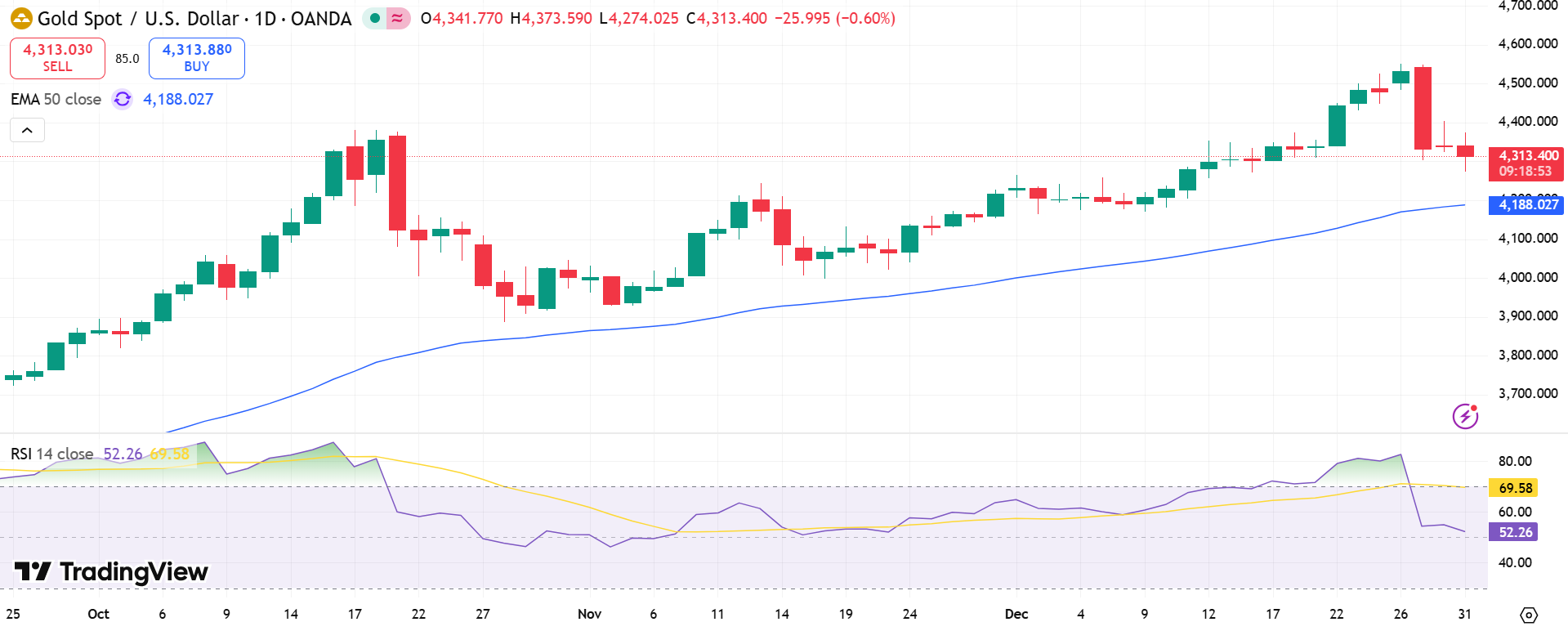
By late Wednesday, silver was trading 5.5% lower at $72.06 per ounce, reflecting profit-taking similar to gold. Still, its annual performance stood among the strongest across global commodities.
Platinum also recorded an exceptional year, climbing more than 110% as supply limitations collided with recovering industrial demand. Years of underinvestment in mining capacity left the market vulnerable to sharp price swings once consumption improved. Platinum last traded 7.2% lower at $2,025.16 per ounce.
Elsewhere in the metals complex, U.S. copper futures fell 2.1% to $5.66 per pound, ending the year on a softer note despite broader optimism around electrification trends.
Together, the precious metals complex closed 2025 as one of the strongest-performing asset groups, shaped by monetary policy shifts, supply constraints, and persistent global uncertainty.
Sources & Methodology
Primary-source standard: Market-moving facts should link to original data releases, regulator notices, company filings or official project announcements whenever available. Secondary reporting is used for additional context, not as a substitute for original evidence.
Page last reviewed: