The euro stayed firm against the U.S. dollar on Monday, holding above the 1.1800 level after new data showed a small improvement in German business sentiment for February. At the same time, uncertainty surrounding U.S. trade policy continued to weigh on the dollar, helping EUR/USD trade at 1.1820 on the four-hour chart.
Germany is the largest economy in Europe. When its business outlook improves, even slightly, it often supports the euro. The data signaled modest optimism among companies, giving the single currency a steady base.
Tariffs Weigh on the Dollar
The U.S. dollar remains under pressure after the Supreme Court ruled that President Donald Trump exceeded his constitutional authority by using the International Emergency Economic Powers Act (IEEPA) to impose unilateral tariffs. The court’s decision removed one legal path for trade restrictions.
In response, President Trump said he would move forward using alternative legal tools, including Section 301 of the Trade Act of 1974. Over the weekend, he announced an immediate increase in global tariffs to 15%, up from 10%, and warned that more levies could follow.
The European Commission rejected the U.S. tariff increase and asked Washington to honor the EU–U.S. trade agreement reached in 2025. Ongoing trade tension creates uncertainty for businesses and investors. When uncertainty rises, the dollar can weaken because traders worry about slower growth and unclear Federal Reserve policy.
With no major U.S. economic data scheduled, trade headlines are likely to remain the main driver of currency moves.
Technical Levels to Watch
From a technical perspective, EUR/USD shows mixed signals. On the four-hour chart:
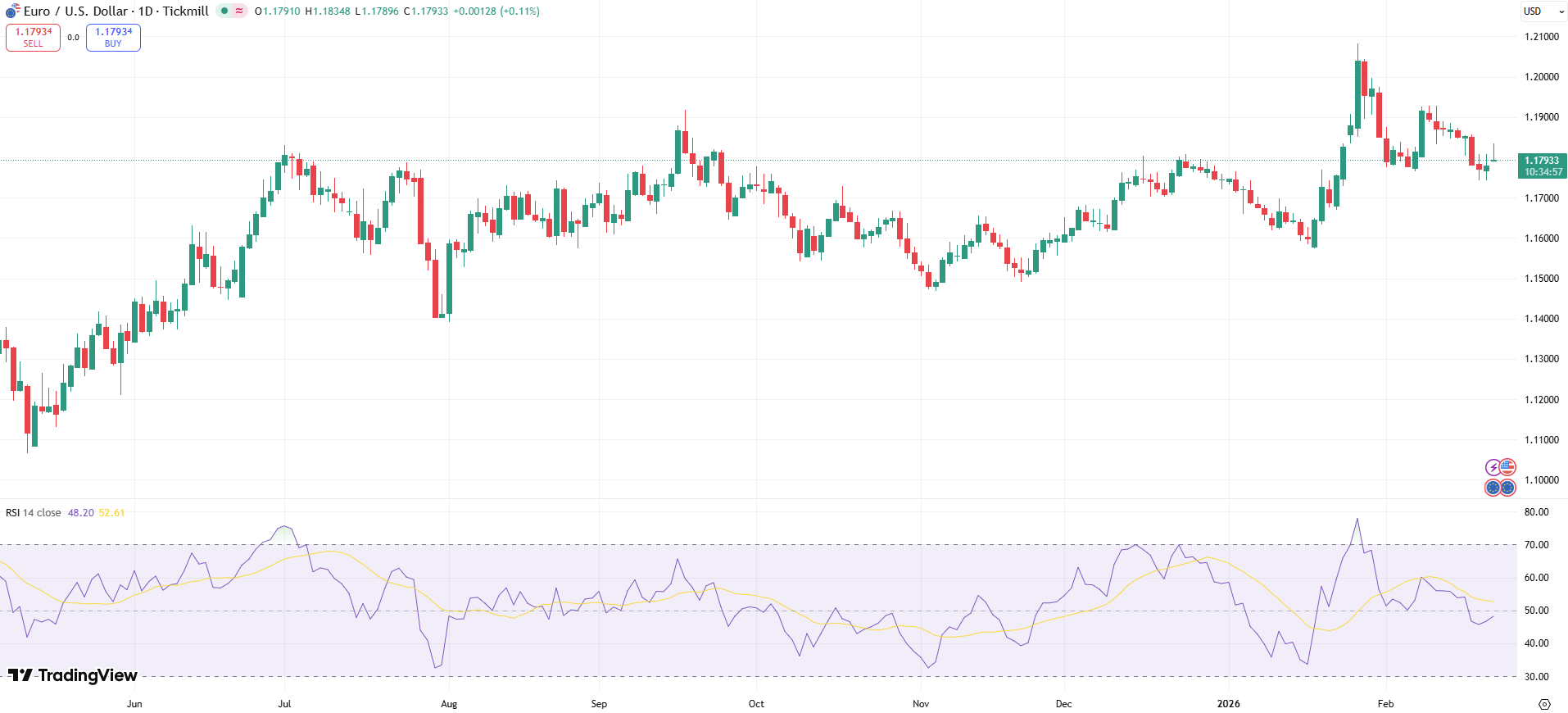
- The pair trades at 1.1820.
- The 20-, 50-, and 100-period Simple Moving Averages (SMAs) slope lower.
- The 20 SMA sits below the 50 and 100 SMAs, signaling short-term bearish pressure.
- Price is below the 50 SMA (1.1836 resistance) and 100 SMA, but above the 200 SMA, which provides broader support.
- The Relative Strength Index (14) stands at 55, showing modest positive momentum without overbought conditions.
A descending trendline from 1.2023 limits further gains, with resistance near 1.1838. Looking at Fibonacci retracement levels measured from the 1.1590 low to the 1.2026 high:
- The 50% retracement at 1.1808 acts as near-term support.
- A drop below 1.1808 could open the way to the 61.8% level at 1.1757.
- A break above trendline resistance could target the 38.2% retracement at 1.1860.
In simple terms, the euro is holding steady because the dollar is weak. Trade policy uncertainty in the United States remains the key factor. Unless clarity emerges, EUR/USD may continue to trade with a slight upward bias while staying sensitive to political headlines.
Sources & Methodology
Primary-source standard: Market-moving facts should link to original data releases, regulator notices, company filings or official project announcements whenever available. Secondary reporting is used for additional context, not as a substitute for original evidence.
Page last reviewed: