
The Australian dollar is holding firm above 0.7100 against the U.S. dollar, marking its sixth straight weekly gain. The rally reflects steady domestic inflation, a restrictive Reserve Bank of Australia (RBA), and improving investor positioning. Yet risks from global trade tensions and Middle East instability continue to limit stronger upside momentum.
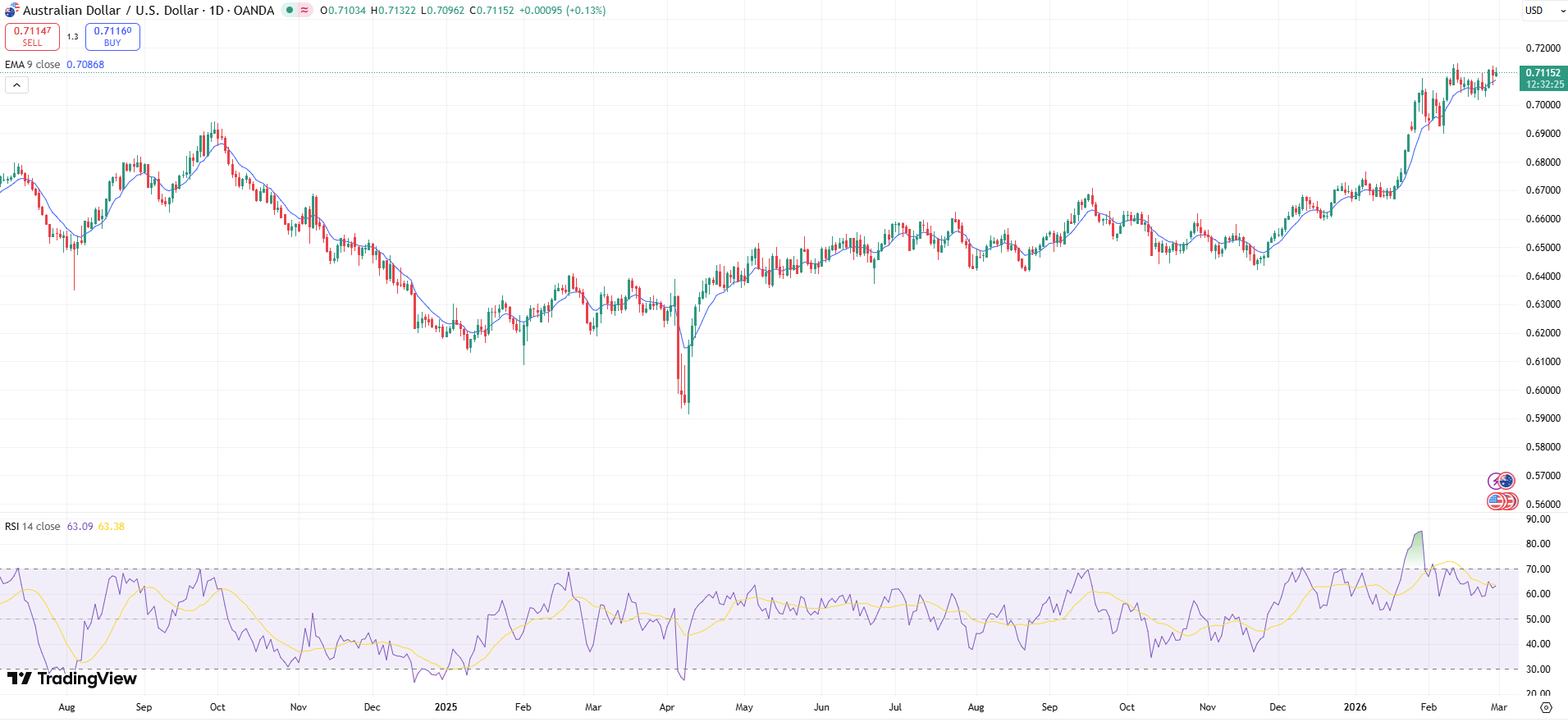
Technically, AUD/USD trades near 0.7094 and remains in a clear uptrend. The pair is comfortably above its 55-day and 100-day moving averages near 0.6800, while the 200-day average around 0.6600 supports the broader bullish structure. Momentum indicators confirm strength: the Relative Strength Index sits at 61, above the neutral 50 mark, and the Average Directional Index at 41 signals a strong but stabilizing trend.
RBA Policy Anchors the Rally
The RBA recently lifted its Official Cash Rate to 3.85%, reinforcing its commitment to fighting inflation. January’s Consumer Price Index held steady at 3.8% year-over-year, above the 3.7% forecast. More importantly, the Trimmed Mean CPI—a core measure closely watched by policymakers—rose to 3.4% from 3.3%.
The RBA projects inflation will peak in Q2 2026, with headline CPI near 4.2% and core inflation around 3.7%, before easing toward the 2–3% target band by mid-2028. Markets are pricing roughly 41 basis points of additional tightening by year-end, signaling expectations for policy to stay restrictive.
Key domestic data support the narrative of controlled cooling:
- Q3 GDP expanded 0.4% quarter-over-quarter, 2.1% annually
- Trade surplus widened to A$3.373 billion
- Employment rose 17.8K in January
- Unemployment steady at 4.1%
- Manufacturing PMI 52.0; Services PMI 52.2
These numbers show an economy slowing gradually, not sharply contracting.
China Provides Stability
China, Australia’s largest trading partner, is offering steady but unspectacular support. The economy grew 4.5% year-over-year in Q4 and 1.2% quarter-over-quarter. Retail sales increased 0.9%.
However, official PMIs slipped into contraction at 49.3 (manufacturing) and 49.4 (non-manufacturing). In contrast, Caixin surveys remained in expansion at 50.3 and 52.3. Inflation remains subdued, with CPI at 0.2% and producer prices down 1.4%.
The People’s Bank of China kept its one-year and five-year Loan Prime Rates unchanged at 3.00% and 3.50%. Stability—not stimulus—is the current strategy.
Positioning and Key Levels
Investor sentiment toward the Aussie is improving. According to Commodity Futures Trading Commission data, non-commercial net long positions rose to nearly 46,000 contracts, the highest since 2017. Open interest climbed to 256,200 contracts, signaling growing conviction.
Technically, immediate resistance stands near 0.7158, followed by 0.7283. Support lies at 0.6897 and 0.6870, with deeper backing around 0.6660 and 0.6593.
The broader bias remains constructive. But the Australian dollar is sensitive to global risk appetite. Strong U.S. data, tariff tensions, or geopolitical shocks could quickly shift momentum. For now, as long as the U.S. dollar remains contained, dips in AUD/USD are likely to attract buyers rather than sellers.
Sources & Methodology
Primary-source standard: Market-moving facts should link to original data releases, regulator notices, company filings or official project announcements whenever available. Secondary reporting is used for additional context, not as a substitute for original evidence.
Page last reviewed: